Mathematics I and Physical Science — June/July 2025
KNEC Diploma in Civil Engineering — Module I. Paper code: 2707/102 (shared with 2705/102, 2709/102 and 2710/102)
Attempt each question before reading the answer. These are independent revision answers, not official KNEC marking schemes. Optional questions are included for revision.
Time: 3 hours. Answer five questions, choosing at least two from each section. Every printed question is answered for revision. Ambiguous or inconsistent printed data are explained in the relevant answer.
Question 1(a)
Given that Cosθ = 4/5, determine the other 5 trigonometric ratios of θ.
(6 marks)
Answer
| Step | Working |
|---|---|
| Right-triangle interpretation | For an acute angle, adjacent = 4 and hypotenuse = 5. Opposite = √(5² − 4²) = 3. |
| Sine and tangent | sinθ = 3/5; tanθ = 3/4. |
| Reciprocals | secθ = 5/4; cosecθ = 5/3; cotθ = 4/3. |
The question does not specify a quadrant. If θ is not assumed acute, cosθ > 0 also allows quadrant IV: sinθ, tanθ, cosecθ and cotθ then have the corresponding negative signs, while secθ remains positive.
Question 1(b)
Change the Cartesian equation: x² + (y − 3)² = 9 to polar form.
(5 marks)
Answer
| Step | Working |
|---|---|
| Expand | x² + y² − 6y + 9 = 9 ⇒ x² + y² = 6y. |
| Substitute polar coordinates | x = r cosθ; y = r sinθ; x² + y² = r². |
| Simplify | r² = 6r sinθ ⇒ r(r − 6 sinθ) = 0. |
| Polar equation | r = 6 sinθ. The origin is included when r = 0. |
Question 1(c)
Town A is (20°N, 30°E) while town B is (65°S, 30°E). Determine the distance between the two towns in: (i) nautical miles; (ii) kilometres. (Take the radius of the earth as 6371 Km)
(5 marks)
Answer
| Step | Working | Result |
|---|---|---|
| Angular distance | The towns are on the same meridian, on opposite sides of the equator: 20° + 65°. | 85° |
| (i) Nautical miles | Using the examination convention of 1 minute of latitude = 1 nautical mile: 85 × 60. | 5,100 nautical miles |
| (ii) Kilometres | s = Rθ = 6,371 × (85π/180). | 9,451.57 km |
The kilometre value uses the radius specified in the question. Converting 5,100 nautical miles using the modern exact definition 1 nautical mile = 1.852 km gives 9,445.2 km; this differs slightly from the spherical-meridian approximation used in part (i).
Question 1(d)
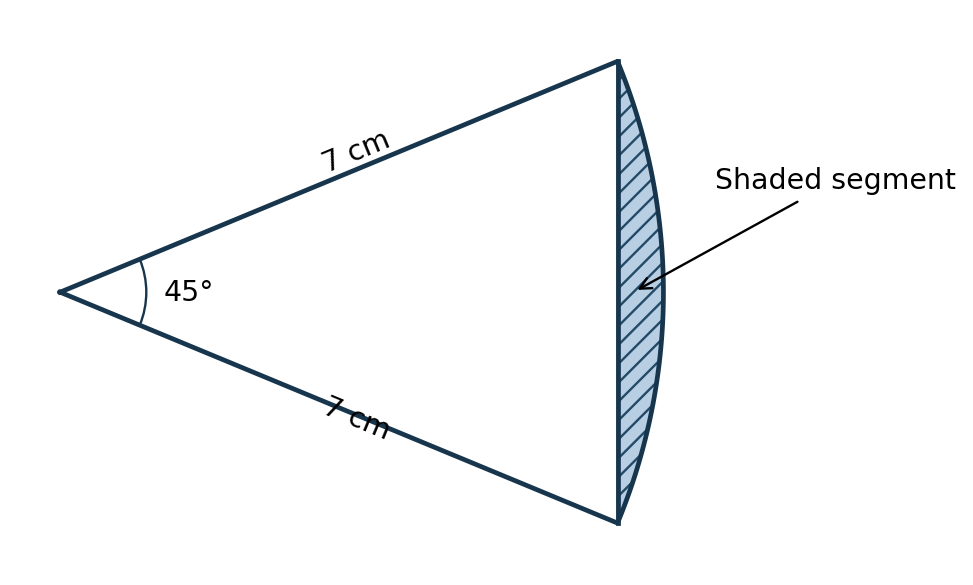
Figure 1 represents a section of a floor. Determine the area of the shaded region.
(4 marks)
Answer
| Step | Working |
|---|---|
| Identify the region | The shaded region is the minor circular segment bounded by the chord joining the ends of the two 7 cm radii and the 45° arc. |
| Sector area | (45/360) × π × 7² = 49π/8 = 19.2423 cm². |
| Triangle area | ½ × 7 × 7 × sin45° = 49√2/4 = 17.3241 cm². |
| Shaded segment | 19.2423 − 17.3241 = 1.9181 cm² ≈ 1.92 cm². |
Question 2(a)
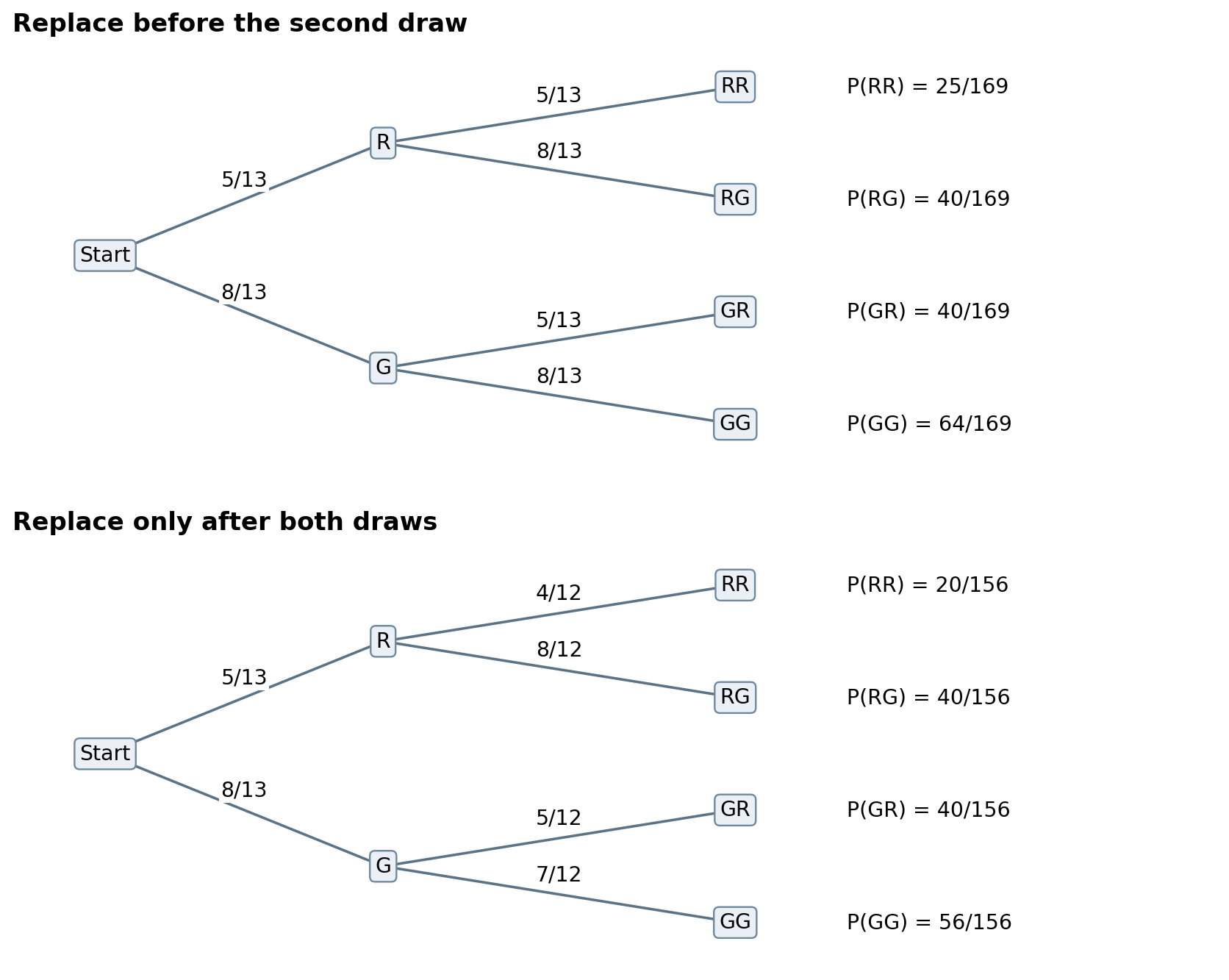
A bag contains 5 red marbles and 8 green ones. Two marbles are selected from the bag in succession and subsequently replaced. Use a tree diagram to determine the probability that the marbles selected are: (i) both red; (ii) both green; (iii) of different colours.
(8 marks)
Answer
The phrase “subsequently replaced” does not state whether the first marble is returned before the second draw or both are returned after the pair. The two possible interpretations are shown explicitly.
| Event | If each marble is replaced before the next draw | If replacement occurs only after both draws |
|---|---|---|
| (i) Both red | (5/13)(5/13) = 25/169 ≈ 0.14793 | (5/13)(4/12) = 20/156 = 5/39 ≈ 0.12821 |
| (ii) Both green | (8/13)(8/13) = 64/169 ≈ 0.37870 | (8/13)(7/12) = 56/156 = 14/39 ≈ 0.35897 |
| (iii) Different colours | P(RG) + P(GR) = (5/13)(8/13) + (8/13)(5/13) = 80/169 ≈ 0.47337 | (5/13)(8/12) + (8/13)(5/12) = 80/156 = 20/39 ≈ 0.51282 |
| Check | (25 + 64 + 80)/169 = 1 | (5 + 14 + 20)/39 = 1 |
Question 2(b)
Table 1 represents the marks scored by Diploma students in a mathematics examinations. Determine the: (i) mean; (ii) median; (iii) variance.
Table 1
| Marks | 0–5 | 5–10 | 10–15 | 15–20 | 20–25 | 25–30 | 30–35 |
|---|---|---|---|---|---|---|---|
| No. of students | 2 | 3 | 4 | 6 | 3 | 2 | 3 |
(12 marks)
Answer
| Class | f | Midpoint x | fx | fx² | Cumulative f |
|---|---|---|---|---|---|
| 0–5 | 2 | 2.5 | 5 | 12.5 | 2 |
| 5–10 | 3 | 7.5 | 22.5 | 168.75 | 5 |
| 10–15 | 4 | 12.5 | 50 | 625 | 9 |
| 15–20 | 6 | 17.5 | 105 | 1837.5 | 15 |
| 20–25 | 3 | 22.5 | 67.5 | 1518.75 | 18 |
| 25–30 | 2 | 27.5 | 55 | 1512.5 | 20 |
| 30–35 | 3 | 32.5 | 97.5 | 3168.75 | 23 |
| Total | 23 | 402.5 | 8843.75 |
| Statistic | Working | Answer |
|---|---|---|
| Mean | Σfx/Σf = 402.5/23 | 17.5 marks |
| Median | N/2 = 11.5, so the median class is 15–20. Median = L + [(N/2 − cumulative frequency before)/f]h = 15 + [(11.5 − 9)/6] × 5. | 17.0833 ≈ 17.08 marks |
| Variance | Σfx²/N − x̄² = 8,843.75/23 − 17.5² | 78.2609 ≈ 78.26 marks² |
These are grouped-data estimates using class midpoints; variance uses the population divisor N.
Question 3(a)
Solve the equation: log₄(4x − 4) − log₄(3x − 3) = 2.
(5 marks)
Answer
| Step | Working |
|---|---|
| Domain | 4x − 4 > 0 and 3x − 3 > 0, so x > 1. |
| Combine logarithms | log₄[(4x − 4)/(3x − 3)] = 2 ⇒ (4x − 4)/(3x − 3) = 4² = 16. |
| Factor for x > 1 | (4x − 4)/(3x − 3) = 4(x − 1)/[3(x − 1)] = 4/3. |
| Contradiction | 4/3 ≠ 16, so there is no real solution. Cross-multiplication yields x = 1, but this makes both logarithms undefined. |
The printed equation is inconsistent; x = 1 must not be accepted as a solution.
Question 3(b)
Use substitution to solve the simultaneous equations: 3x + 2y + 4z = 19; 4x + 3y + 2z = 16; 5x + 3y + 4z = 23.
(10 marks)
Answer
| Step | Working |
|---|---|
| Make y the subject | From the first equation, y = (19 − 3x − 4z)/2. |
| Substitute into the second | 4x + 3(19 − 3x − 4z)/2 + 2z = 16 ⇒ −x − 8z = −25 ⇒ x + 8z = 25. |
| Substitute into the third | 5x + 3(19 − 3x − 4z)/2 + 4z = 23 ⇒ x − 4z = −11. |
| Solve for z | (x + 8z) − (x − 4z) = 25 − (−11) ⇒ 12z = 36 ⇒ z = 3. |
| Back-substitute | x = 25 − 8(3) = 1; y = [19 − 3(1) − 4(3)]/2 = 2. |
| Check | 3 + 4 + 12 = 19; 4 + 6 + 6 = 16; 5 + 6 + 12 = 23. |
| Solution | x = 1, y = 2, z = 3. |
Question 3(c)
Use factorization to solve the quadratic equation x² + 5x + 6 = 0.
(5 marks)
Answer
| Step | Working |
|---|---|
| Find two numbers | 2 and 3 add to 5 and multiply to 6. |
| Factorise | x² + 5x + 6 = (x + 2)(x + 3) = 0. |
| Solve | x + 2 = 0 or x + 3 = 0, giving x = −2 or x = −3. |
Question 4(a)
The 5th and 9th terms of an arithmetic progression are 19 and 35 respectively. Determine the: (i) common difference; (ii) first term; (iii) sum of the first 10 terms.
(6 marks)
Answer
| Step | Working | Result |
|---|---|---|
| Term equations | a + 4d = 19; a + 8d = 35. | |
| (i) Common difference | Subtract: 4d = 16. | d = 4 |
| (ii) First term | a = 19 − 4(4). | a = 3 |
| (iii) Sum | S₁₀ = 10/2[2(3) + 9(4)] = 5 × 42. | S₁₀ = 210 |
Question 4(b)
Use the Simpson’s with 4 strips to determine the area under the curve: y = 4x² + 7x + 3, 0 ≤ x ≤ 4.
(8 marks)
Answer
| x | y = 4x² + 7x + 3 | Simpson weight | Weighted y |
|---|---|---|---|
| 0 | 3 | 1 | 3 |
| 1 | 14 | 4 | 56 |
| 2 | 33 | 2 | 66 |
| 3 | 60 | 4 | 240 |
| 4 | 95 | 1 | 95 |
| Total | 460 |
| Step | Working |
|---|---|
| Strip width | h = (4 − 0)/4 = 1. |
| Simpson’s rule | A ≈ h/3[y₀ + y₄ + 4(y₁ + y₃) + 2y₂] = 460/3. |
| Area | 153⅓ square units ≈ 153.33 square units. |
Question 4(c)
Given that Q = x²y³/z⁴, use the binomial theorem to determine the percentage change in Q if x increases by 2%, y decreases by 3% and Z increases by 5%.
(6 marks)
Answer
| Step | Working |
|---|---|
| New-to-old ratio | Q′/Q = (1 + 0.02)²(1 − 0.03)³(1 + 0.05)⁻⁴. |
| First-order binomial expansions | (1 + 0.02)² ≈ 1 + 2(0.02); (1 − 0.03)³ ≈ 1 − 3(0.03); (1 + 0.05)⁻⁴ ≈ 1 − 4(0.05). |
| Ignore products of small changes | Q′/Q ≈ 1 + 0.04 − 0.09 − 0.20 = 0.75. |
| Approximate percentage change | (0.75 − 1) × 100% = −25%, so Q decreases by approximately 25%. |
| Exact comparison | [(1.02)²(0.97)³/(1.05)⁴ − 1] × 100% = −21.8807%. The 25% decrease is the first-order binomial estimate requested, not the exact change. |
Question 5(a)
Balance the following nuclear reaction equations: (i) ²³⁸_Z U → ᴬ₉₀Th + ⁴₂α; (ii) ᴬ₂₇Co → ⁶⁰_Z Ni + ⁰₋₁β.
(8 marks)
Answer
| Reaction | Conserve mass number | Conserve atomic number | Balanced equation |
|---|---|---|---|
| (i) Alpha emission | 238 = A + 4 ⇒ A = 234. | Z = 90 + 2 ⇒ Z = 92. | ²³⁸₉₂U → ²³⁴₉₀Th + ⁴₂α |
| (ii) Beta-minus emission | A = 60 + 0 ⇒ A = 60. | 27 = Z − 1 ⇒ Z = 28. | ⁶⁰₂₇Co → ⁶⁰₂₈Ni + ⁰₋₁β |
The balancing above follows the particles printed in the examination. A fuller physical description of beta-minus decay also includes an electron antineutrino.
Question 5(b)
A radio-active sample weighs 448 milligrams. If its half life is 21 days, determine the mass remaining after 105 days.
(6 marks)
Answer
| Step | Working |
|---|---|
| Number of half-lives | n = 105/21 = 5. |
| Decay formula | m = m₀(½)ⁿ = 448(½)⁵. |
| Remaining mass | m = 448/32 = 14 mg. |
| Check successive halvings | 448 → 224 → 112 → 56 → 28 → 14 mg. |
Question 5(c)
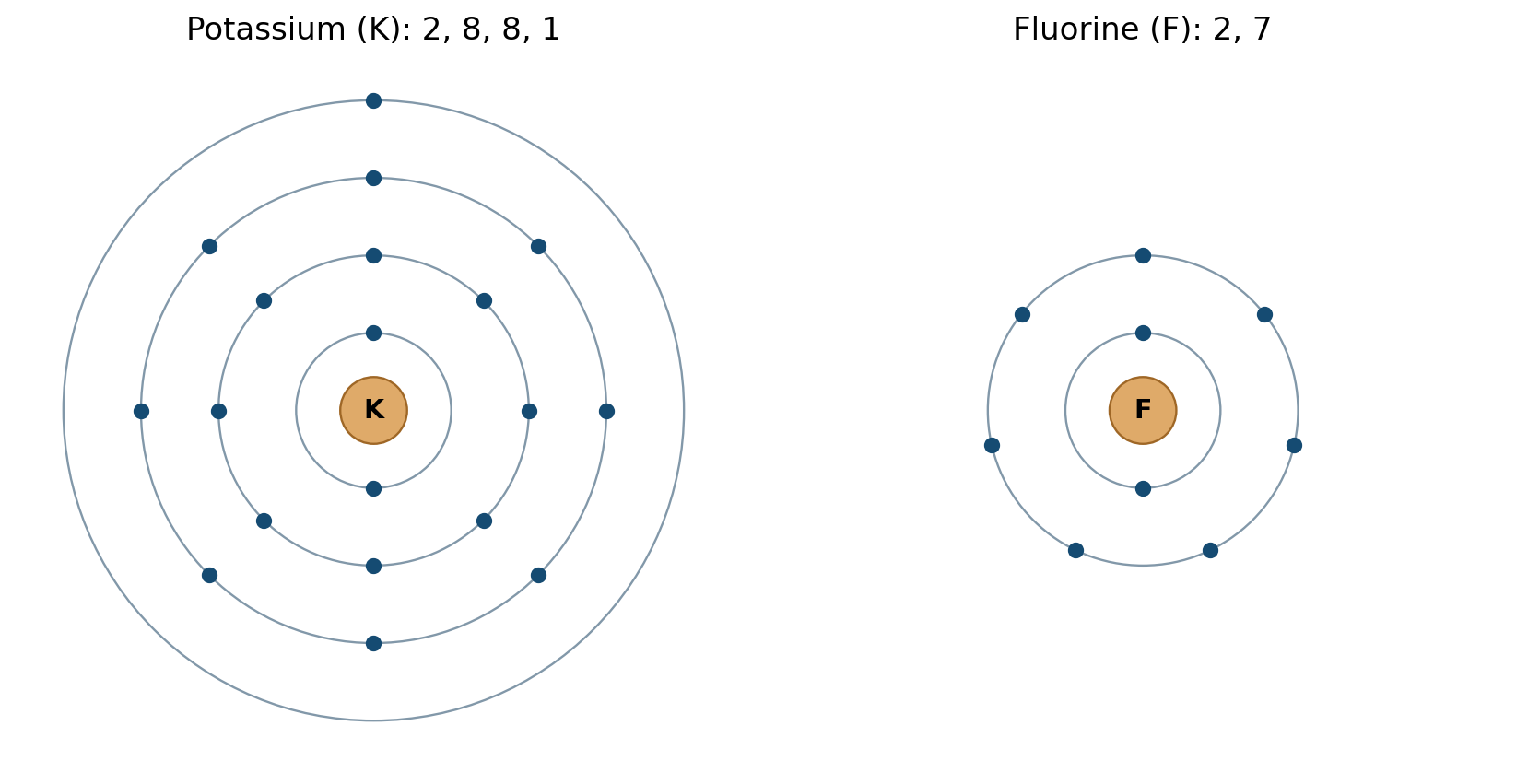
(i) Determine the electronic configuration of: (I) Potassium; (II) Fluorine. (ii) Hence draw their electronic structures; (iii) State two properties of ionic compounds.
(6 marks)
Answer
| Element | Electrons | Shell configuration | Orbital configuration |
|---|---|---|---|
| Potassium (K) | 19 | 2, 8, 8, 1 | 1s² 2s² 2p⁶ 3s² 3p⁶ 4s¹ |
| Fluorine (F) | 9 | 2, 7 | 1s² 2s² 2p⁵ |
(iii) Ionic compounds generally have high melting points because of strong electrostatic attraction between ions. They conduct electricity when molten or dissolved in water, where ions can move, but do not normally conduct in the solid state.
Question 6(a)
(i) State the laws of refraction. (ii) State three properties of images formed by a plane mirror. (iii) Determine the number of images if an object is placed between two plane mirrors at an angle of 60° to each other.
(8 marks)
Answer
(i) The incident ray, refracted ray and normal at the point of incidence lie in one plane. For a given pair of media and wavelength, sin i/sin r is constant (Snell’s law: n₁ sin i = n₂ sin r).
(ii) The image is virtual; upright; and the same size as the object. It is also laterally inverted and as far behind the mirror as the object is in front.
| Step | Working |
|---|---|
| Mirror ratio | 360°/60° = 6, an even integer. |
| Number of images | N = 360°/θ − 1 = 6 − 1 = 5 images. |
Question 6(b)
A convex lens has a focal length of 8 cm. An object is placed 9 cm from the lens: Determine the: (i) position of the image; (ii) magnification; (iii) nature of the image.
(9 marks)
Answer
| Step | Working | Result |
|---|---|---|
| Lens formula | Using positive magnitudes for this real-object/real-image case: 1/f = 1/u + 1/v. | |
| (i) Image distance | 1/v = 1/8 − 1/9 = 1/72. | v = 72 cm on the opposite side of the lens from the object. |
| (ii) Magnification | |m| = v/u = 72/9. | 8 times; signed transverse magnification m = −8. |
| (iii) Image nature | The object lies between F and 2F of a converging lens. | Real, inverted and enlarged. |
Question 6(c)
Using a diagram, explain how white light is dispersed using a triangular prism.
(3 marks)
Answer
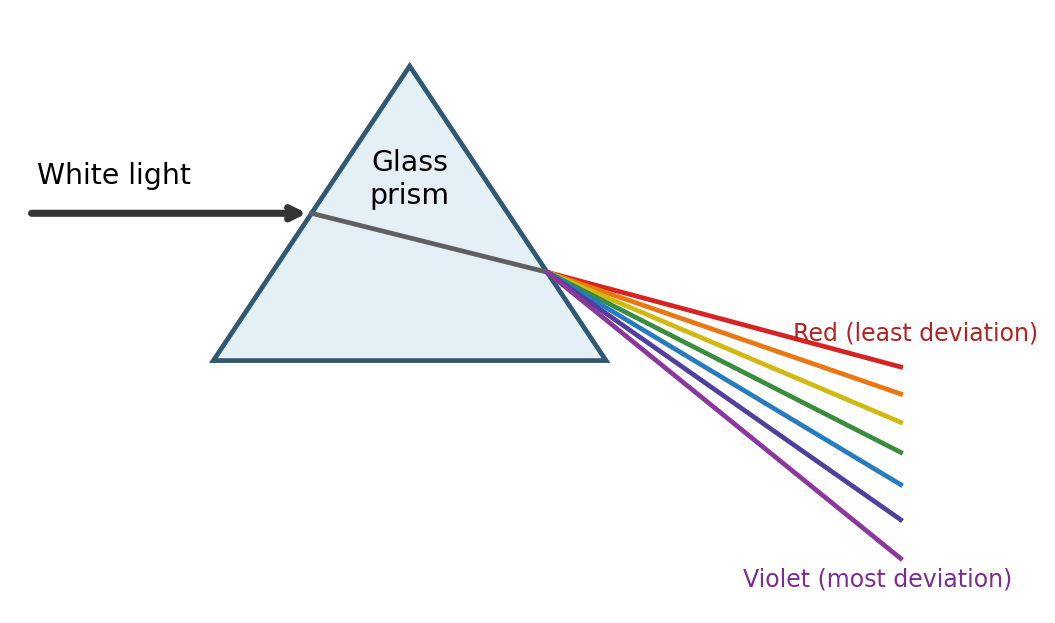
White light contains a range of wavelengths. The refractive index of glass depends on wavelength, so its colours refract through different angles at the prism faces. Red light is deviated least and violet most, producing a spectrum.
Question 7(a)
(i) Define the following terms as used in sound: (I) frequency; (II) displacement. (ii) A sound wave travels in water at a speed of 1500 m/s with a wavelength of 0.75m. Determine: (I) frequency; (II) period.
(7 marks)
Answer
(i) Frequency is the number of complete oscillations per second, measured in hertz. Displacement is the distance and direction of a vibrating particle from its equilibrium position at a particular instant.
| Quantity | Formula and substitution | Answer |
|---|---|---|
| (ii)(I) Frequency | f = v/λ = 1,500/0.75 | 2,000 Hz |
| (ii)(II) Period | T = 1/f = 1/2,000 | 0.0005 s = 0.5 ms |
Question 7(b)
A sound signal is emitted from an echo sounds and its echo from a cliff is received after 8 seconds. If the speed of sound in air is 340 m/s determine the distance between the echo-sounder and the cliff.
(5 marks)
Answer
| Step | Working |
|---|---|
| Total sound path | The signal travels to the cliff and back, so total distance = 2d. |
| Use speed × time | 2d = vt = 340 × 8 = 2,720 m. |
| One-way distance | d = 2,720/2 = 1,360 m. |
Question 7(c)
(i) Define the terms: (I) concentrated load; (II) uniformly distributed load. (ii) State two conditions necessary for a body to be in mechanical equilibrium. (iii) A beam of length 5 m weighs 4 kN. It is supported at both ends. If its centre of mass is 3 m from one end, determine the reaction forces at the supports.
(8 marks)
Answer
(i) A concentrated load is idealised as acting at a single point. A uniformly distributed load has a constant load per unit length over the loaded region.
(ii) The resultant force must be zero (ΣF = 0) and the resultant moment about any point must be zero (ΣM = 0).
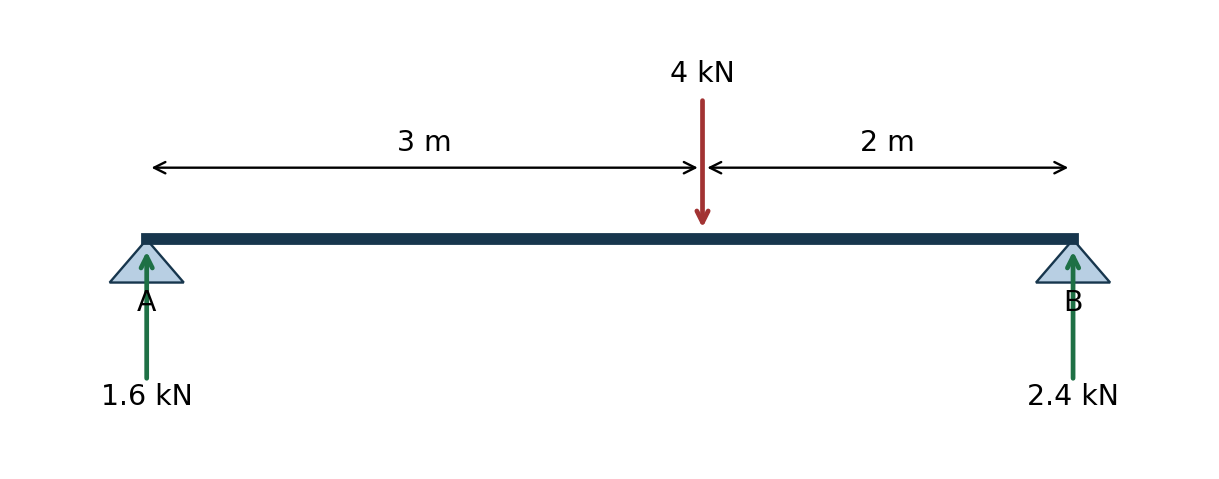
| Step | Working |
|---|---|
| Take moments about A | 5R_B − 4 × 3 = 0 ⇒ R_B = 12/5 = 2.4 kN upward. |
| Vertical equilibrium | R_A + R_B = 4 ⇒ R_A = 4 − 2.4 = 1.6 kN upward. |
| Check moments about B | 1.6 × 5 = 4 × 2 = 8 kN m. |
| Answer | The support 3 m from the centre of mass carries 1.6 kN; the support 2 m from it carries 2.4 kN. |
Question 8(a)
(i) Define polymerization: (ii) State one example of each of the following: (I) natural polymer; (II) synthetic polymer.
(3 marks)
Answer
(i) Polymerization is the chemical process in which many small molecules called monomers join to form large polymer molecules.
(ii) Natural polymer: cellulose. Synthetic polymer: polyethene.
Question 8(b)
(i) Define: (I) reduction; (II) oxidation in terms of electron transfer. (ii) Write a balanced redox equation of the burning of carbon in excess oxygen to produce carbon (iv) oxide. (iii) Identify the reducing and the oxidising agents in (ii).
(6 marks)
Answer
(i) Reduction is gain of electrons; oxidation is loss of electrons.
| Part | Answer |
|---|---|
| (ii) Balanced equation | C(s) + O₂(g) → CO₂(g). |
| Oxidation-state check | Carbon changes from 0 to +4 and is oxidised. Oxygen changes from 0 to −2 and is reduced. |
| (iii) Agents | Carbon is the reducing agent because it is oxidised. Oxygen is the oxidising agent because it is reduced. |
Question 8(c)
(i) Define: (I) temporary hardness of water; (II) permanent hardness of water. (ii) State two methods of removing permanent hardness from water.
(4 marks)
Answer
| Part | Answer |
|---|---|
| (i)(I) Temporary hardness | Hardness mainly due to dissolved calcium and magnesium hydrogencarbonates; it can be removed by boiling. |
| (i)(II) Permanent hardness | Hardness due to dissolved calcium or magnesium salts such as sulfates and chlorides; it is not removed by ordinary boiling. |
| (ii) Two removal methods | Use an ion-exchange water softener; or add washing soda (sodium carbonate) to precipitate the hardness-forming ions. |
Question 8(d)
(i) State three properties of alkalis. (ii) Balance the chemical equation: NaOH(aq) + H₂SO₄(aq) + Na₂SO₄(aq) + H₂O(l)
(7 marks)
Answer
(i) Alkalis produce hydroxide ions in aqueous solution and have pH above 7; turn red litmus blue; and neutralise acids to form salt and water.
(ii) The printed equation uses a plus sign where the reaction arrow is expected. Interpreting it as sodium hydroxide reacting with sulfuric acid:
| Step | Working |
|---|---|
| Balance sodium | Put 2 before NaOH to supply the two Na atoms in Na₂SO₄. |
| Balance hydrogen and oxygen | There are four H atoms on the left, so put 2 before H₂O. Oxygen then balances at six atoms on each side. |
| Balanced equation | 2NaOH(aq) + H₂SO₄(aq) → Na₂SO₄(aq) + 2H₂O(l). |