Structures I and Construction Materials — June/July 2025
KNEC Diploma in Civil Engineering — Module I. Paper code: 2707/103 (shared with 2705/103, 2709/103 and 2710/103)
Attempt each question before reading the answer. These are independent revision answers, not official KNEC marking schemes. Optional questions are included for revision.
Time: 3 hours. Answer five questions, choosing at least two from each section. All eight questions are answered here. Dimensions on the redrawn source figures retain the printed values; diagrams are schematic unless a scale is stated.
Question 1(a)
(i) Calculate the minimum diameter of a circular solid column carrying a compressive load of 1540 kN, if the permissible stress is not to exceed 50 N/mm². (ii) A 3.2 metre long bar is extended by 2 mm after subjection to a tensile force. If the bar diameter is 10 mm, determine the magnitude of the tensile force. (Take Young’s Modulus (E) = 210 kN/mm²)
(8 marks)
Answer
| Part | Step | Working |
|---|---|---|
| (i) | Required area | A = P/σ = 1,540,000/50 = 30,800 mm². |
| (i) | Circular diameter | A = πd²/4 ⇒ d = √(4 × 30,800/π) = 198.03 mm. The selected diameter must be at least this value; 199 mm or a suitable larger standard size satisfies the stress limit. |
| (ii) | Area and length | A = π(10)²/4 = 78.5398 mm²; L = 3.2 × 1,000 = 3,200 mm. |
| (ii) | Use axial extension | δ = PL/(AE) ⇒ P = δAE/L = 2 × 78.5398 × 210/3,200 = 10.3084 kN. |
| (ii) | Answer | The tensile force is approximately 10.31 kN. |
Question 1(b)
(i) Define: (I) elasticity; (II) Hooke’s law (ii) Sketch a typical stress/strain graph for a mild steel specimen and explain four points identified on the graph.
(12 marks)
Answer
(i) Elasticity is the ability of a material to return to its original shape and dimensions after the load is removed, provided its elastic limit is not exceeded. Hooke’s law states that stress is proportional to strain within the proportional limit: σ = Eε.
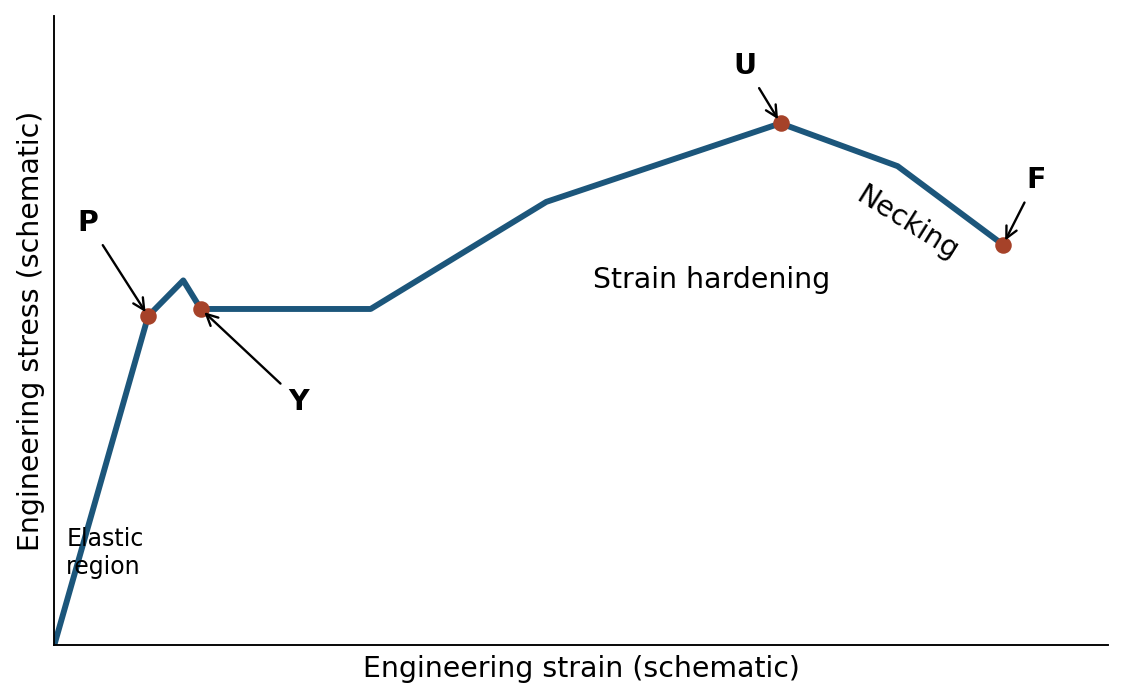
| Point | Explanation |
|---|---|
| P: proportional limit | End of the straight part where stress is directly proportional to strain. |
| Y: yield region | Substantial plastic strain develops with little increase in stress; mild steel may show upper and lower yield points. |
| U: ultimate tensile stress | Maximum engineering stress, calculated using the original cross-sectional area. Necking develops thereafter. |
| F: fracture | The specimen breaks after plastic extension and necking. |
The elastic limit is the greatest stress from which complete recovery occurs on unloading. It is close to, but need not exactly equal, the proportional limit.
Question 2(a)
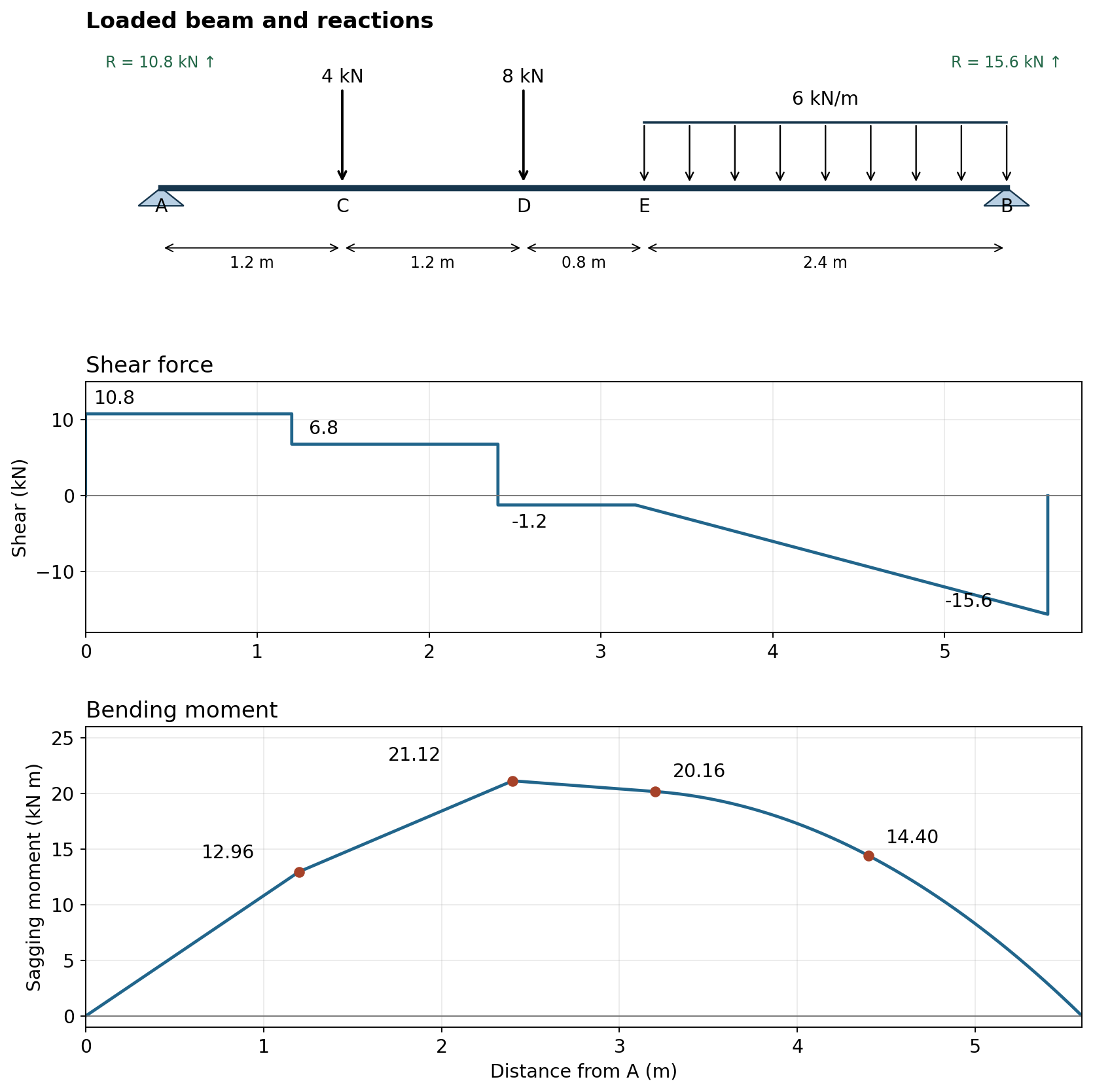
Draw the sheer force and bending moment diagram for the loaded beam shown in fig 1 below indicating values at critical points.
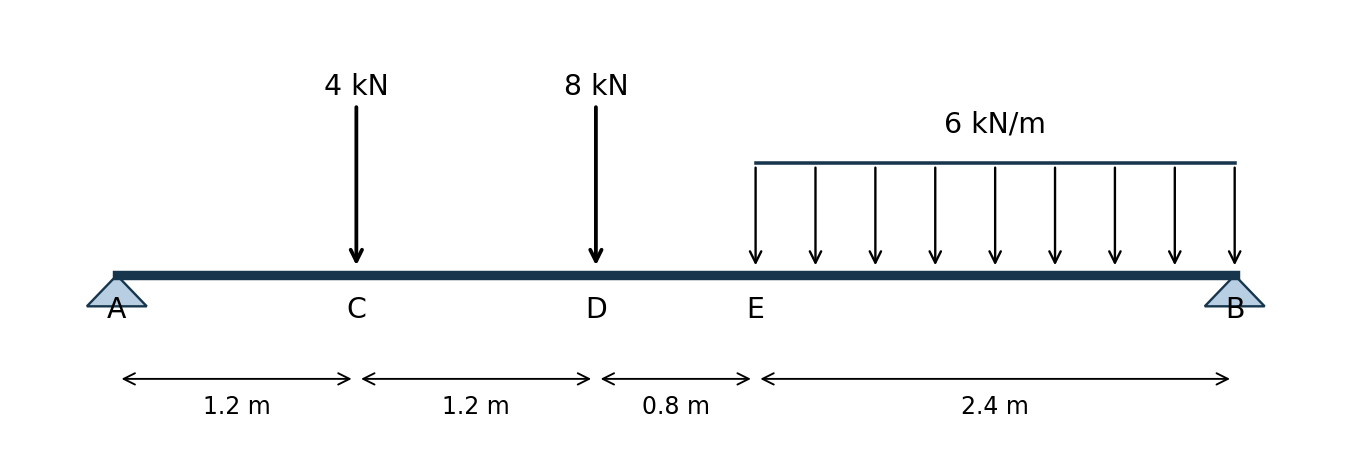
(18 marks)
Answer
| Step | Working |
|---|---|
| UDL resultant | W = 6 × 2.4 = 14.4 kN, acting at x = 3.2 + 1.2 = 4.4 m from A. |
| Moment equilibrium about A | 5.6R_B = 4(1.2) + 8(2.4) + 14.4(4.4) = 87.36 ⇒ R_B = 15.6 kN. |
| Vertical equilibrium | R_A = 4 + 8 + 14.4 − 15.6 = 10.8 kN. |
| Position | x from A (m) | Shear immediately right (kN) | Bending moment (kN m) |
|---|---|---|---|
| A | 0 | 10.8 | 0 |
| C | 1.2 | 6.8 | 12.96 |
| D | 2.4 | -1.2 | 21.12 |
| E | 3.2 | -1.2 | 20.16 |
| B, before reaction | 5.6 | -15.6 | 0 |
| B, after reaction | 5.6 | 0 | 0 |
Shear is constant between concentrated loads and decreases linearly under the UDL. The bending moment is piecewise linear from A to E and parabolic from E to B. Its maximum is 21.12 kN m at D, where shear changes from positive to negative.
Question 2(b)
Determine the bending moment at the mid-point of the UDL.
(2 marks)
Answer
| Step | Working |
|---|---|
| Midpoint location | x = 3.2 + 2.4/2 = 4.4 m from A. |
| Left-side moment | M = 10.8(4.4) − 4(4.4 − 1.2) − 8(4.4 − 2.4) − [6(1.2)](1.2/2). |
| Answer | M = 47.52 − 12.8 − 16 − 4.32 = 14.40 kN m, sagging. |
Question 3
Using the method of tension co-efficient, resolve the forces in the members in the frame as shown in figure 2 below.
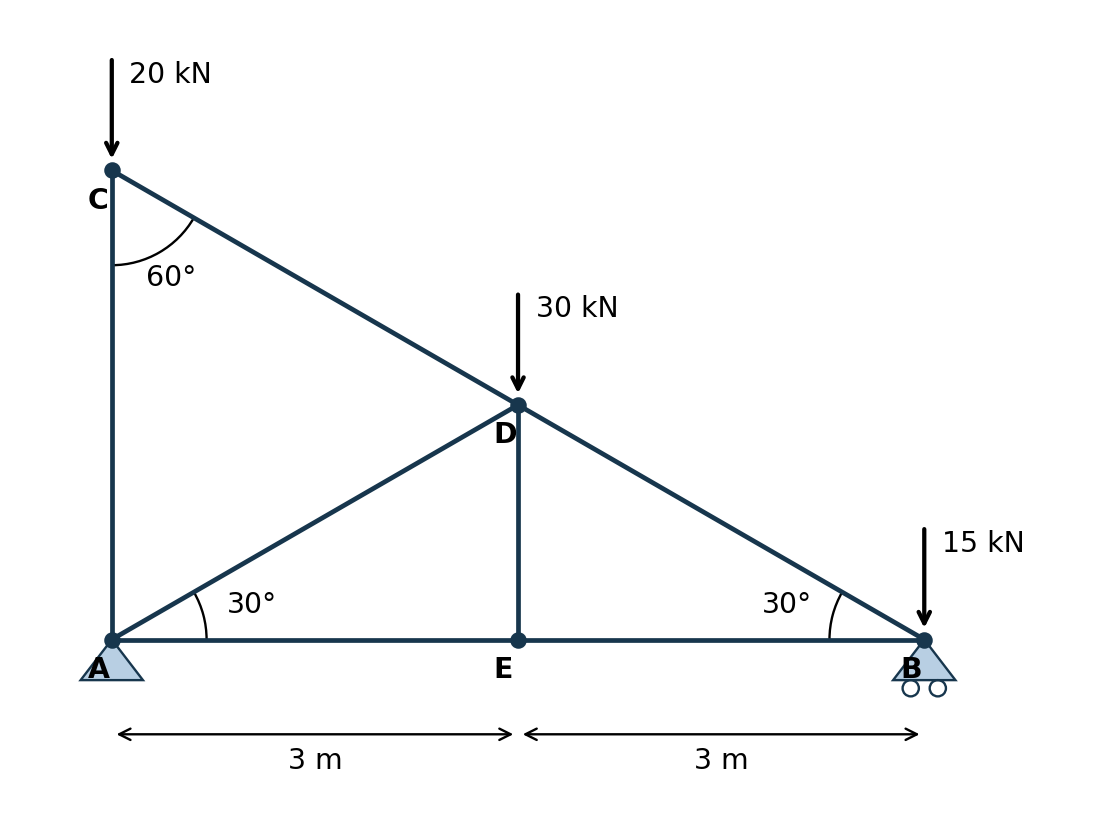
(20 marks)
Answer
Take tension as positive and define the tension coefficient of member ij as tᵢⱼ = Nᵢⱼ/Lᵢⱼ. Use coordinates in metres: A(0,0), E(3,0), B(6,0), D(3,√3), C(0,2√3). The slopes shown are 30° to the horizontal.
| Step | Equilibrium equation and result |
|---|---|
| Support reactions | ΣM_A = 0: 6R_B = 30(3) + 15(6) ⇒ R_B = 30 kN. ΣF_y = 0 ⇒ R_A = 20 + 30 + 15 − 30 = 35 kN. Horizontal reaction = 0. |
| Joint C, horizontal | 3t_CD = 0 ⇒ t_CD = 0. |
| Joint C, vertical | −2√3 t_AC − √3 t_CD − 20 = 0 ⇒ t_AC = −20/(2√3) = −5.7735 kN/m. |
| Joint A, vertical | 2√3 t_AC + √3 t_AD + 35 = 0 ⇒ −20 + √3 t_AD + 35 = 0 ⇒ t_AD = −8.6603 kN/m. |
| Joint A, horizontal | 3t_AE + 3t_AD = 0 ⇒ t_AE = 8.6603 kN/m. |
| Joint E, vertical | √3 t_DE = 0 ⇒ t_DE = 0. |
| Joint E, horizontal | −3t_AE + 3t_EB = 0 ⇒ t_EB = 8.6603 kN/m. |
| Joint D, horizontal | −3t_AD − 3t_CD + 3t_DB = 0 ⇒ t_DB = −8.6603 kN/m. |
| Joint D, vertical check | −√3 t_AD + √3 t_CD − √3 t_DB − √3 t_DE − 30 = 15 + 0 + 15 − 0 − 30 = 0. |
| Joint B check | The net external vertical force is 30 − 15 = 15 kN upward. Member DB contributes 15 kN downward and 25.9808 kN right; EB contributes 25.9808 kN left. |
| Member | Length (m) | t (kN/m) | N = tL (kN) | Nature |
|---|---|---|---|---|
| AC | 2√3 = 3.4641 | −5.7735 | -20 | Compression |
| CD | 2√3 = 3.4641 | 0 | 0 | Zero-force |
| AD | 2√3 = 3.4641 | −8.6603 | -30 | Compression |
| DB | 2√3 = 3.4641 | −8.6603 | -30 | Compression |
| DE | √3 = 1.7321 | 0 | 0 | Zero-force |
| AE | 3 | 8.6603 | 25.9808 | Tension |
| EB | 3 | 8.6603 | 25.9808 | Tension |
Question 4(a)
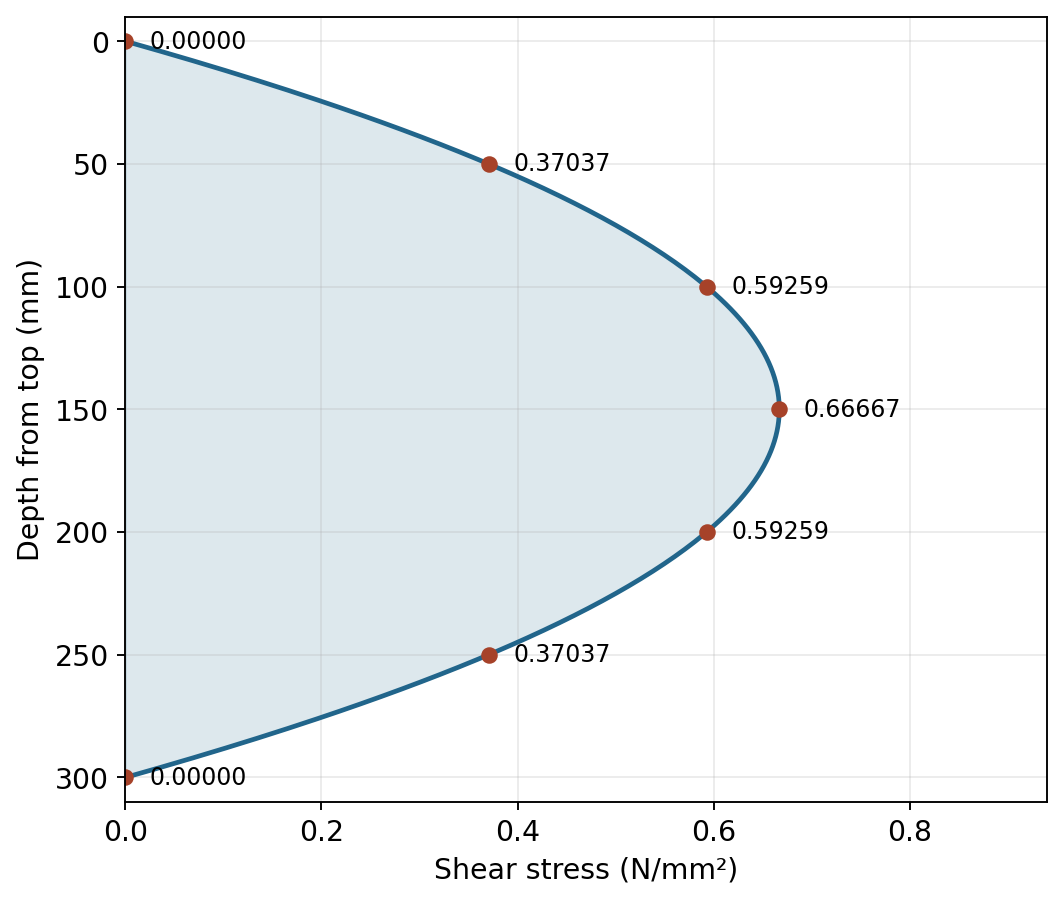
Draw the shear stress distribution graph for rectangular beam section of breadth 150 mm and depth 300 mm, when subject to a shearing force of 20 kN. Indicate stress value in stages of 50mm along the depth.
(15 marks)
Answer
| Step | Working |
|---|---|
| Area | A = bh = 150 × 300 = 45,000 mm². |
| Distribution | τ(y) = (3V/2bh)[1 − 4y²/h²], where y is measured from the neutral axis. |
| Maximum at y = 0 | τ_max = 3(20,000)/[2(150)(300)] = 0.666667 N/mm². |
| Mean stress | τ_mean = V/A = 0.444444 N/mm²; maximum stress is 1.5 times the mean. |
| Depth from top (mm) | y from neutral axis (mm) | Shear stress (N/mm²) |
|---|---|---|
| 0 | -150 | 0 |
| 50 | -100 | 0.37037 |
| 100 | -50 | 0.59259 |
| 150 | 0 | 0.66667 |
| 200 | 50 | 0.59259 |
| 250 | 100 | 0.37037 |
| 300 | 150 | 0 |
Question 4(b)
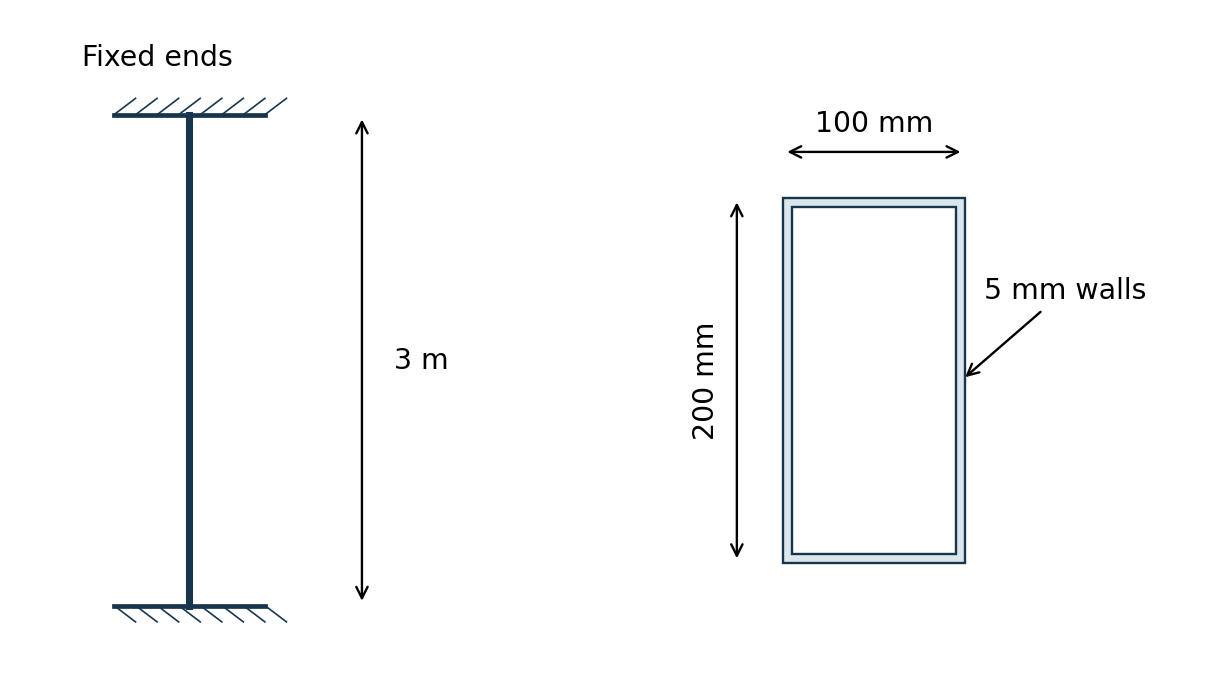
Calculate Euler’s crippling load for the strut shown in fig 3 below. Take E = 210 kN/mm².
(5 marks)
Answer
| Step | Working |
|---|---|
| Section dimensions | Outer section: 100 mm × 200 mm; wall thickness = 5 mm. Inner section: 90 mm × 190 mm. |
| Second moments of area | I_x = [100(200³) − 90(190³)]/12 = 15,224,166.67 mm⁴. I_y = [200(100³) − 190(90³)]/12 = 5,124,166.67 mm⁴. |
| Critical axis | Use I_min = 5,124,166.67 mm⁴ for the weaker bending axis. |
| Effective length | Both ends are shown fixed: L_e = L/2 = 3,000/2 = 1,500 mm. |
| Euler load | P_cr = π²EI_min/L_e² = π² × 210 × 5,124,166.67/1,500² = 4,720.19 kN ≈ 4.72 MN. |
This is the ideal elastic Euler result requested. It assumes perfect fixity and an elastic, initially straight column; it is not an allowable working load.
Question 5(a)
Describe the three main classification of rocks.
(4.5 marks)
Answer
| Classification | Description and example |
|---|---|
| Igneous | Formed by cooling and solidification of molten magma or lava; examples include granite and basalt. |
| Sedimentary | Formed by deposition, compaction and cementation of sediments, or by chemical or biological accumulation; examples include sandstone and limestone. |
| Metamorphic | Formed when existing rocks are changed by heat, pressure or chemically active fluids without complete melting; examples include marble and slate. |
Question 5(b)
(i) Define ‘quarrying’; (ii) Describe three method of quarrying.
(8 marks)
Answer
(i) Quarrying is the extraction of usable stone or other construction material from a natural rock deposit, commonly in an open excavation.
| Method | Description |
|---|---|
| Wedging | Holes or slots are made along a desired splitting line, and wedges apply pressure to separate a stone block. |
| Channel cutting or machine sawing | Mechanical cutters or saws cut channels around a block so it can be detached with controlled damage. |
| Controlled blasting | A licensed specialist uses a planned blast to fracture rock where suitable. The method can produce broken rock for aggregate rather than intact dimension-stone blocks. |
Question 5(c)
Outline five tests carried out on stones.
(7.5 marks)
Answer
- Compressive-strength test: a prepared specimen is loaded in compression to determine the load and stress at failure.
- Water-absorption test: compare a dried specimen’s mass with its mass after soaking to assess the quantity of water absorbed.
- Abrasion-resistance test: subject the stone to controlled rubbing or wear and measure the material lost.
- Impact or toughness test: apply standard impacts and assess resistance to sudden loading and fragmentation.
- Soundness or durability test: expose specimens to specified weathering or salt-crystallisation cycles and examine deterioration or mass loss.
Question 6(a)
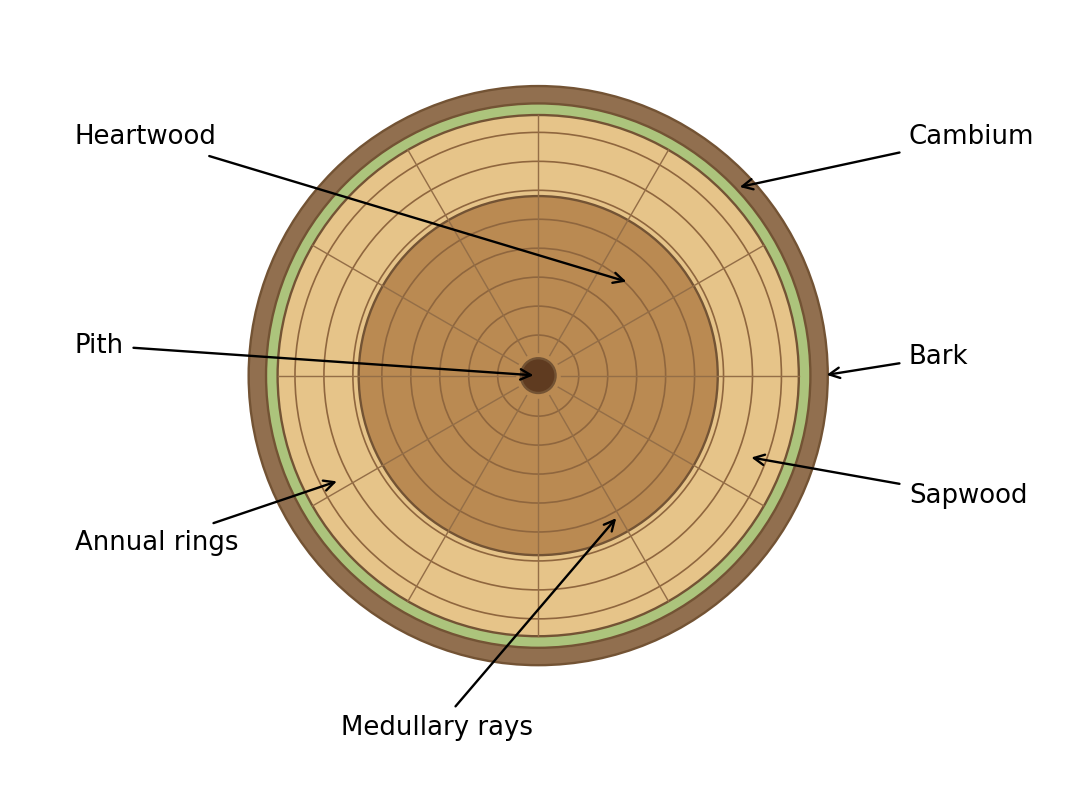
Sketch and label a typical section of an exogenous tree trunk.
(4 marks)
Answer
Question 6(b)
(i) Differentiate between conversion and seasoning of timber. (ii) Define the term ‘Natural seasoning’. (iii) Explain the following natural seasoning methods: (I) air seasoning; (II) water seasoning.
(7 marks)
Answer
| Term or method | Explanation |
|---|---|
| (i) Conversion | Sawing logs into usable sections such as boards, planks and beams. |
| (i) Seasoning | Reducing timber moisture content to a level suitable for its intended use. |
| (ii) Natural seasoning | Drying timber using natural environmental processes rather than artificially heated kiln drying. |
| (iii)(I) Air seasoning | Timber is stacked on supports above ground with spacers between layers, protected from rain and direct severe sun, and left so circulating air removes moisture gradually. |
| (iii)(II) Water seasoning | The traditional method first immerses logs in clean flowing water to leach soluble sap constituents, then removes and air-dries them. Immersion alone does not produce dry timber; the subsequent drying is essential. |
Question 6(c)
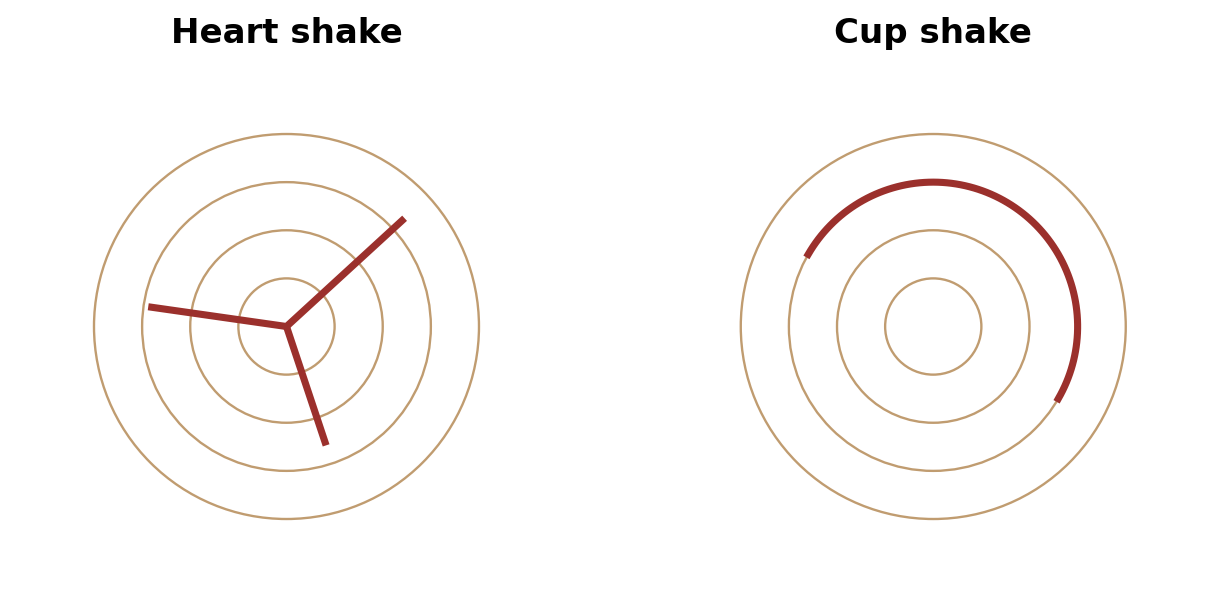
(i) Explain the following defects of timber: (I) dry rot; (II) wet rot. (ii) Sketch the following timber defects: (I) heart shake; (II) cup shake.
(7 marks)
Answer
(i) Dry rot is fungal decay that weakens timber, often causing brittle, cubical cracking; despite the name, moisture is required for the fungus to develop. Wet rot is fungal decay associated with persistently damp timber, causing loss of strength and deterioration in the affected wet area.
Question 6(d)
List four timber manufactured boards.
(2 marks)
Answer
- Plywood.
- Particleboard (chipboard).
- Medium-density fibreboard (MDF).
- Blockboard.
Question 7(a)
(i) Explain the basic process of manufacture of fired clay bricks. (ii) Describe three types of clay bricks and state where each type is used.
(11 marks)
Answer
(i) The basic manufacturing sequence is:
- Excavate suitable clay and remove stones and other unwanted material.
- Weather and prepare the clay, then mix and temper it with water to produce a consistent workable material.
- Form bricks by moulding, pressing or extrusion and cutting.
- Dry the green bricks gradually to remove moisture and reduce cracking.
- Fire the dried bricks in a kiln to develop strength and durability.
- Cool gradually, sort and inspect the bricks before storage or dispatch.
| Type | Description | Typical use |
|---|---|---|
| Common brick | A general-purpose clay brick whose appearance is not the main requirement. | Internal or concealed masonry, with suitability checked for the exposure. |
| Facing brick | Selected or manufactured for consistent colour, texture and appearance. | Exposed external walls and architectural masonry. |
| Engineering brick | Dense, strong and relatively low in water absorption. | Masonry requiring high strength or resistance to moisture, such as suitable below-ground work. |
Question 7(b)
List four types of iron ores.
(2 marks)
Answer
- Haematite (Fe₂O₃).
- Magnetite (Fe₃O₄).
- Limonite (hydrated iron oxides).
- Siderite (FeCO₃).
Question 7(c)
(i) Define the following in relation to metal: (I) heat treatment; (II) electroplating. (ii) Explain the following types of heat treatment (I) annealing; (II) hardening.
(7 marks)
Answer
| Term | Explanation |
|---|---|
| Heat treatment | Controlled heating and cooling of a metal to change its microstructure and properties while retaining its general shape. |
| Electroplating | Depositing a thin layer of a metal on a conductive article by electrolysis, usually for protection, appearance or a functional surface. |
| Annealing | Heating suitably, holding and cooling in a controlled manner, often slowly, to soften the metal, relieve stresses and improve ductility or machinability. |
| Hardening | For suitable steels, heating to the required transformation range and quenching to produce a harder structure. Tempering normally follows when toughness is required. |
Question 8(a)
Define the following terms in reference to plastics: (i) monomer; (ii) polymer
(3 marks)
Answer
| Term | Definition |
|---|---|
| Monomer | A small molecule capable of joining with other molecules in polymerisation. |
| Polymer | A large molecule made from many repeating units derived from monomers. |
Question 8(b)
State three uses of plastics in the construction industry.
(3 marks)
Answer
- Water-supply and drainage pipes and fittings.
- Insulation and protective coverings for electrical cables.
- Damp-proof membranes and waterproofing sheets.
Question 8(c)
(i) Explain the function of the following components of paint: (I) pigment; (II) medium/vehicle; (III) thinner; (IV) base. (ii) State four functions of paint
(10 marks)
Answer
| Component | Function |
|---|---|
| Pigment | Provides colour and opacity, and may contribute to protection or other film properties. |
| Medium/vehicle | Carries the solid particles during application and forms the binding film that adheres to the surface after drying or curing. |
| Thinner | Adjusts viscosity and workability for application and evaporates as the coating dries. |
| Base | The principal solid body-forming material in traditional paint terminology; contributes to covering power, durability and protective properties. Some materials also act as pigments. |
(ii) Functions of paint:
- Protect surfaces against weathering and moisture.
- Reduce corrosion of appropriately prepared metal surfaces.
- Improve appearance through colour and finish.
- Provide a smoother, more easily cleaned surface.
Question 8(d)
(i) Describe the term ‘bitument’. (ii) State four properties of asphalt.
(4 marks)
Answer
(i) “Bitument” is the printed spelling of bitumen: a dark, viscous or semi-solid hydrocarbon binder, commonly obtained from petroleum, used in paving and waterproofing.
(ii) A suitable compacted asphalt paving mixture has:
- Resistance to water penetration when properly proportioned and compacted.
- Durability against weather and traffic wear.
- Sufficient stability to resist rutting and deformation under its design conditions.
- Sufficient flexibility to accommodate limited movement without excessive cracking.