Surveying I and Workshop Technology I (Mechanical) — March/April 2025
KNEC Diploma in Civil Engineering — Module I. Paper code: 2707/104 (shared paper: 2705/104, 2709/104 and 2710/104). Time: 3 hours.
Attempt each question before reading the answer. These are independent revision answers, not official KNEC marking schemes. All eight printed questions, including the optional questions, are answered for revision.
The cover instructs candidates to answer five questions, choosing at least two from each section and one other. The Section B heading instead says “Answer ONE question”; this inconsistency is retained as a source note. All questions are supplied here for revision.
Question 1(a)
Explain the following: (i) topographical surveying; (ii) cadastral surveying; (iii) engineering surveying; (iv) aerial surveying.
(6 marks)
Answer
| Type | Explanation |
|---|---|
| Topographical surveying | Determining the positions and elevations of natural and artificial features to prepare a map or plan of the terrain. |
| Cadastral surveying | Surveying land parcels to establish or re-establish legally recognised property boundaries, dimensions and areas. |
| Engineering surveying | Survey work for planning, designing, setting out and monitoring engineering works such as roads and buildings. |
| Aerial surveying | Obtaining measurements and mapping information from photographs or other sensors carried by aircraft or drones, with suitable survey control. |
Question 1(b)
Classify the obstacles in chain surveying stating one example for each.
(4.5 marks)
Answer
| Class | Effect | Example |
|---|---|---|
| Obstacle to chaining only | The line can be ranged, but its distance cannot be measured directly across the obstruction. | A pond or river across the survey line. |
| Obstacle to ranging only | The distance can be measured in sections, but the end stations are not intervisible. | A hill or rising ground. |
| Obstacle to both chaining and ranging | Neither direct measurement nor a direct line of sight is available. | A building on the line. |
Question 1(c)
With the aid of sketches, outline the field procedure for ‘repeated alignment’ in chain surveying.
(9.5 marks)
Answer
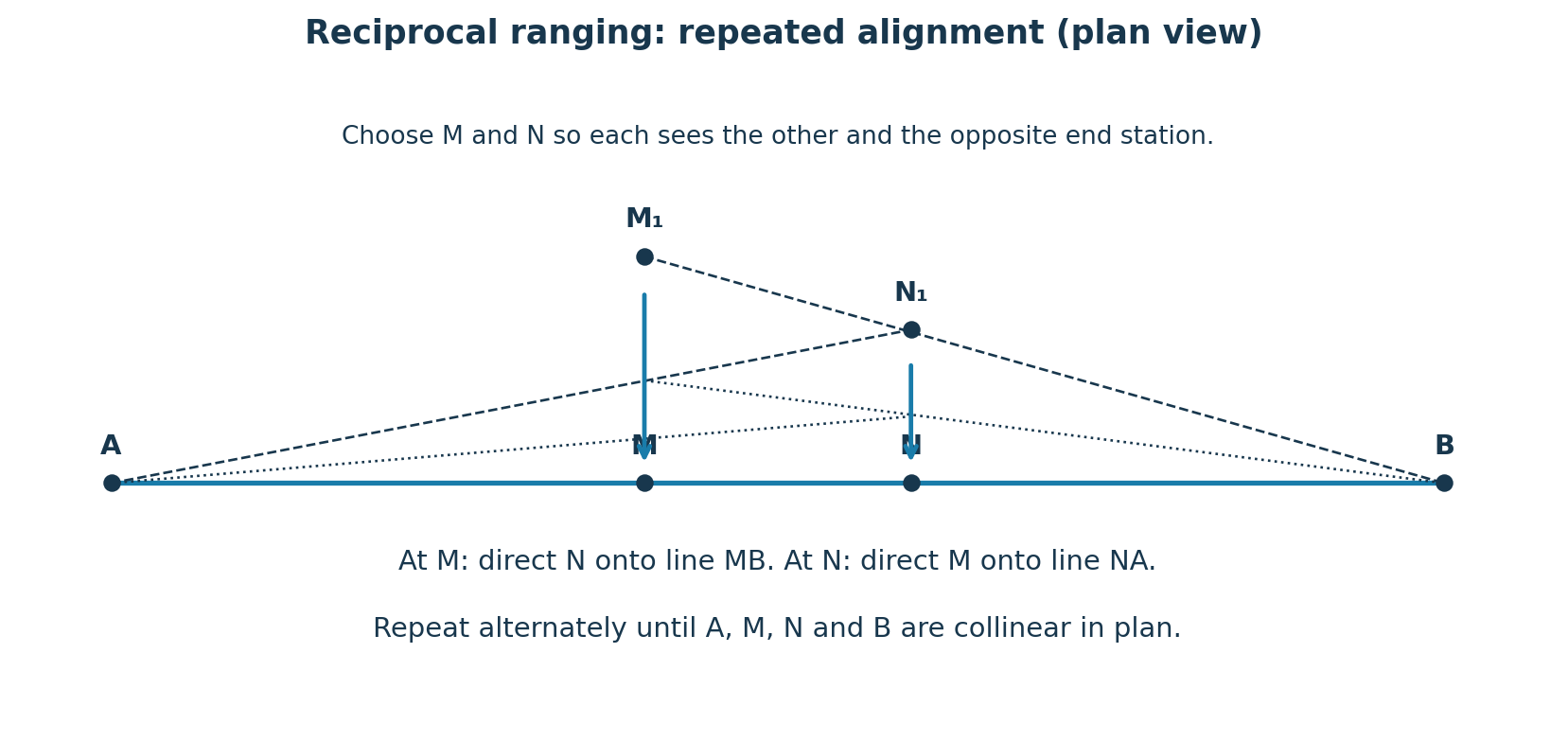
- Place two ranging rods at approximate intermediate positions M and N near the crest. Choose positions so M sees N and B, while N sees M and A.
- From M, direct the assistant at N sideways until N lies on line MB.
- From the corrected N position, direct M sideways until M lies on line NA.
- Repeat these alternate adjustments. The required corrections become smaller until neither observer needs another correction.
- The final rods M and N lie on the straight survey line AB in plan. Mark the stations and measure the line in suitable sections.
Question 2(a)
Define each of the following terms in levelling: (i) bench mark; (ii) back sight; (iii) line of collimation; (iv) level line.
(6 marks)
Answer
| Term | Definition |
|---|---|
| Bench mark | A stable, identifiable point whose reduced level is known relative to an adopted datum. |
| Back sight | The first staff reading after setting up the level, taken on a point of known or previously determined reduced level to establish the height of collimation. |
| Line of collimation | The line through the intersection of the crosshairs and the optical centre of the objective; it is horizontal when the level is correctly adjusted and levelled. |
| Level line | A curved line on a level surface, everywhere perpendicular to the local direction of gravity. |
Question 2(b)
The following staff readings were taken on a continuously falling ground at the interval of 20 m: 0.568, 0.998, 1.636, 2.188, 3.089, 0.421, 1.325, 2.012 (BM RL of 935.67 m), 2.542, 3.432. (i) Rule-out a page of a level notebook, enter the readings and reduce by the ‘Height of collimation method’ applying the necessary checks. (ii) Calculate the gradient of the line from second point to last point assuming the ground to be sloping uniformly.
(14 marks)
Answer
The abrupt reset from 3.089 to 0.421 on continuously falling ground is treated as a change of instrument: 3.089 is the foresight and 0.421 the backsight on the same change point. This point has one chainage, not two. All readings and reduced levels below are in metres.
| Step | Calculation | Result (m) |
|---|---|---|
| Find second height of collimation from BM | HC₂ = 935.670 + 2.012 | 937.682 |
| Recover change-point level | RL₅ = 937.682 − 0.421 | 937.261 |
| Recover first height of collimation | HC₁ = 937.261 + 3.089 | 940.350 |
| Reduce each point | RL = applicable HC − staff reading | See level book |
| Point | Chainage (m) | BS | IS | FS | HC | RL | Remarks |
|---|---|---|---|---|---|---|---|
| 1 | 0 | 0.568 | — | — | 940.350 | 939.782 | First point |
| 2 | 20 | — | 0.998 | — | — | 939.352 | Second point |
| 3 | 40 | — | 1.636 | — | — | 938.714 | |
| 4 | 60 | — | 2.188 | — | — | 938.162 | |
| 5 | 80 | 0.421 | — | 3.089 | 937.682 | 937.261 | Change point: FS then BS |
| 6 | 100 | — | 1.325 | — | — | 936.357 | |
| 7 | 120 | — | 2.012 | — | — | 935.670 | BM: given RL |
| 8 | 140 | — | 2.542 | — | — | 935.140 | |
| 9 | 160 | — | — | 3.432 | — | 934.250 | Last point |
| Check | Calculation | Result (m) |
|---|---|---|
| ΣBS | 0.568 + 0.421 | 0.989 |
| ΣFS | 3.089 + 3.432 | 6.521 |
| ΣBS − ΣFS | 0.989 − 6.521 | −5.532 |
| Last RL − first RL | 934.250 − 939.782 | −5.532: agrees |
| (ii) Gradient step | Calculation | Result |
|---|---|---|
| Horizontal distance, point 2 to point 9 | 160 − 20 | 140 m |
| Fall | 939.352 − 934.250 | 5.102 m |
| Gradient denominator | 140 ÷ 5.102 | 27.4402 |
| Gradient | Fall / horizontal distance | Falling 1 in 27.44 (approximately 3.644%) |
Question 3(a)
State the three sources of error in levelling.
(3 marks)
Answer
- Instrumental errors: for example, collimation error in a level that is out of adjustment or incorrect staff graduations.
- Personal errors: for example, parallax, misreading the staff, holding it out of vertical or recording the wrong value.
- Natural errors: for example, refraction, Earth curvature, wind and temperature effects.
Errors are also described by their behaviour as gross mistakes, systematic errors and random errors. These are classifications of errors rather than the physical sources listed above.
Question 3(b)
Table 1 shows staff readings from a level book. Reduce the readings by the rise and fall method (apply arithmetic checks).
| Back sight | Intermediate sight | Foresight | Remarks |
|---|---|---|---|
| 0.863 | — | — | A |
| — | 2.146 | — | B |
| — | 0.936 | — | C |
| — | 1.043 | — | D |
| 2.435 | — | 1.462 | E |
| — | 1.975 | — | F |
| — | 1.185 | — | BM (850 m) |
| — | — | 0.423 |
(17 marks)
Answer
| Step | Calculation | Result (m) |
|---|---|---|
| Second setup HC from BM | 850.000 + 1.185 | 851.185 |
| Change point E | 851.185 − 2.435 | 848.750 |
| First setup HC | 848.750 + 1.462 | 850.212 |
| Starting point A | 850.212 − 0.863 | 849.349 |
Compare successive readings only within the same instrument setup. At E the foresight and backsight refer to the same ground point; no rise or fall is entered between those two readings.
| Point | BS (m) | IS (m) | FS (m) | Rise (m) | Fall (m) | RL (m) |
|---|---|---|---|---|---|---|
| A | .863 | — | — | — | — | 849.349 |
| B | — | 2.146 | — | — | 1.283 | 848.066 |
| C | — | .936 | — | 1.210 | — | 849.276 |
| D | — | 1.043 | — | — | .107 | 849.169 |
| E (CP) | 2.435 | — | 1.462 | — | .419 | 848.750 |
| F | — | 1.975 | — | .460 | — | 849.210 |
| BM | — | 1.185 | — | .790 | — | 850.000 |
| G (last) | — | — | .423 | .762 | — | 850.762 |
| Arithmetic check | Calculation | Result (m) |
|---|---|---|
| ΣBS − ΣFS | (0.863 + 2.435) − (1.462 + 0.423) | 1.413 |
| Σrise − Σfall | 3.222 − 1.809 | 1.413 |
| Last RL − first RL | 850.762 − 849.349 | 1.413: all three agree |
Question 4(a)
State six characteristics of contours.
(6 marks)
Answer
- Every point on a contour has the same reduced level.
- A contour is continuous and closes on itself, although its closure may lie outside the map.
- Contours of different levels do not normally cross or branch; special cliff cases need careful representation.
- Closely spaced contours indicate a steep slope.
- Widely spaced contours indicate a gentle slope.
- Uniformly spaced contours indicate a uniform slope.
Question 4(b)
Distinguish between ‘plane surveying’ and ‘geodetic surveying’.
(4 marks)
Answer
| Basis | Plane surveying | Geodetic surveying |
|---|---|---|
| Earth curvature | Neglected over the area surveyed; the surface is treated as a plane. | Allowed for using a curved Earth model. |
| Extent and geometry | Suited to relatively small areas; ordinary plane geometry is used. | Suited to extensive surveys and control networks; curved-surface geometry is used. |
Question 4(c)
Outline the field procedure of the ‘direct method’ of contouring.
(10 marks)
Answer
- Reconnoitre the ground, establish a bench mark and survey control, and choose a suitable contour interval.
- Set up and level the instrument, take a backsight on the bench mark and calculate the height of collimation.
- For the selected contour, calculate the required staff reading: target reading = HC − contour RL.
- Move the staff up or down the slope until the target reading is obtained. Mark the point and determine its horizontal position from the survey control.
- Find and mark further points at the same reduced level to trace that contour across the site.
- Repeat for the other contour levels. When moving the instrument, transfer the level through a firm change point and apply the levelling checks. Plot and join the points smoothly.
Question 5(a)
Explain five roles of an employer in Health and Safety Act.
(10 marks)
Answer
- Provide and maintain plant and work systems that are safe and without risks to health.
- Make arrangements for safe use, handling, storage and transport of articles and substances.
- Provide the information, instruction, training and supervision needed for employees to work safely.
- Maintain a safe workplace, safe access and exits, and suitable working conditions and welfare facilities.
- Assess workplace risks, take preventive measures, communicate hazards and involve employees in arrangements for managing safety.
These points summarise employer/occupier duties under Kenya’s Occupational Safety and Health Act, 2007, including section 6.
Question 5(b)
Differentiate between ‘carbon dioxide’ and ‘dry powder’ fire extinguishers.
(4 marks)
Answer
| Basis | Carbon dioxide (CO₂) | Dry powder |
|---|---|---|
| Agent and action | Discharges CO₂, which reduces the oxygen concentration around the flame; leaves no powder residue. | Discharges fine extinguishing powder, which interrupts combustion and may form a separating layer; leaves residue. |
| Typical application | Often selected for energised electrical equipment and suitable flammable-liquid fires. | Suitability depends on the powder rating: ABC powder covers ordinary solids, flammable liquids and gases; other powders have different ratings. |
Select an extinguisher by its marked fire rating and workplace instructions. Neither agent is universally suitable; avoid using CO₂ where its oxygen-displacing effect could endanger people.
Question 5(c)
Outline four safety measures observed when using hammers.
(6 marks)
Answer
- Choose the correct hammer type and weight for the task.
- Inspect the handle and head; do not use a cracked handle, loose head or damaged striking face.
- Wear eye protection and keep other people clear of flying fragments.
- Support the work securely and strike squarely. Do not strike one hardened hammer face against another.
Question 6(a)
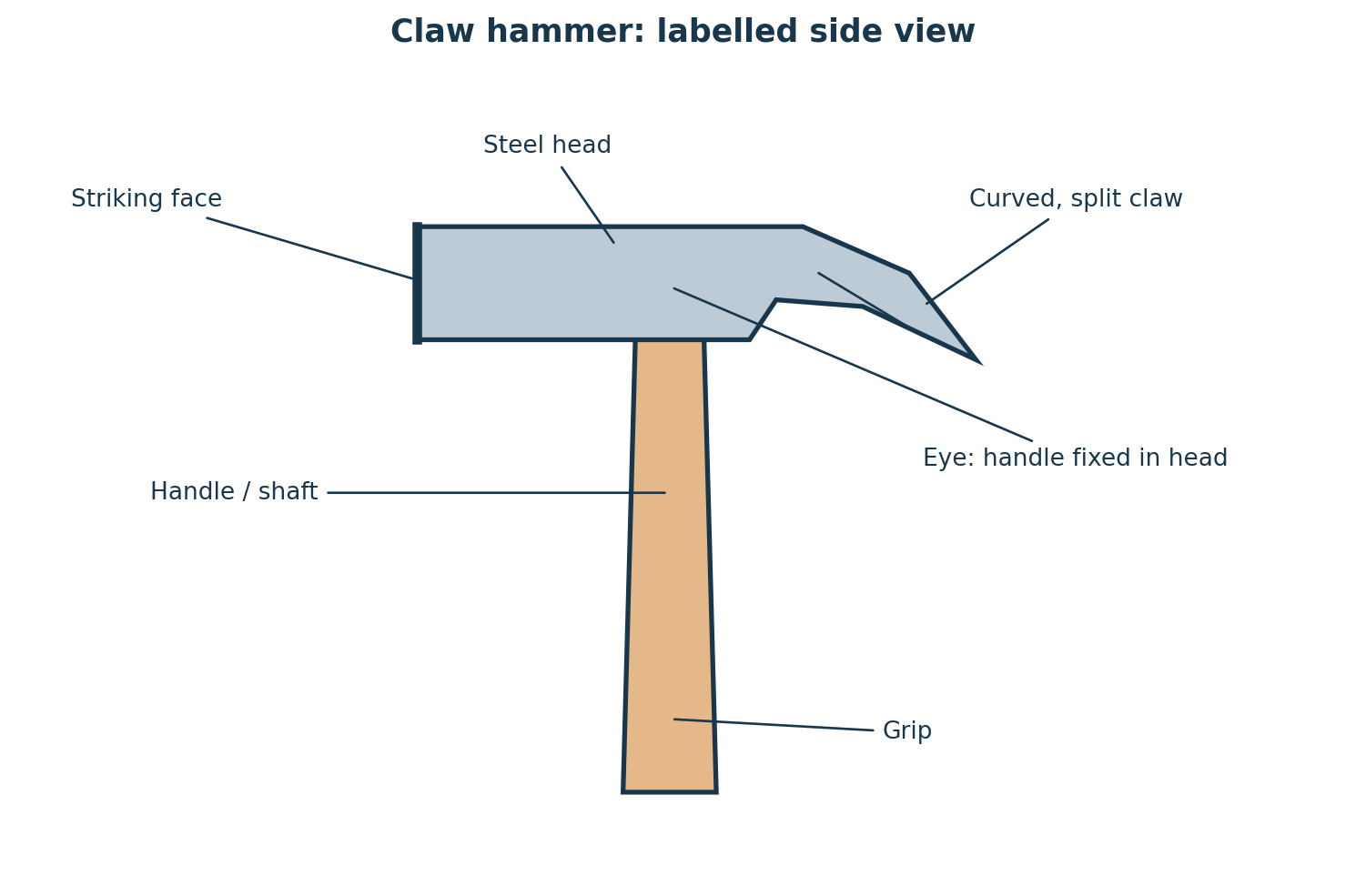
Sketch and label a claw hammer.
(6 marks)
Answer
Question 6(b)
Explain five types of chisels based on use.
(10 marks)
Answer
| Chisel | Use |
|---|---|
| Flat chisel | General cutting, chipping and removing metal from flat surfaces. |
| Cross-cut / cape chisel | Cutting narrow grooves, slots and keyways. |
| Round-nose chisel | Cutting semicircular oil grooves or channels. |
| Diamond-point chisel | Cutting V-grooves and cleaning sharp internal corners. |
| Side-cut chisel | Trimming the sides of narrow grooves and slots. |
Question 6(c)
State four advantages of a centrifugal pump.
(4 marks)
Answer
- It delivers a comparatively continuous, smooth flow.
- Its construction is simple, with relatively few moving parts and no reciprocating mechanism.
- It can handle large flow rates at suitable heads.
- It can be driven directly by a high-speed electric motor, and routine maintenance is usually modest.
Question 7(a)
With the aid of a labelled sketch, describe the operation of a hand water pump.
(10 marks)
Answer
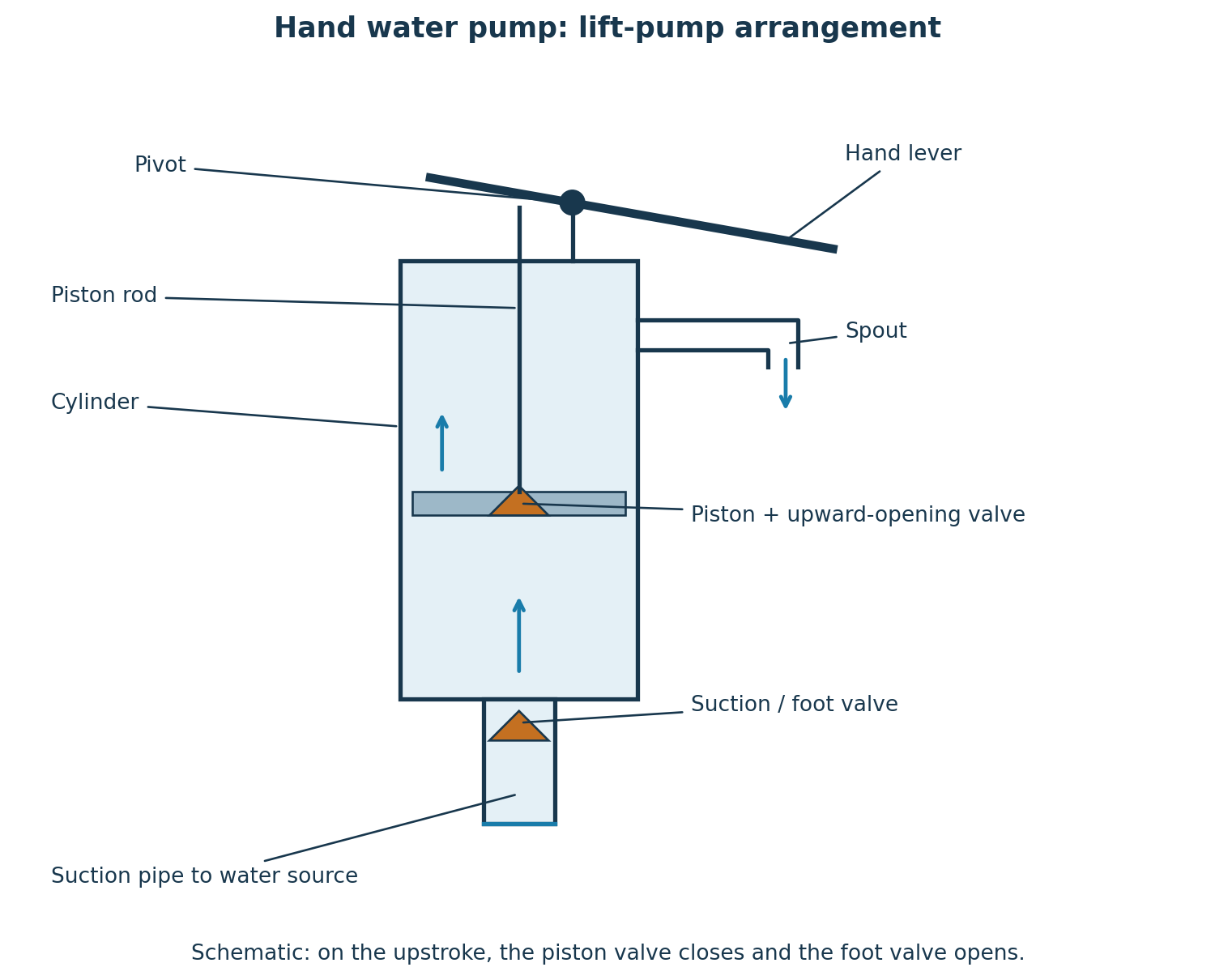
- Operating the hand lever moves the piston up and down through the piston rod. The pump is primed as required and its suction joints must be airtight.
- On the upstroke, the valve in the piston closes. The pressure below the piston falls, the foot valve opens, and atmospheric pressure acting on the source water drives water into the cylinder. Water above the piston is raised towards the spout.
- On the downstroke, the foot valve closes to prevent return flow. The piston valve opens so water passes through the descending piston to the space above it.
- Repeated strokes draw fresh water into the cylinder and raise the water above the piston to discharge through the spout. The two valves maintain one-way flow.
Question 7(b)
Describe the operation of a four-stroke engine system.
(10 marks)
Answer
| Stroke | Piston movement | Valve positions | Operation |
|---|---|---|---|
| Induction / intake | TDC to BDC | Inlet open; exhaust closed | The cylinder takes in an air-fuel mixture in a typical petrol engine, or air alone in a diesel engine. |
| Compression | BDC to TDC | Both closed | The charge is compressed, increasing pressure and temperature. Near the end, a spark ignites a petrol charge; diesel fuel is injected into hot compressed air. |
| Power / expansion | TDC to BDC | Both closed for most of stroke | Combustion produces high-pressure gases which force the piston down and deliver work to the crankshaft. |
| Exhaust | BDC to TDC | Exhaust open; inlet closed | The piston expels the burnt gases through the exhaust port. |
One complete cycle takes four piston strokes and two crankshaft revolutions. TDC means top dead centre; BDC means bottom dead centre. Actual valve timing may include overlap.
Question 8(a)
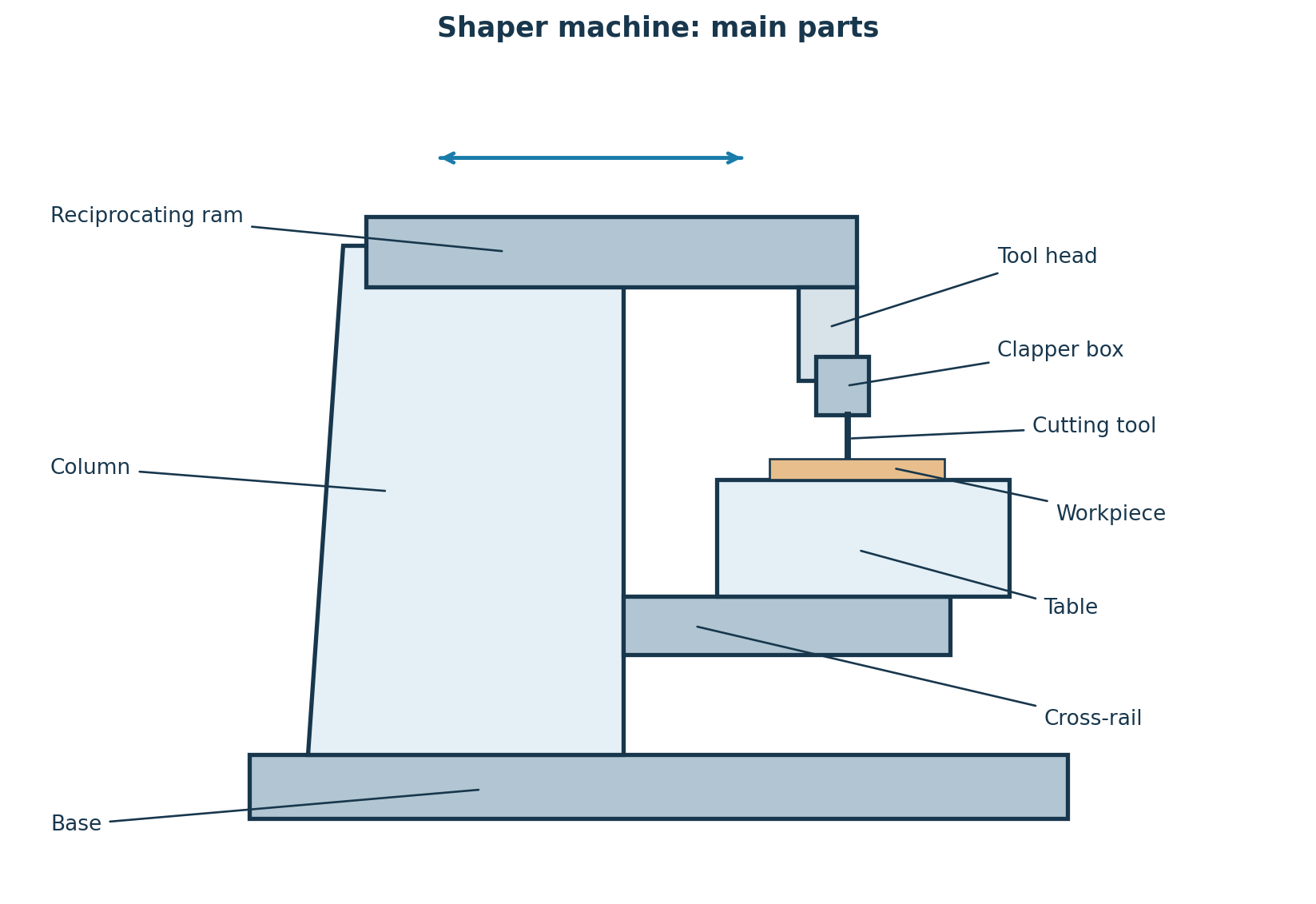
Sketch and label a shaper machine.
(7 marks)
Answer
Question 8(b)
State five rules observed when operating a lathe machine.
(5 marks)
Answer
- Secure the work in the chuck or between centres and clamp the cutting tool at the correct height with minimum overhang.
- Remove the chuck key immediately after use and before starting the spindle.
- Wear eye protection, tie back long hair and secure loose clothing; keep gloves and hands away from rotating work.
- Stop the spindle before measuring, adjusting or clearing the work area.
- Keep guards in position and remove swarf with a suitable brush or hook after stopping; never use bare hands.
Question 8(c)
State four differences between a ‘diesel engine’ and a ‘petrol engine’.
(8 marks)
Answer
| Basis | Diesel engine | Typical petrol engine |
|---|---|---|
| Ignition | Compression ignition: injected fuel ignites in hot compressed air. | Spark ignition: a spark plug ignites the charge. |
| Compression ratio | Generally higher. | Generally lower. |
| Induction and mixture formation | Air is compressed first; fuel is injected near the end of compression. | A combustible air-fuel charge is formed for spark ignition; the fuel system may use port or direct injection. |
| Load control | Mainly by changing the quantity of fuel injected. | Usually by throttling the intake charge and supplying the matching fuel quantity. |
References for further study
- Kenya Occupational Safety and Health Act, 2007 — employer and employee duties, sections 6 and 13.
- Health and Safety Executive: construction fire safety — extinguisher selection and precautions.