Jemshah · KNEC Diploma in Food and Beverage Management · Module III
Sales and Marketing — June/July 2023
Paper: 2802/302; 2920/302 · Time: 3 hours
Answer ALL questions in Section A and any THREE questions in Section B.
Questions are transcribed from the supplied KNEC paper. Answers are independent study explanations, not an official KNEC marking scheme. Attempt each part before reading its Answer.
SECTION A (40 marks)
Answer ALL questions in this section.
Question 1
Answer
- A clearly defined target market.
- Customer needs and satisfaction.
- Integrated marketing across the organisation.
- Profitability through delivering customer value.
Question 2
Answer
- Customers.
- Suppliers.
- Competitors.
- Marketing intermediaries, such as distributors and retailers.
Question 3
Answer
- Cultural background and values.
- Social influences, including family and reference groups.
- Personal factors, such as age, occupation and income.
- Psychological factors, such as motivation, perception and attitudes.
Question 4
Answer
- Measurable size and characteristics.
- Large or profitable enough to serve.
- Accessible through suitable channels.
- Distinct and actionable with an appropriate marketing programme.
Question 5
Answer
Penetration pricing sets a relatively low initial price to attract many buyers and build market share quickly. Skimming pricing sets a relatively high initial price for customers willing to pay more, then may reduce it as later segments are targeted or competition develops.
Question 6
Answer
- Dishonesty.
- Poor listening.
- Lack of persistence or reliability.
- Rudeness or inability to relate respectfully to customers.
Question 7
Answer
- Test and refine the offer with the target market so its features and value meet real customer needs.
- Use coordinated launch promotion and suitable distribution so intended buyers know the benefits and can obtain the product.
Question 8
Answer
- Research customer needs and the market.
- Develop and position the product.
- Set the price.
- Plan distribution and promotional communication.
Question 9
Answer
- Define the target audience and measurable objectives.
- Use messages that communicate relevant customer benefits.
- Choose suitable channels and timing.
- Measure response and adjust the campaign using evidence.
Question 10
Answer
An adverse sales variance occurs when actual sales are below the comparable budget or forecast. A favourable sales variance occurs when actual sales are above it. For this paper, variance is calculated as actual sales minus forecast sales.
SECTION B (60 marks)
Answer any THREE questions in this section.
Question 11(a)
Ziko Limited sells two products A and B. The following information relates to the two products for the year 2021:
| Product | Forecasted sales | Actual sales |
|---|---|---|
| A | 200,000 | 210,000 |
| B | 370,000 | 335,000 |
Calculate: (i) the variance per product; (ii) total variance for the firm.
(10 marks)
Answer
| Product | Working | Variance | Interpretation |
|---|---|---|---|
| A | 210,000 − 200,000 | +10,000 | Favourable |
| B | 335,000 − 370,000 | −35,000 | Adverse |
| Total | 545,000 − 570,000 | −25,000 | Adverse |
The figures are expressed in the same sales units as supplied in the question. Do not add the absolute values of the two product variances; combine their signs.
Question 11(b)
Answer
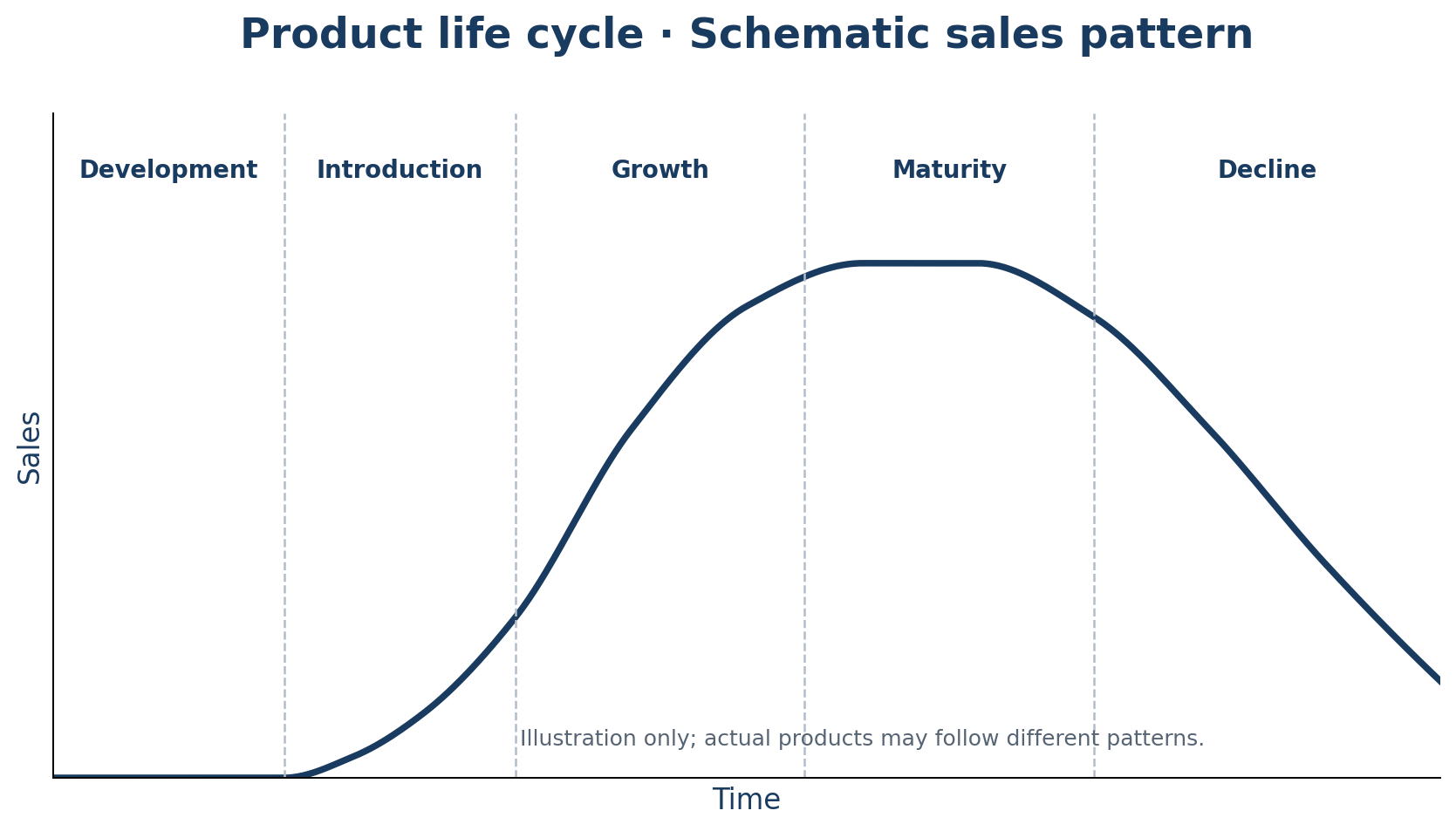
- Development: the product is researched and designed before commercial sales; expenditure is incurred without sales revenue.
- Introduction: sales begin slowly while awareness and distribution are built; promotion costs are often high.
- Growth: acceptance increases and sales rise quickly, attracting competition and wider distribution.
- Maturity: growth slows and sales reach a high level; competition encourages differentiation and efficiency.
- Decline: sales fall as preferences, technology or competing offers change; the business may modify, withdraw or target a smaller market.
The curve is a teaching illustration, not measured data. Products do not all follow the same timing or shape.
Question 12(a)
Answer
- Insufficient finance restricts research, prototypes and launch preparation.
- Weak market information leads to an offer that customers do not want.
- Lack of technical skills or equipment prevents reliable design and production.
- Poor coordination causes delays between marketing, production and finance.
- Strong competition or regulatory barriers can make the proposed product difficult to launch economically.
Question 12(b)
Answer
- Break bulk into quantities convenient for customers.
- Store goods and make them available when needed.
- Transport and distribute products to more locations.
- Provide market information and promote the offer.
- Finance stock or assume agreed trading risks, reducing the producer’s distribution burden.
Question 13(a)
Answer
- Encourage customers to try a product for the first time.
- Increase short-term purchase volume.
- Stimulate repeat purchases or customer loyalty.
- Clear seasonal or excess stock.
- Encourage retailers or distributors to stock and display the product.
Question 13(b)
Answer
- Research the market and interpret customer and competitor information.
- Develop marketing objectives, strategies and budgets.
- Coordinate product, price, distribution and promotion decisions.
- Lead the marketing team and collaborate with other departments.
- Monitor results and make changes to improve customer value and business performance.
Question 14(a)
Answer
- Identifies potential buyers who have a relevant need, authority and ability to purchase.
- Allows sales effort to focus on promising leads, reducing time spent on unsuitable contacts.
Question 14(b)(i)
Answer
Anything offered to a market to satisfy a need or want, including a physical good, service or experience.
Question 14(b)(ii)
Answer
Obtaining something of value by offering something of value in return through an agreed transaction or relationship.
Question 14(b)(iii)
Answer
A want for a particular offer supported by willingness and purchasing power to obtain it.
Question 14(c)
Answer
- Target audience: channels must reach the intended buyers in a suitable way.
- Nature of the product: complex or expensive products may need personal explanation.
- Product life-cycle stage: introduction may require awareness, while maturity may require differentiation.
- Budget and resources: available funds affect the feasible reach and methods.
- Marketing objectives and channel strategy: the mix should support the intended response and distribution approach.
Question 15(a)
Answer
- Pricing only from cost and ignoring customer value or willingness to pay.
- Failing to account for all relevant costs, producing an unsustainable margin.
- Ignoring competitor prices and the intended market position.
- Keeping prices rigid despite changes in costs, demand or product conditions.
Question 15(b)
Answer
- Dynamic: economic, technological and customer conditions change over time.
- Complex: many connected forces influence the firm simultaneously.
- Uncertain: the timing and effects of changes are not always predictable, requiring monitoring and adaptation.
Question 15(c)
Answer
- Confirms satisfaction and resolves problems before they damage trust.
- Builds relationships that encourage repeat sales and referrals.
- Collects feedback and identifies further needs for product and service improvement.
Printing and PDF downloads: Coming Soon.