Jemshah · KNEC Diploma in Food and Beverage Management · Module I
ICT, Communication Skills and Entrepreneurship — June/July 2023
Paper: 2802/101 · Time: 3 hours
This shared KNEC paper includes Diploma in Food and Beverage Management. Answer any two questions from Section A, any one from Section B and any two from Section C.
Questions are transcribed from the supplied KNEC paper. Answers are independent study explanations, not an official KNEC marking scheme. Attempt each part before reading its Answer.
Section A: ICT (40 marks)
Answer any TWO questions from this section.
Question 1(a)
Answer
Data are raw facts or observations, such as individual daily sales figures, before meaningful processing. Information is data organised and interpreted to give useful meaning, such as a monthly sales report showing totals and comparisons. Data are the input; information is the meaningful output.
Question 1(b)
Table I shows the basis on which computers are classified. Complete the table by stating two types of computers under each category.
| Basis of classification | Types of computers |
|---|---|
| Purpose | |
| Physical size and processing power | |
| Functionality |
(Mark allocation not printed in the supplied scan)
Answer
| Basis of classification | Two types |
|---|---|
| Purpose | General-purpose computers; special-purpose computers. |
| Physical size and processing power | Microcomputers; mainframe computers. |
| Functionality | Analogue computers; digital computers. |
Other valid size categories include minicomputers and supercomputers; hybrid computers are another functionality category. Supply only two examples per row as requested.
Question 1(c)
Explain the circumstance under which each of the following data processing modes may be appropriate in an organization:
- batch organization;
- time sharing;
- real time.
(6 marks)
Answer
- Batch processing: appropriate when similar transactions can be collected and processed together at a scheduled time, such as monthly payroll, with no immediate result needed. The source prints “batch organization”; batch processing is the intended mode.
- Time sharing: appropriate when several users need interactive access to one computer system. The processor gives each active user or task a short time slice, creating the impression of simultaneous service.
- Real-time processing: appropriate when events require an immediate or time-bounded response, such as industrial control or updating a booking’s availability as it is made.
Question 1(d)
Explain each of the following terms as used in the internet:
- internet service provider;
- surfing.
(4 marks)
Answer
- Internet service provider (ISP): an organisation that supplies users with an internet connection and related services.
- Surfing: browsing or moving between web pages and websites, normally through hyperlinks, addresses or search results.
Question 2(a)
Figure 1 shows a network topology.
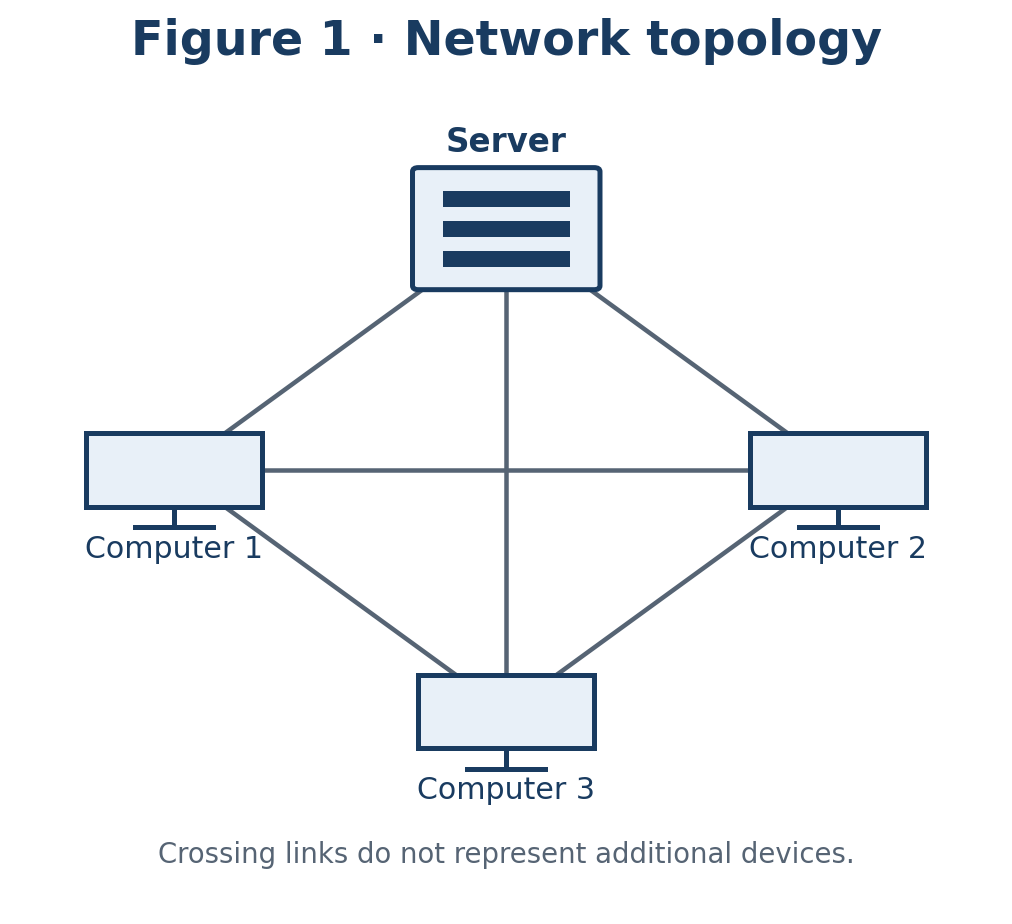
- Identify the topology.
- Outline four merits of the topology identified in (i).
(5 marks)
Answer
(i) Full mesh topology. Each of the four devices has a direct connection to every other device. There are 4 × 3 ÷ 2 = 6 links.
(ii) Four merits:
- Alternative routes can maintain communication when one link fails, provided routing supports them.
- Dedicated links reduce competition for a shared communication channel.
- A failed link can be identified and isolated without stopping all other links.
- There is no single central switch or hub on which all inter-device communication depends.
Question 2(b)
- Distinguish between slide design and slide transition with respect to presentation software.
- State four sources of graphics in presentation software.
(8 marks)
Answer
(i) Slide design concerns the appearance and arrangement of content within a slide, including its layout, colours, fonts and background. A slide transition is the visual effect used when moving from one slide to the next during a presentation.
(ii) Four sources of graphics:
- Pictures stored in local files.
- Built-in clip art, icons or stock-image collections.
- Images obtained from the web with appropriate permission.
- Images created or captured by a camera, scanner or graphics program.
Question 2(c)
A secretary has been asked to send letters to the members of the welfare committee inviting them to an Annual General Meeting using a word processing program.
- Identify the word processing feature that would be most appropriate for this task.
- Explain three files that the secretary is likely to create when working with the feature identified in (i).
(7 marks)
Answer
(i) Mail merge. It combines a standard invitation with each member’s details to produce personalised letters.
(ii) Three files:
- Main document: the common invitation text and merge fields, such as name and address placeholders.
- Data source: the table or list containing each member’s details, with one record per recipient.
- Merged output: the completed personalised letters generated by combining the main document with the data source.
Question 3(a)
Answer
An address register, commonly the memory address register (MAR), holds the address of the memory location to be accessed. A storage or data register, commonly the memory data register (MDR), temporarily holds the actual data or instruction being transferred to or from that location. One holds the location; the other holds its contents.
Question 3(b)
Answer
- Right-click an empty area of the desktop.
- Choose New from the shortcut menu.
- Choose Folder.
- Type the required folder name and press Enter.
This is the usual Windows desktop procedure; the menu wording depends on the operating system.
Question 3(c)
Table II shows an extract of a worksheet stored in a spreadsheet program.
| Row | A | B | C | D | E | F | G |
|---|---|---|---|---|---|---|---|
| 1 | Name of sales person | Weekly sales | Total sales | Total commission | |||
| 2 | Week 1 | Week 2 | Week 3 | Week 4 | |||
| 3 | Jaza | 1300 | 1400 | 1120 | 1250 | ||
| 4 | Lucky | 850 | 1120 | 1350 | 950 | ||
| 5 | Bernard | 2500 | 1890 | 1600 | 1300 | ||
| 6 | Rhoda | 1850 | 1320 | 1550 | 760 | ||
| 7 | Mark | 1400 | 1210 | 1090 | 910 | ||
| 8 | Commission rate | 8% | |||||
| 9 | Mean sales |
Total commission = commission rate × total sales. Using cell addresses only, write the expression that would be used to compute:
- total sales for Lucky;
- total commission for Rhoda;
- mean for total sales.
(6 marks)
Answer
| Part | Expression | Explanation |
|---|---|---|
| (i) Lucky’s total sales | =B4+C4+D4+E4 | Add the four weekly sales cells in row 4. |
| (ii) Rhoda’s total commission | =$B$8*F6 | Multiply Rhoda’s total in F6 by the commission rate in B8. |
| (iii) Mean for total sales | =(F3+F4+F5+F6+F7)/5 | Add the five sales totals and divide by five. |
Rhoda’s total = 1,850 + 1,320 + 1,550 + 760 = 5,480
Rhoda’s commission = 0.08 × 5,480 = 438.40
Totals: 5,070; 4,270; 7,290; 5,480; 4,610
Mean total sales = 26,720 ÷ 5 = 5,344
The first row groups B–E as weekly sales in the original worksheet. Absolute references in $B$8 keep the rate fixed when a formula is copied; =B8*F6 is also sufficient for that single cell. The requested expressions use cell references and arithmetic rather than SUM or AVERAGE functions.
Question 3(d)
Explain each of the following methods of securing data against loss:
- audit trail;
- back up;
- firewall.
(6 marks)
Answer
- Audit trail: a record of access, transactions and changes showing who did what and when. It helps detect and investigate unauthorised changes, but does not itself create a recoverable copy of lost data.
- Back up: a separate copy of data retained so it can be restored after deletion, corruption or equipment failure; restoration should be checked and copies protected.
- Firewall: a control that permits or blocks network traffic according to rules, reducing some risks of unauthorised network access. It does not replace backups.
Section B: Communication Skills (20 marks)
Answer any ONE question from this section.
Question 4(a)
Explain the way in which a speaker may apply each of the following principles of effective communication:
- completeness;
- conciseness.
(4 marks)
Answer
- Completeness: include all information the audience needs, such as the purpose, relevant facts, action required and timing, and answer likely questions.
- Conciseness: use clear, brief wording, avoid repetition and irrelevant detail, and retain every essential point.
Question 4(b)
Answer
- Make it relevant: highlight qualifications, skills and achievements that match the intended role, using specific evidence.
- Use a clear structure: organise details under readable headings and present education and experience in a consistent order.
- Be accurate and polished: use truthful, up-to-date details and correct grammar, spelling and formatting; proofread before submitting.
Question 4(c)
Answer
- Achievement of agreed work objectives and performance standards.
- Strengths and areas requiring improvement.
- Training and development needs.
- Future goals, responsibilities and career aspirations.
Question 4(d)
Answer
- Reduced travel: people meet from different locations, saving transport costs and travel time.
- Immediate interaction: participants can speak, ask questions and observe visual cues in real time.
- Collaborative tools: screen sharing and shared documents help participants explain and review information together.
Question 5(a)
Answer
A statutory report is required by law and may have prescribed contents, timing and recipients. A non-statutory report is produced for management or another purpose without a specific legal requirement, such as an internal report recommending a change to restaurant service.
Question 5(b)
Answer
- Communicate plans, decisions and instructions so staff understand their duties and targets.
- Exchange feedback and discuss work problems to coordinate action and agree solutions.
Question 5(c)
Answer
- Plan the purpose and points: prepare a short agenda or notes and gather the relevant records so the message is clear and questions can be answered.
- Prepare the contact and setting: confirm the recipient’s number and a suitable time, choose a quiet place and have materials ready to record the response or agreed action.
Question 5(d)
Answer
- Repeated yawning.
- Slouching or leaning away from the speaker.
- Repeatedly checking a watch or looking around.
- Fidgeting, doodling or otherwise turning attention away.
Such behaviour can have other explanations. Interpret patterns in context rather than assuming boredom from one gesture.
Question 5(e)
Answer
- Formulate the idea or purpose of the message.
- Encode the idea into suitable words, symbols or gestures.
- Select an appropriate communication channel and transmit the message.
- Seek and interpret feedback to check understanding and correct any misunderstanding.
Section C: Entrepreneurship (40 marks)
Answer any TWO questions from this section.
Question 6(a)
Answer
- Creativity and initiative.
- Self-confidence.
- Persistence and determination.
- Willingness to take calculated risks.
- Self-discipline and hard work.
- Adaptability and willingness to learn.
Question 6(b)
Answer
- Employment: new and expanding businesses create jobs and income for owners and employees.
- Innovation: entrepreneurs introduce or improve products, services and production methods.
- Economic output and revenue: business activity adds goods and services to the economy and contributes tax revenue.
- Use of resources and market development: enterprises turn available skills and materials into useful products and may open new local or export markets.
Question 6(c)
Answer
- Weak direction: unclear objectives and operating plans make it difficult to prioritise work and measure progress.
- Poor financial control: without forecasts and budgets the entrepreneur may underestimate costs, funding needs or cash shortages.
- Difficulty obtaining support: lenders or investors lack a coherent explanation of the opportunity, risks and repayment or return prospects.
Question 7(a)
Answer
- Treat employees respectfully and protect them from stigma, harassment and discrimination.
- Protect confidentiality and let employees choose whether and to whom they disclose their status.
- Listen empathetically and provide reassurance about available workplace support.
- Offer access to confidential counselling or support groups, with the employee’s consent.
- Agree reasonable flexibility and support for appointments or difficult periods so the employee feels supported.
Support should respect the employee’s choices and privacy; disclosure should not be forced.
Question 7(b)
Answer
- Demand: establish whether enough customers need the product and will pay for it.
- Competition and differentiation: assess rival offerings and what makes the proposed business attractive.
- Resources and feasibility: consider skills, equipment, suppliers, premises and ability to deliver reliably.
- Financial viability: compare likely sales with costs, investment and cash-flow needs to judge whether sustainable profit is possible.
Question 7(c)
- Distinguish between a private limited company and a public limited company.
- Outline three disadvantages of private limited companies.
(7 marks)
Answer
(i) A private limited company restricts public invitations to subscribe for its shares and usually restricts share transfers under its constitution. A public limited company can seek investment from the public subject to the applicable legal requirements. A public company is not necessarily listed on a stock exchange.
(ii) Three disadvantages:
- Access to equity finance is more limited because shares cannot be offered generally to the public in the same way.
- Restrictions on transferring shares can make it harder for an owner to sell their investment.
- Formation and continuing record-keeping and reporting requirements can be more costly than those of a sole proprietorship.
Question 8(a)
Explain each of the following sources of business finance:
- trade creditors;
- retained earnings;
- sale and lease back.
(6 marks)
Answer
- Trade creditors: suppliers allow the business to receive goods or services now and pay later, providing short-term finance during the agreed credit period.
- Retained earnings: profits kept in the business rather than distributed to owners, and used to finance operations or expansion.
- Sale and lease back: the business sells an asset to release cash, then leases it from the buyer so it can keep using it. It gives up ownership and takes on rental payments.
Question 8(b)
Answer
- Supply safe, dependable products: maintain quality, provide necessary safety information and address defects responsibly.
- Use truthful and fair dealings: give accurate product and price information and avoid misleading promotions or unfair treatment.
- Respond to customer concerns: provide accessible complaint handling, fair remedies and respectful treatment of customer information.
Question 8(c)
Answer
- Education and training: teach business skills and provide mentoring, advisory services and practical enterprise programmes.
- Access to finance: support suitable credit, guarantees or funding programmes that help viable enterprises obtain capital.
- Infrastructure: improve transport, electricity, communications and business facilities to reduce operating barriers.
- Supportive administration: provide clear, proportionate rules and efficient registration and licensing so entrepreneurs can start and operate businesses.
Printing and PDF downloads: Coming Soon.