Jemshah · KNEC Diploma in Food and Beverage Management · Module I
Catering Premises, Equipment and Mathematics — June/July 2023
Paper: 2802/102 · Time: 3 hours
Section A: answer Question 1 and any other three questions. Section B: answer Question 6 and any other three questions. Show all mathematical workings.
Questions are transcribed from the supplied KNEC paper. Answers are independent study explanations, not an official KNEC marking scheme. Attempt each part before reading its Answer.
Section A: Catering Premises and Equipment (50 marks)
Answer question ONE (compulsory) and any other THREE questions from this section.
Question 1(a)
Answer
- Measure and monitor: record energy consumption and compare it with meals produced to identify avoidable use.
- Use energy efficiently: select efficient equipment and operate it at suitable loads and temperatures.
- Prevent waste: switch off unused appliances, lights and extraction when safe; avoid unnecessary preheating.
- Maintain and improve: service equipment, repair leaking seals and train staff to meet clear energy-saving targets.
Question 1(b)(i)
Answer
A catering outlet is a place or business where food and beverages are prepared, sold or served to customers, such as a restaurant, cafeteria or takeaway.
Question 1(b)(ii)
Answer
Work flow is the planned sequence and movement of staff, food, utensils and information through tasks, for example from receiving and storage through preparation, cooking and service to washing up. An efficient flow avoids crossing clean and dirty routes.
Question 1(b)(iii)
Answer
A plinth is a raised base or supporting platform beneath equipment, fittings or a structure. In a kitchen it can support a unit above floor level and, when properly sealed, reduce inaccessible dirt traps.
Question 1(c)
Answer
- Proof the building: seal cracks and fit door brushes and window screens to prevent pest entry.
- Remove food and water: clean spillages promptly, keep food covered and repair leaks so pests cannot feed or drink.
- Manage refuse: use covered bins, empty them regularly and keep the refuse area clean and away from food preparation.
- Remove harbourage: clear clutter, avoid unused packaging and store goods off the floor to expose hiding places.
- Use physical trapping: position and monitor suitable mechanical traps or insect light traps through trained pest-control staff; keep them away from exposed food.
Question 2(a)
Answer
- Clear, unobstructed escape routes and marked fire exits.
- Suitable fire alarms and firefighting equipment.
- Sound, non-slip floors and adequate lighting.
- Safe, maintained electrical and gas installations.
- Guarded machinery and suitable personal protective equipment.
- Accessible first-aid supplies, trained first-aiders and emergency procedures.
Question 2(b)(i)
Answer
Maintenance is triggered by the observed condition of equipment, such as an inspection showing a worn belt, a refrigerant leak or a temperature outside its acceptable range, rather than by a fixed service date alone.
Question 2(b)(ii)
Answer
Measurements and trends, such as vibration, temperature or oil analysis, are used to predict when a component is likely to fail. Maintenance is then scheduled before that predicted failure disrupts service.
Question 3(a)
Answer
- Function and available space: furniture should fit the layout, provide comfortable seating and allow safe staff and guest circulation.
- Durability and hygiene: strong, stable furniture with easily cleaned finishes withstands frequent use and maintains sanitation.
- Cost and style: purchase and maintenance costs should suit the budget, while the appearance matches the outlet and its customers.
Question 3(b)
Answer
- Follow the establishment’s fire-safety instructions and safe working procedures.
- Report fire hazards and defective alarms, appliances or firefighting equipment promptly.
- Keep exits, escape routes and access to extinguishers unobstructed.
- Take part in fire training and drills and raise the alarm and evacuate as instructed in an emergency.
These are practical employee fire-safety responsibilities; the question’s wording is retained without treating it as the title of a verified Kenyan statute.
Question 4(a)
Answer
- Stop work in the affected area and move people and exposed food away from the water.
- Shut the relevant water isolation valve or main stopcock.
- Arrange safe isolation of affected electrical supplies by a competent person; do not touch wet electrical equipment.
- Notify management and a plumber, contain and remove water safely, then clean and check the area before reopening.
Question 4(b)
Answer
- Arrange workstations in task order: position receiving, storage, preparation, cooking and service areas to reduce backtracking.
- Keep items at the point of use: place frequently used tools and ingredients within easy reach and at a comfortable height.
- Plan and combine work: complete mise-en-place, group similar tasks and use suitable trolleys or equipment to avoid repeated trips and unnecessary lifting.
Question 5(a)
Answer
- Repair leaking taps, pipes and valves promptly.
- Fit suitable low-flow taps or controlled spray heads.
- Wash produce and utensils in a basin where appropriate instead of leaving taps running.
- Run dishwashers with full suitable loads and correct settings.
- Measure cooking water and use dry cleaning or scraping before rinsing surfaces and utensils.
Question 5(b)
Answer
- Stop contact with the hot liquid or steam and make the area safe.
- Cool the scald under cool running water for at least 20 minutes; do not apply ice, butter or creams.
- Remove jewellery and loose clothing near the injury while cooling, but leave anything stuck to the skin in place.
- Cover the cooled injury loosely with cling film or a clean non-fluffy dressing; do not wrap tightly around a limb or burst blisters.
- Seek urgent medical help for serious, extensive or deep injuries, sensitive areas or breathing problems; keep the person warm without heating the injury.
First-aid reference: British Red Cross: burns and scalds.
Section B: Mathematics (50 marks)
Answer question SIX (compulsory) and any other THREE questions. Show all workings.
Question 6(a)
Determine the value of x in the equation
(4 marks)
Answer
2(3x − 10)/3 = 0
2(3x − 10) = 0
3x − 10 = 0
3x = 10
x = 10/3 = 3⅓
Check: 3 × (10/3) − 10 = 0, so the left side is 8.
Question 6(b)(i)
Answer
= 5 × 4 × 4 = 80 m³
1 m³ = 1,000 litres
Capacity = 80 × 1,000 = 80,000 litres
Question 6(b)(ii)
Answer
= 80,000 ÷ 400
Time = 200 hours
Assume the usage remains constant and no water enters the tank.
Question 6(c)(i)
Answer
Median = (4th value + 5th value) ÷ 2
= (15 + 15) ÷ 2
Median = 15
Question 6(c)(ii)
Answer
Number of values = 8
Mean = 124 ÷ 8
Mean = 15.5
Question 6(d)
In figure 1 BCD is a quadrant, determine the area of the shaded part.
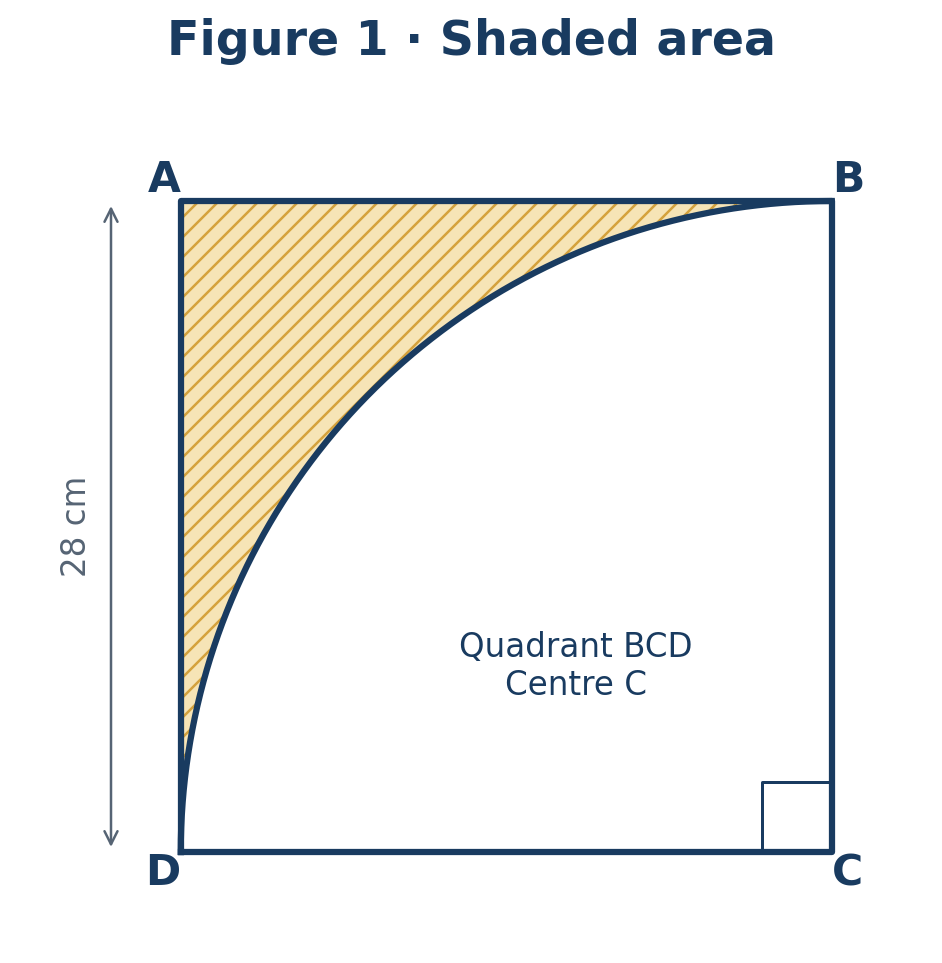
(4 marks)
Answer
Area of quadrant = ¼ × π × 28²
Using π = 22/7: ¼ × (22/7) × 784 = 616 cm²
Shaded area = square − quadrant
Shaded area = 784 − 616 = 168 cm²
With calculator π the answer is approximately 168.25 cm². State the value of π used. The diagram is reconstructed from the supplied paper.
Question 6(e)(i)
Answer
⁶C₂ = 6!/(2!4!) = 15
⁷C₃ ÷ ⁶C₂ = 35/15
Answer = 7/3 = 2⅓
Question 6(e)(ii)
Answer
⁶P₂ = 6 × 5 = 30
⁷P₃ ÷ ⁶P₂ = 210/30
Answer = 7
Question 7(a)
Figure 2 shows a pie-chart of how John spent his monthly income.
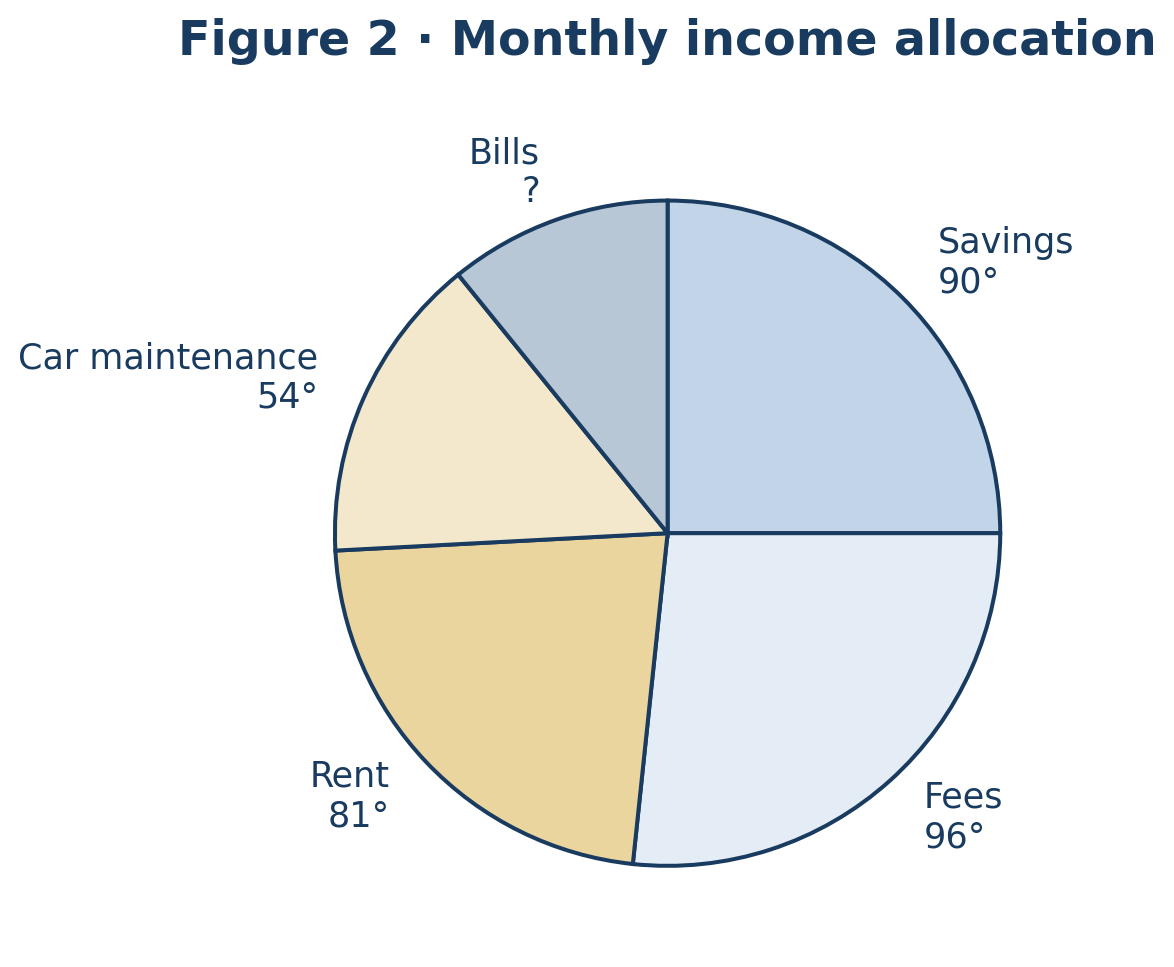
How much did he spend on bills, if his income was Ksh 96,000?
(4 marks)
Answer
Bills angle = 360° − 321° = 39°
Amount on bills = (39/360) × 96,000
Amount on bills = Ksh 10,400
Question 7(b)
Answer
Commission = (8.5/100) × 120,000 = 10,200
Total earnings = basic salary + commission
= 45,500 + 10,200
Total earnings = Ksh 55,700
Commission applies only to the amount exceeding Ksh 100,000.
Question 8(i)
Answer
The paper prints “floor”; the calculation concerns porridge flour. Bags are assumed to have equal weight.
| Type | Bags | Cost per bag (Ksh) | Total cost (Ksh) |
|---|---|---|---|
| A | 30 | 4,000 | 120,000 |
| B | 50 | 3,500 | 175,000 |
| Total | 80 | — | 295,000 |
Profit per bag = 0.30 × 3,687.50 = 1,106.25
Selling price = 3,687.50 + 1,106.25
Selling price per bag = Ksh 4,793.75
Question 8(ii)
Answer
= 0.30 × 295,000
Total profit = Ksh 88,500
Check: 80 × 4,793.75 = 383,500
383,500 − 295,000 = 88,500
Question 9(a)
Answer
= −5/−1 = 5
Substitute A (−1, −3): −3 = 5(−1) + c
−3 = −5 + c → c = 2
y = 5x + 2
Check B: 5(−2) + 2 = −8.
Question 9(b)(i)
Answer
The value 3 occurs three times, more often than any other value. Mode = 3.
Question 9(b)(ii)
Answer
| x | Frequency f | fx | fx² |
|---|---|---|---|
| 2 | 1 | 2 | 4 |
| 3 | 3 | 9 | 27 |
| 4 | 2 | 8 | 32 |
| 5 | 2 | 10 | 50 |
| 7 | 1 | 7 | 49 |
| 8 | 1 | 8 | 64 |
| 13 | 1 | 13 | 169 |
| 15 | 1 | 15 | 225 |
| Total | 12 | 72 | 620 |
Population variance = Σfx²/Σf − (mean)²
= 620/12 − 6²
= 155/3 − 36 = 47/3
Variance = 15⅔ ≈ 15.67
This treats the given set as the whole population, using n = 12. A sample estimate would instead divide the sum of squared deviations by n − 1.
Question 10(a)
Complete the missing values in table 1 for y = x² + x − 6.
| x | -4 | -3 | -2 | -1 | 0 | 1 | 2 | 3 |
|---|---|---|---|---|---|---|---|---|
| y | 6 | -6 | -6 | -4 |
(4 marks)
Answer
| x | -4 | -3 | -2 | -1 | 0 | 1 | 2 | 3 |
|---|---|---|---|---|---|---|---|---|
| x² | 16 | 9 | 4 | 1 | 0 | 1 | 4 | 9 |
| x | -4 | -3 | -2 | -1 | 0 | 1 | 2 | 3 |
| -6 | -6 | -6 | -6 | -6 | -6 | -6 | -6 | -6 |
| y = x² + x − 6 | 6 | 0 | -4 | -6 | -6 | -4 | 0 | 6 |
The second row of the source table is printed “x”; it is interpreted as the intended y-values. Missing values are 0, -4, 0 and 6.
Question 10(b)
Answer
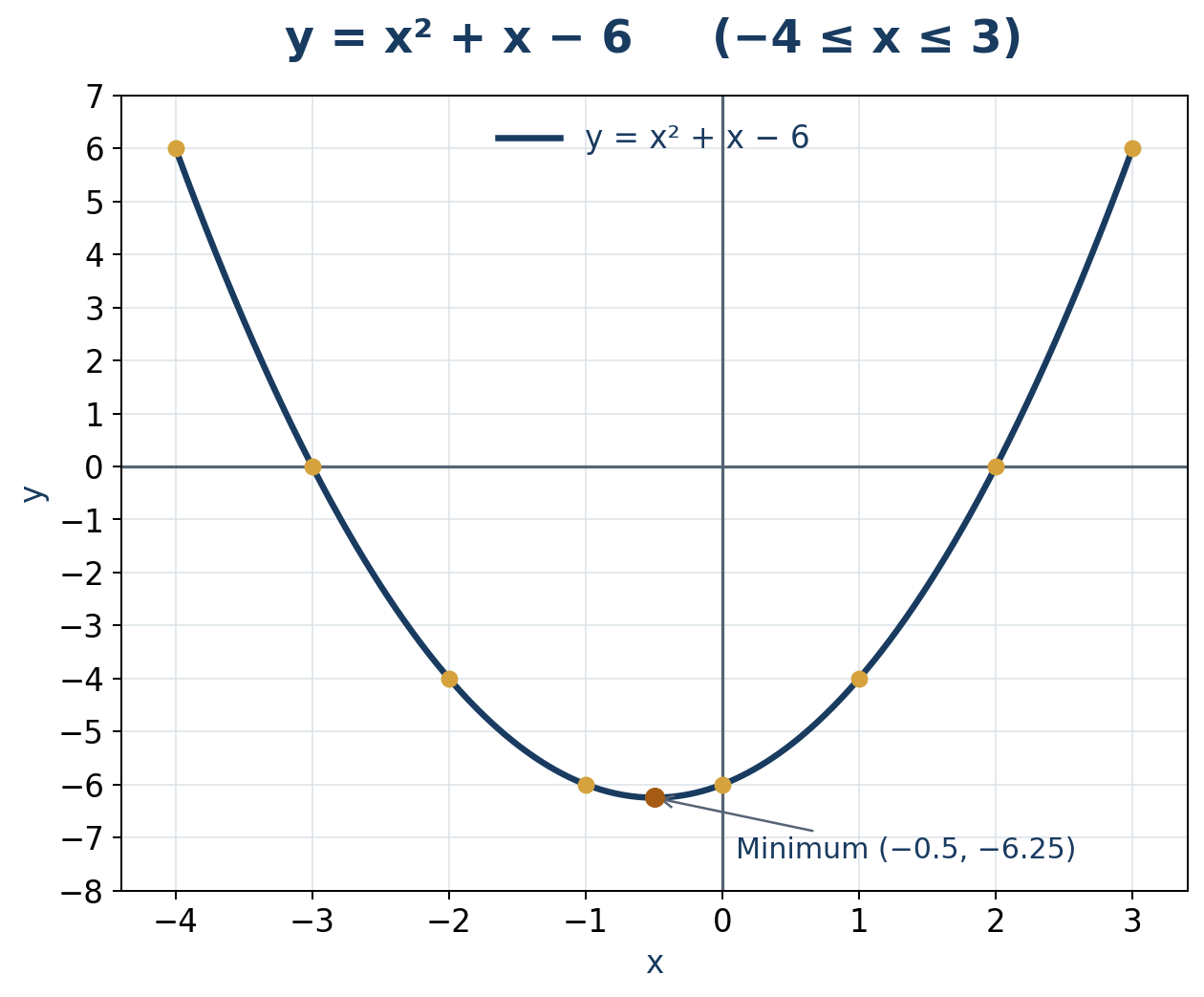
Plot the eight points in the completed table and join them with a smooth U-shaped curve. Label both axes and use a consistent scale.
Question 10(c)
Answer
y = (−0.5)² + (−0.5) − 6
= 0.25 − 0.5 − 6 = −6.25
Minimum point = (−0.5, −6.25)
Equivalently, y = (x + ½)² − 6¼. A graph reading should be close to this point.
Printing and PDF downloads: Coming Soon.