Jemshah · KNEC Diploma in Food and Beverage Management · Module I
Food and Beverage Service Theory — June/July 2023
Paper: 2802/104 · Time: 3 hours
Answer Question 1 (compulsory) and any other four questions. Each part below retains its original number and marks.
Questions are transcribed from the supplied KNEC paper. Answers are independent study explanations, not an official KNEC marking scheme. Attempt each part before reading its Answer.
Food and Beverage Service Theory
Answer Question 1 (compulsory) and any other FOUR questions.
Question 1(a)
Answer
- Two-plate clearing method.
- Three-plate clearing method.
- Tray clearing method.
- Trolley clearing method.
Question 1(b)
Answer
- Supervise and coordinate restaurant service staff.
- Receive guests and manage reservations and table allocation.
- Allocate service stations and brief staff on the menu and service arrangements.
- Handle guest complaints and special requests professionally.
- Maintain service standards and liaise with the kitchen to ensure smooth service.
Question 1(c)(i)
Answer
A mixologist is a beverage specialist who prepares and develops mixed drinks and cocktails, using knowledge of ingredients, balance, presentation and mixing techniques.
Question 1(c)(ii)
Answer
The paper prints “barister”; in this food-service context the intended term is barista: a person trained to prepare and serve coffee, especially espresso-based drinks, and operate coffee equipment.
Question 1(c)(iii)
Answer
A sommelier is a wine specialist who advises guests on wine selection and food pairing and oversees wine storage and service.
Question 1(d)
Answer
- Plate or American service: prepared portions are plated in the kitchen and served to the guest.
- Silver service: the waiter transfers food from a service dish onto the guest’s plate using service cutlery.
- Guéridon service: food is finished, carved or portioned at a trolley near the table.
- Butler service: food is presented on a dish and guests help themselves.
- Family or English service: serving dishes are placed at the table and the host or guests distribute the food.
Question 2(a)
Answer
- Carrying and balancing trays safely.
- Handling plates, glassware, cutlery and service cloths correctly.
- Laying table covers and completing mise-en-place.
- Taking and recording orders accurately.
- Serving and clearing food and beverages using suitable service techniques.
Question 2(b)
Answer
- Safe access and position: approach from the side appropriate to the service method, use the guest’s available space and place the plate centrally in the cover without reaching across the guest.
- Presentation and temperature: orient the dish attractively, handle the plate by its rim without touching food, and warn the guest if it is hot.
Question 2(c)
Answer
- Welcome the guests and show them to their table.
- Present menus and explain dishes or specials.
- Take and record food and beverage orders.
- Communicate orders and serve drinks and food in the appropriate sequence.
- Check guest satisfaction and clear used items at suitable times.
- Present and settle the bill, thank the guests and reset the table.
Question 2(d)
Answer
- Age-appropriate portion sizes and suitable menu choices.
- Allergies and dietary requirements, confirmed with the accompanying adult.
- Safe seating, such as a stable high chair when needed.
- Safe food temperature and suitable cutlery or crockery.
- Prompt, patient service that keeps hot drinks and other hazards out of reach.
Question 3(a)
Answer
- The needs, preferences and spending power of the target customers.
- The type of outlet and its service style.
- The skills and number of kitchen and service staff.
- The availability and seasonal supply of ingredients.
- The equipment, space, budget and required profitability of the establishment.
Question 3(b)
Answer
- Espresso extraction.
- Filter or drip brewing.
- Cafetière or French-press brewing.
- Percolation.
- Boiled or Turkish-style coffee preparation.
Question 3(c)(i)
Answer
A logical order ensures tasks are completed efficiently and nothing is missed. For example, clean the table and lay the cloth before setting polished cutlery and glasses, so completed work is not disturbed or dirtied.
Question 3(c)(ii)
Answer
Clean service gloves can prevent fingerprints on polished silver, cutlery and glassware and improve presentation. They must be clean and replaced when soiled; they do not replace hand hygiene.
Question 3(c)(iii)
Answer
Clothing up means laying the tablecloth and related linen correctly. It provides a clean, even, attractive surface and helps establish consistent table presentation before the cover is laid.
Question 3(d)
Answer
| Method | Copies and use |
|---|---|
| Triplicate | Three matching copies are made: typically one for the kitchen or bar, one for the cashier and one retained by the waiter. They provide separate production, billing and service records. |
| Duplicate | Two copies are made: typically one for the kitchen or bar and one retained for service and billing control. The cashier may use that retained record or another linked system. |
Exact routing varies with the establishment. The essential distinction is three copies versus two copies of the same order.
Question 4(a)(i)
Answer
Cloudiness can result from disturbed sediment, poor cellar handling or dirty dispensing lines; unsuitable storage temperature can also cause haze. Some unfiltered beers are intentionally hazy, so cloudiness is a fault only when it is abnormal for that beer.
Question 4(a)(ii)
Answer
Flat beer has lost its carbonation. Causes include inadequate dispensing pressure, leakage, prolonged exposure after opening or poor storage and service practices.
Question 4(a)(iii)
Answer
An unexpected sour taste may be caused by microbial contamination, particularly through dirty beer lines or poor storage of an opened container. Deliberately sour beer styles should not be confused with spoilage.
Question 4(b)
Answer
- The name and identifying work details of the injured person.
- The date, time and exact place of the accident.
- A factual description of what happened and the injury sustained.
- The witnesses and immediate action taken, including first aid and the person reporting the incident.
These are key accident-record details. The question’s statute wording is reproduced as printed; follow the establishment’s applicable reporting procedure.
Question 4(c)
Answer
A supplement food check records extra items ordered after an original order has already been sent. It must refer to that original check so the additions are produced and charged once.
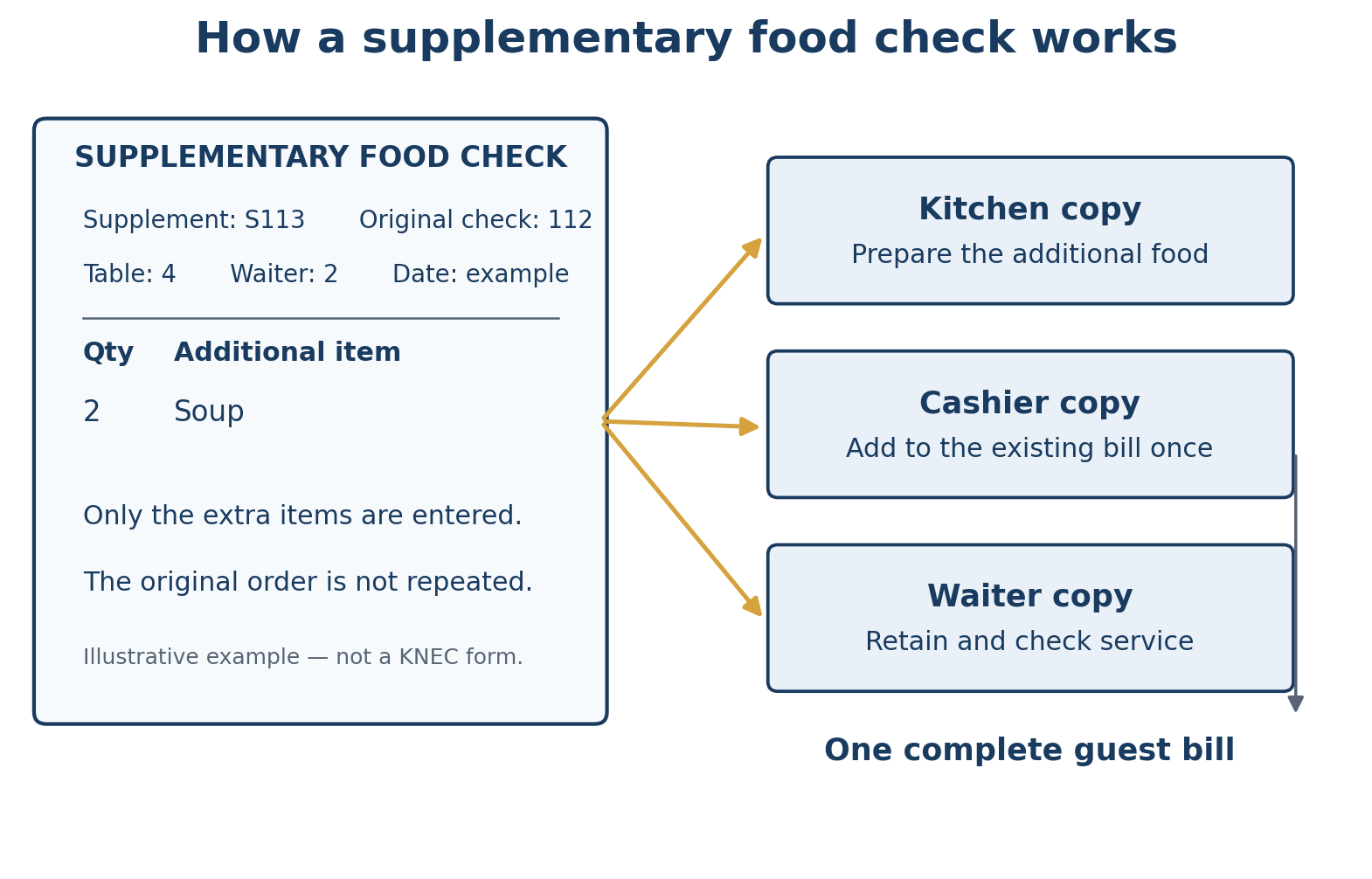
- A guest adds items after the original order has been submitted.
- The waiter writes a separately numbered supplement and records the date, table and waiter number.
- The original check number is written clearly as a cross-reference.
- Only additional quantities and items are listed; the original order is not repeated.
- The production copy goes to the kitchen to prepare the additional food.
- The billing copy goes to the cashier to add the new charges to the existing bill.
- The waiter retains the service copy and checks that the extra items are delivered.
- The cashier reconciles the original and supplementary checks before presenting one complete bill.
The numbers and soup items in the diagram are an illustrative example, not details supplied by KNEC.
Question 4(d)
Answer
- Tea.
- Coffee.
Question 5(a)
Answer
- Accurate production: a written order specifies the drinks, quantities and any guest requirements, reducing mistakes.
- Correct billing: the order provides a record of what should be charged to the guest.
- Stock control: drinks issued can be compared with sales and stock movement to detect loss or unauthorised issues.
- Accountability: numbered orders identify the table and responsible staff and provide an audit trail for reconciliation.
Question 5(b)
Answer
- Fitness for purpose: the material must be food-safe, strong enough and suitable for the food’s temperature and service conditions, such as hot soup or takeaway drinks.
- Overall cost and disposal: consider purchase, storage and waste-handling costs, together with practical disposal or recycling options and environmental requirements.
Question 5(c)
Answer
- Carry and serve drinks or glasses.
- Clear small items of used glassware or crockery.
- Carry small service items such as condiments or side dishes.
- Present a bill and return change or a receipt.
Question 5(d)
Answer
A general market serves the public at large; any customer can normally choose to use the outlet, for example a public restaurant. A restricted market serves a defined group with limited access, such as employees in a staff canteen, students in a school or members of a club.
Question 6(a)
Answer
Examples suitable for this revision question include:
- Interest in health and dietary needs: guests seek lighter choices, clear ingredient information and options for allergies or special diets.
- Convenience and digital service: guests value quick service, online ordering and simple reservation or payment methods.
- Value and personal experiences: guests compare price with quality and expect attentive service and choices suited to their preferences.
- Concern about sustainability and provenance: guests may favour local ingredients, reduced waste and responsible packaging.
These are qualitative examples for the June/July 2023 paper; they are not a statistical claim about today’s market. Explain how each trend changes guest expectations.
Question 6(b)(i)
Answer
Ingredients are poured directly into the serving glass, usually over ice, and gently stirred if needed. The drink is assembled in the glass rather than shaken in a separate shaker.
Question 6(b)(ii)
Answer
Ingredients are poured carefully, often over the back of a spoon, in an order based on their density so they form distinct layers without mixing immediately.
Question 6(b)(iii)
Answer
The drink is poured back and forth between two vessels in a controlled stream. This mixes and aerates it; ice is usually retained in one vessel using a strainer. It is different from shaking or blending.
Question 6(c)
Answer
- Natural cork.
- Synthetic cork.
- Screw cap.
Question 6(d)
Answer
- Triplicate order-check system.
- Duplicate order-check system.
- Electronic point-of-sale (EPOS) ordering and billing system.
Printing and PDF downloads: Coming Soon.