Economics — July 2024
KNEC Craft Certificate in Sales and Marketing — Module II. Paper code: 1902/205
Attempt the questions before reading the answers. These are independent revision answers, not official KNEC marking schemes. All printed questions are answered for revision, including any optional questions.
Answer all Section A questions and any four Section B questions in the examination. All printed questions are answered here for revision.
Question 1
State three types of economic systems.
(3 marks)
Answer
- Market economy.
- Command or centrally planned economy.
- Mixed economy.
Question 2
State the difference between a shift in demand curve and a movement along the demand curve.
(4 marks)
Answer
| Shift in the demand curve | Movement along the demand curve |
|---|---|
| The whole curve moves to a new position because a non-price determinant changes, such as income, tastes or the number of buyers. | The point moves along the same curve because the commodity’s own price changes, other determinants remaining constant. |
| It represents a change in demand at every given price. | It represents a change in quantity demanded. |
Question 3
State four factors that may affect the supply of a commodity at the market.
(4 marks)
Answer
- The cost and availability of production inputs.
- Production technology.
- Taxes and subsidies affecting producers.
- The number of firms supplying the commodity.
Question 4
List three market-based pricing strategies that may be adopted by a firm.
(3 marks)
Answer
- Penetration pricing.
- Price skimming.
- Competitive or going-rate pricing.
Question 5
State three advantages of division of labour to a firm.
(3 marks)
Answer
- Workers develop specialised skills and become more efficient.
- Less time is lost changing from one task to another.
- Specialised tasks make the use of suitable machinery and large-scale production easier.
Question 6
State three ways in which the government may control the operations of markets in an economy.
(3 marks)
Answer
- Using taxes and subsidies to influence production and consumption.
- Applying licensing, quality, safety and competition regulations.
- Setting legally enforceable price controls where such controls are adopted.
Question 7
List three functions of money.
(3 marks)
Answer
- A medium of exchange.
- A unit of account or measure of value.
- A store of value.
Question 8
Highlight three causes of cost-push inflation.
(3 marks)
Answer
- Higher wages without corresponding productivity gains.
- Rising raw-material prices.
- Higher energy and transport costs.
Question 9
List three types of secondary production activities.
(3 marks)
Answer
- Manufacturing.
- Processing.
- Construction.
Question 10
State three reasons that make a government to levy taxes on its citizens.
(3 marks)
Answer
- To finance public services and infrastructure.
- To redistribute income.
- To regulate economic activity or discourage harmful consumption.
Question 11(a)
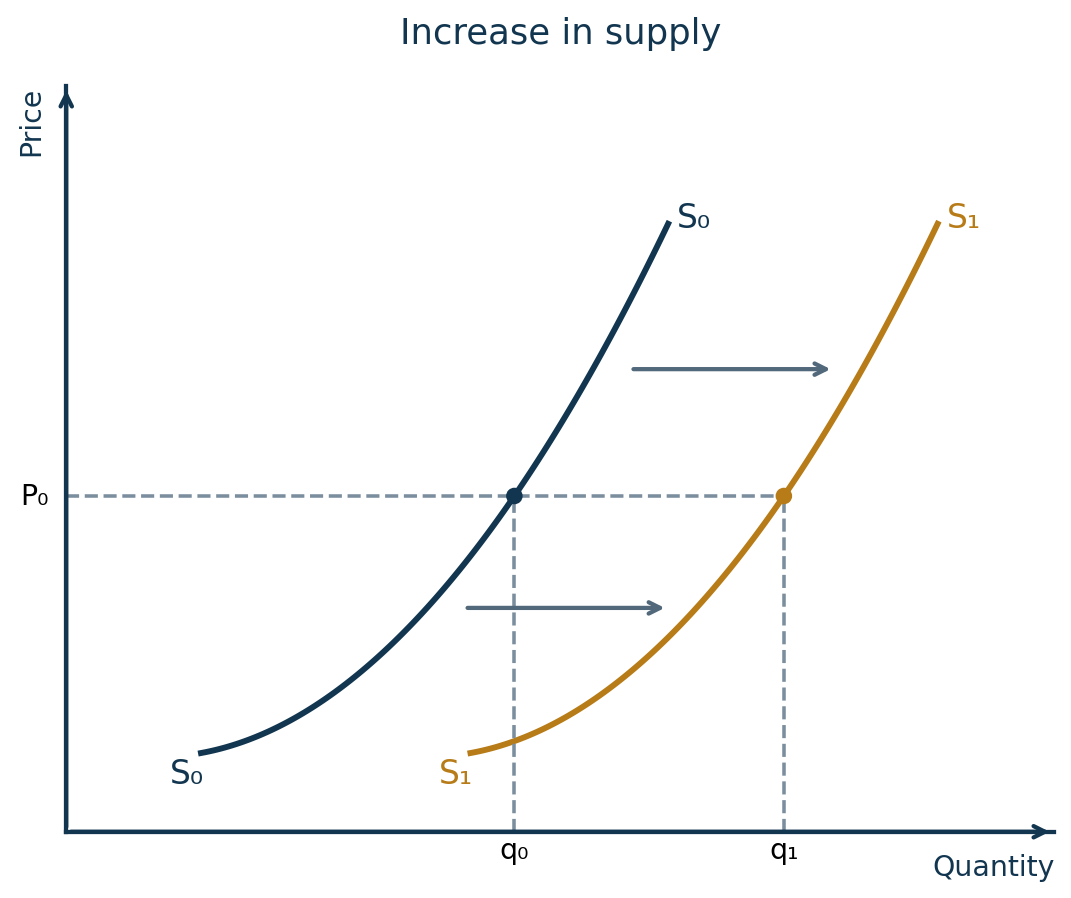
The following graph shows the supply curve of a certain commodity in the market. Highlight six causes of the change from S0S0 to S1S1.
(9 marks)
Answer
- Lower prices of inputs reduce production costs, enabling firms to supply more at each selling price.
- Improved production technology raises efficiency and output from the available resources.
- Production subsidies or lower indirect taxes improve producers’ returns and encourage output.
- Entry of additional firms increases the number of suppliers and total market supply.
- Favourable weather or other production conditions raise output, particularly for agricultural commodities.
- Greater availability or productivity of inputs, such as more reliable power or better-trained workers, allows firms to expand production.
Question 11(b)
Explain four functions of the world bank.
(8 marks)
Answer
- Development financing: provides loans, concessional credits and grants to support projects and programmes such as infrastructure, education and health.
- Policy advice: helps countries design economic and institutional reforms intended to improve development outcomes.
- Technical assistance and capacity building: provides expertise and training to strengthen institutions and help implement development programmes.
- Research and knowledge sharing: produces development data, analysis and lessons that help countries assess needs and make informed policy decisions.
Reference: World Bank, What We Do and Products and Services.
Question 12(a)
Explain six characteristics of human wants.
(9 marks)
Answer
- They are numerous: satisfying some wants creates room for other wants, so all wants cannot be satisfied with limited resources.
- They recur: needs such as food and transport arise repeatedly even after being satisfied on an earlier occasion.
- They vary: wants differ between people and change with income, age, culture, location and time.
- They can be ranked: some wants are more urgent or important than others and receive priority.
- They may be complementary: satisfying one want may require another good, such as a vehicle requiring fuel.
- They may compete or be substituted: limited income forces choices, and alternative goods can sometimes meet a similar need.
Question 12(b)
Explain four measures that may be taken by the government to reduce unemployment in Kenya.
(8 marks)
Answer
- Promote investment and enterprise development so that more businesses can expand and hire workers.
- Provide relevant vocational training and improve links between training institutions and employers to reduce skills mismatches.
- Invest in useful infrastructure and public works that create jobs directly and lower business operating costs.
- Support diversified agricultural and other rural activities to reduce seasonal unemployment and broaden local job opportunities.
Question 13(a)
Explain four undesirable effects of inflation in an economy.
(8 marks)
Answer
- Lower purchasing power: people whose incomes do not rise as quickly as prices can buy fewer goods and services.
- Loss of the real value of savings: cash balances and fixed nominal returns may purchase less as prices rise.
- Planning uncertainty: unstable prices make it harder for households and firms to budget, price products and assess investment returns.
- Reduced external competitiveness: if domestic prices rise faster than those abroad without an offsetting exchange-rate change, exports can become less attractive.
Question 13(b)
Highlight six features of a perfect competition market.
(9 marks)
Answer
- There are many buyers and sellers, each too small to influence the whole market.
- Products sold by competing firms are homogeneous.
- Firms can enter and leave the market freely.
- Buyers and sellers have full information about relevant market conditions.
- Factors of production can move freely between uses.
- Individual firms are price takers, accepting the price determined by market demand and supply.
Question 14(a)
Explain six internal diseconomies of scale that may be encountered by a firm.
(9 marks)
Answer
- Communication difficulties: extra layers and departments can delay or distort messages as the firm grows.
- Coordination problems: a larger range of activities may be harder to schedule and integrate, increasing delays and duplication.
- Bureaucratic delays: more approvals and procedures can slow decisions and increase administrative costs.
- Weaker employee motivation: impersonal relations and narrow responsibilities may reduce commitment and productivity.
- Control and supervision difficulties: managers may struggle to monitor a very large workforce or dispersed operations effectively.
- Internal congestion and technical imbalance: overburdened facilities, bottlenecks or mismatched production stages may raise average costs.
Question 14(b)
Explain four disadvantages of external debt as a source of government revenue.
(8 marks)
Answer
- Debt-service burden: interest and repayments commit future public revenue that could otherwise support services or investment.
- Foreign-exchange risk: depreciation of the domestic currency raises the local-currency cost of repaying foreign-currency debt.
- Policy conditions: lenders may attach conditions that limit the government’s flexibility in choosing policies or spending priorities.
- Refinancing and default risk: reliance on external lenders can expose the government to changes in global interest rates, lender confidence and access to new finance.
Question 15(a)
Using a well labelled diagram, illustrate the circular flow of income in a two seater economy.
(8 marks)
Answer
The printed phrase “two seater” is interpreted as the standard two-sector economy of households and firms.
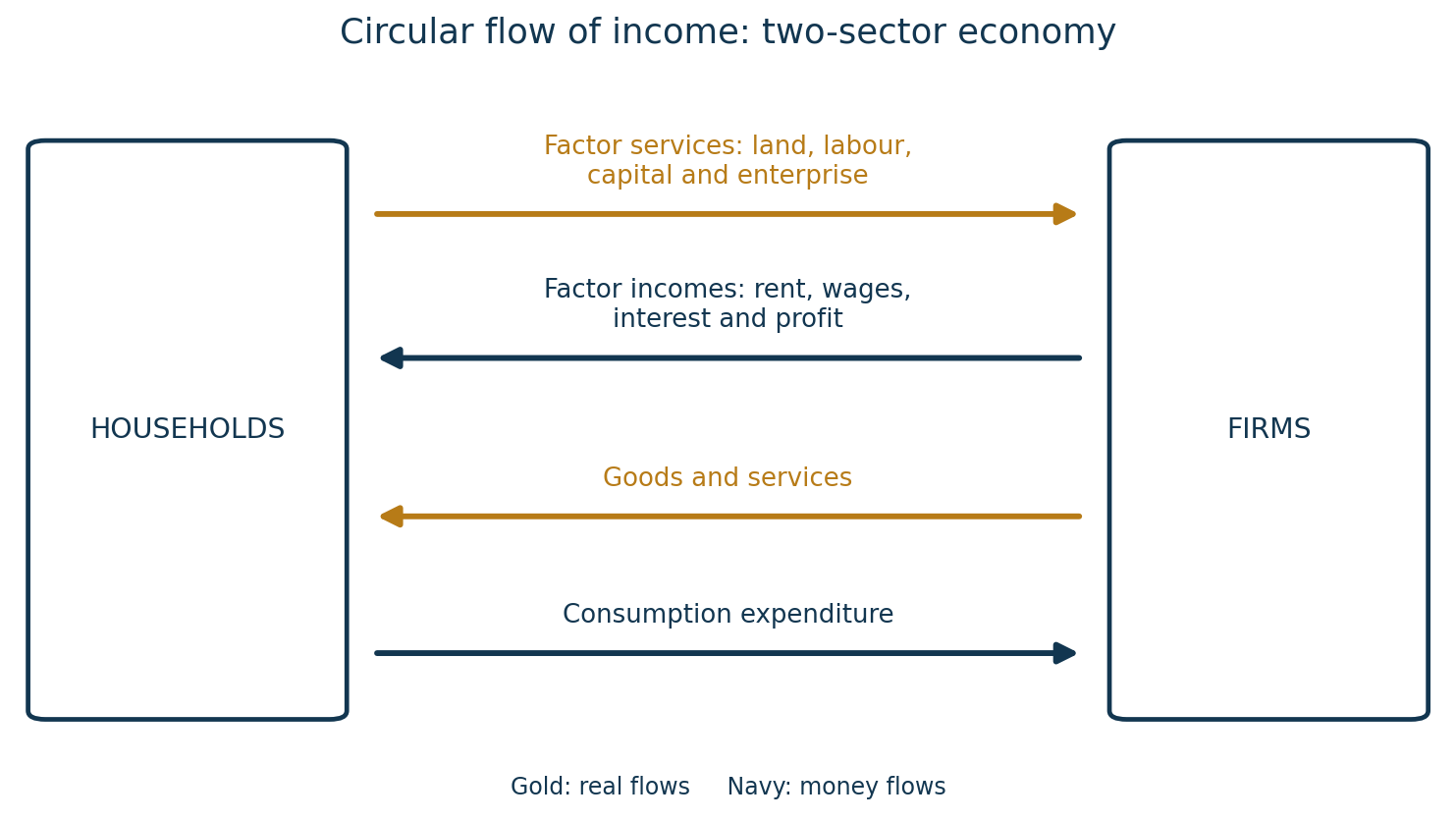
- Households own the factors of production and supply land, labour, capital and enterprise to firms.
- Firms pay factor incomes to households: rent, wages, interest and profit.
- Firms combine the factors to produce goods and services, which flow to households.
- Households spend their income on those goods and services, creating revenue for firms.
In this simple model there is no government, foreign sector, saving or investment. The real flows and money flows move in opposite directions; household income, consumption expenditure and the value of output are equal.
Question 15(b)
The following functions relate to the quantity demanded and quantity supplied of a loaf of bread in a market. Qs = 40 + 2P; Qd = 220 – P. Calculate the: (i) equilibrium price. (ii) quantity demanded at equilibrium. (iii) change in quantity supplied when the price of the loaf of bread is Ksh.65.
(9 marks)
Answer
| Part / step | Working | Answer |
|---|---|---|
| (i) Equilibrium condition | Qs = Qd, so 40 + 2P = 220 – P | Demand equals supply |
| Collect the price terms | 2P + P = 220 – 40 | 3P = 180 |
| Solve for price | P = 180 ÷ 3 | KSh 60 per loaf |
| (ii) Equilibrium quantity demanded | Qd = 220 – 60 | 160 loaves |
| Check using the supply function | Qs = 40 + 2(60) = 40 + 120 | 160 loaves |
| (iii) New supply at KSh 65 | Qs = 40 + 2(65) = 40 + 130 | 170 loaves |
| Change from equilibrium supply | ΔQs = 170 – 160 | An increase of 10 loaves |
For part (iii), the change is measured from the equilibrium position found in parts (i) and (ii). A KSh 5 price increase raises supply by 2 × 5 = 10 loaves.