Economics — November 2024
KNEC Craft Certificate in Sales and Marketing — Module II. Paper code: 1902/205
Attempt the questions before reading the answers. These are independent revision answers, not official KNEC marking schemes. All printed questions are answered for revision, including any optional questions.
Answer all Section A questions and any four Section B questions in the examination. The supplied scan places printed pages 2 and 3 side by side; all questions on both pages are included.
Question 1
State three approaches adopted in the measurement of national income.
(3 marks)
Answer
- The output or value-added approach.
- The income approach.
- The expenditure approach.
Question 2
List four types of demand.
(4 marks)
Answer
- Joint demand.
- Derived demand.
- Competitive demand.
- Composite demand.
Question 3
State three reasons that make it necessary for a producer to locate a firm near a market.
(3 marks)
Answer
- To reduce the cost of transporting finished goods to customers.
- To deliver perishable, bulky or urgent goods quickly.
- To maintain close contact with buyers and respond promptly to their requirements.
Question 4
Name three occupations at the extraction level of production.
(3 marks)
Answer
- Mining.
- Fishing.
- Logging or forestry.
Question 5
State three characteristics of an oligopolistic market structure.
(3 marks)
Answer
- A small number of large firms dominate the market.
- Firms’ decisions are interdependent because each responds to its rivals.
- Significant entry barriers restrict new competitors.
Question 6
State three factors that may influence the amount of money held by an individual for precautionary motive.
(3 marks)
Answer
- The person’s income and ability to maintain a cash reserve.
- The degree of uncertainty about future income and emergency expenses.
- Access to insurance, credit or other funds when an emergency occurs.
Question 7
State three negative effects of inflation in an economy.
(3 marks)
Answer
- It reduces purchasing power when incomes lag behind prices.
- It reduces the real value of cash savings and fixed nominal incomes.
- It creates uncertainty in budgeting and investment decisions.
Question 8
Name two theories of international trade.
(2 marks)
Answer
- The theory of absolute advantage.
- The theory of comparative advantage.
Question 9
State four types of unemployment in a country.
(4 marks)
Answer
- Frictional unemployment.
- Structural unemployment.
- Seasonal unemployment.
- Cyclical or demand-deficient unemployment.
Question 10
State four causes of a shift in the supply curve to the right.
(4 marks)
Answer
- Lower input costs.
- Improved production technology.
- Increased production subsidies or lower indirect taxes.
- An increase in the number of producers.
Question 11(a)
Outline four features of the market economic system.
(8 marks)
Answer
- Private ownership of most productive resources and enterprises.
- Resource allocation is guided mainly by prices determined through demand and supply.
- Consumers and producers have substantial freedom of choice and enterprise.
- Profit incentives and competition influence production and business decisions.
Question 11(b)
Explain six factors that determine price elasticity of demand for a product.
(9 marks)
Answer
- Availability of substitutes: demand is usually more elastic when buyers can easily switch to close alternatives.
- Necessity or luxury: demand for essential goods tends to be less elastic than demand for discretionary luxuries.
- Share of income spent: a price change matters more when the product takes a large part of the consumer’s budget.
- Adjustment time: consumers usually have more opportunity to change habits or find alternatives over a longer period.
- Habit or addiction: strongly habitual consumption can make demand less responsive to price changes.
- Number of uses: a product with several uses may have more elastic demand because some uses are dropped as its price rises.
Question 12(a)
With the aid of a diagram, illustrate the effect of an increase in supply on the equilibrium position of a firm.
(8 marks)
Answer
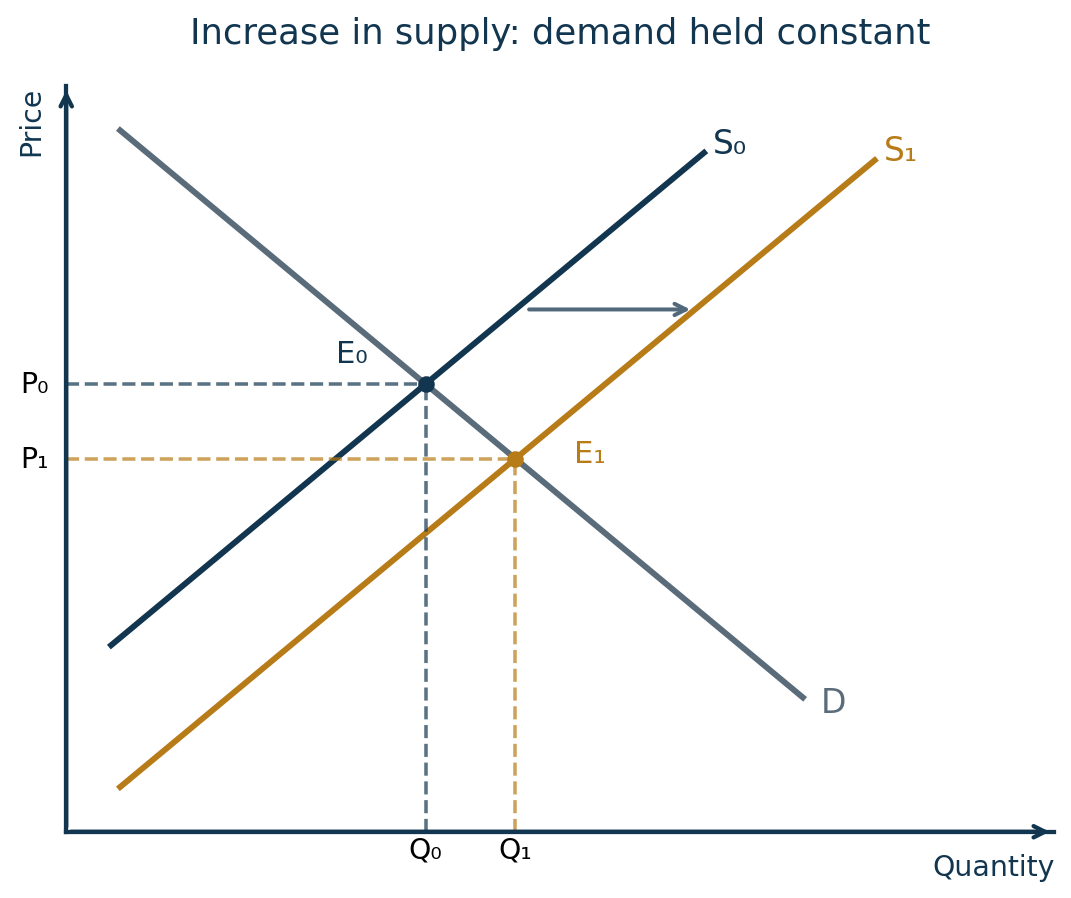
- Initially, demand D intersects supply S0 at E0, giving equilibrium price P0 and quantity Q0.
- An increase in supply shifts the supply curve rightwards from S0 to S1 while demand remains unchanged.
- At the old price P0, the greater supply creates excess supply, putting downward pressure on price.
- The new equilibrium is E1, with a lower price P1 and a higher quantity Q1.
The illustration uses the commodity’s market demand and supply curves, holding the other determinants of demand constant.
Question 12(b)
Explain six ways in which the information on national income is important in a country.
(9 marks)
Answer
- Measuring economic performance: real national-income trends show whether total production is growing or declining.
- Planning resource allocation: information about sector contributions helps identify areas needing infrastructure or investment.
- Formulating policy: income and expenditure data help government assess demand conditions and design fiscal or other economic policies.
- Assessing average living standards: real income per person provides a broad indicator, used alongside health, education and distribution data.
- Making international comparisons: appropriately adjusted figures help compare economic size and income levels across countries.
- Supporting business decisions: trends in income and spending help firms forecast markets and evaluate investment opportunities.
Question 13(a)
Explain four barriers to geographical mobility of labour in a country.
(8 marks)
Answer
- Relocation and housing costs: workers may be unable to afford travel, deposits or suitable accommodation in another area.
- Family and social ties: caring responsibilities, a spouse’s employment or children’s schooling may discourage relocation.
- Lack of information: workers may not know about vacancies, wages or living conditions in other regions.
- Language and cultural differences: difficulty communicating or adapting to unfamiliar communities may deter movement.
Question 13(b)
The government of country X recently raised the tax rates. Highlight six reasons that may account for this move.
(9 marks)
Answer
- To raise additional revenue for public services and infrastructure.
- To reduce a budget deficit and reliance on further borrowing.
- To reduce disposable income and restrain excessive demand or inflation.
- To redistribute income through a more progressive tax burden.
- To discourage consumption of harmful or socially costly products.
- To protect domestic producers where the increase applies to import duties on competing goods.
Question 14(a)
Explain four challenges that a country may face as a result of increased importation of goods.
(8 marks)
Answer
- Foreign-exchange pressure: a rising import bill can worsen the trade balance and strain foreign-exchange resources where export receipts do not keep pace.
- Pressure on domestic firms: competing imports may displace local output and employment when local producers cannot compete.
- Dependence on foreign suppliers: reliance on imported essentials increases exposure to shortages, transport disruptions or restrictions abroad.
- Imported inflation: higher world prices or domestic-currency depreciation can raise the cost of imported goods and production inputs.
Question 14(b)
Explain six reasons that make it necessary for the government to formulate development plans in a country.
(9 marks)
Answer
- Set priorities: plans identify the most important needs and objectives to be addressed with limited resources.
- Coordinate activities: ministries, regions and development partners can align their work and avoid conflicting or duplicated projects.
- Set targets and monitor progress: clear milestones make it possible to assess performance and correct delays.
- Provide essential public goods: plans guide investment in infrastructure and services that private markets may underprovide.
- Promote balanced and inclusive development: targeted programmes can address regional disparities, poverty and unequal access to services.
- Mobilise and budget resources: a plan helps determine financing, skills and material needs and organise them over time.
Question 15(a)
The population of country P has been rising in the past few years. Explain four benefits that the country may derive from this trend.
(8 marks)
Answer
Potential benefits depend on productive employment, skills and adequate supporting services:
- A larger labour force can increase the supply of workers and expand productive capacity as the population enters working age.
- A larger consumer market can support increased demand, business expansion and economies of scale.
- A wider pool of skills and ideas can encourage innovation and entrepreneurship when people have access to education and opportunities.
- A larger employed and productive population can broaden the tax base and help finance public services.
Question 15(b)
Outline six functions of commercial banks in a country.
(9 marks)
Answer
- Accept deposits through suitable current, savings and fixed-deposit accounts.
- Provide credit through loans, overdrafts and other lending facilities.
- Facilitate payments and transfers between customers and other recipients.
- Provide foreign-exchange services and support international payments.
- Offer safe custody for valuables or important documents where that service is available.
- Provide agency services, such as collecting dividends or making authorised payments on a customer’s behalf.