Economics — March/April 2023
KNEC Craft Certificate in Sales and Marketing — Module II. Paper code: 1902/205
Attempt the questions before reading the answers. These are independent revision answers, not official KNEC marking schemes. All printed questions are answered for revision, including any optional questions.
Section A: answer all questions (32 marks). Section B: answer any four questions (68 marks). All five Section B questions are answered here for revision.
Question 1
Name three types of economic systems.
(3 marks)
Answer
- Market or capitalist economy.
- Command or centrally planned economy.
- Mixed economy.
Question 2
State three conditions that are necessary for a monopolist to practice price discrimination.
(3 marks)
Answer
- The seller has enough market power to set different prices.
- The customer groups have different price elasticities of demand.
- The markets can be kept separate and resale between them prevented or restricted.
Question 3
List two types of demand.
(2 marks)
Answer
- Joint demand: goods are required together, such as a printer and compatible ink.
- Derived demand: an input is demanded because of demand for the final product it helps produce.
Question 4
State four goals of economic development in a country.
(4 marks)
Answer
- Raise living standards.
- Reduce unemployment.
- Reduce poverty and income inequality.
- Promote balanced development across regions.
Question 5
Give four reasons why government imposes tax on its citizens.
(4 marks)
Answer
- To raise revenue for public services and infrastructure.
- To redistribute income and reduce excessive inequality.
- To regulate economic activity, including demand and inflation.
- To discourage consumption or production of harmful goods.
Question 6
List three injections to the circular flow of national income.
(3 marks)
Answer
- Investment expenditure.
- Government expenditure.
- Export receipts.
Question 7
Name three types of non-banking financial institutions operating in Kenya.
(3 marks)
Answer
- Insurance companies.
- Pension funds.
- Savings and credit cooperative societies (SACCOs).
Question 8
State three types of production costs.
(3 marks)
Answer
- Fixed costs.
- Variable costs.
- Total costs.
Question 9
List three occupations at the primary level of production.
(3 marks)
Answer
- Farming.
- Fishing.
- Mining.
Question 10
State four causes of cost-push inflation in a country.
(4 marks)
Answer
- Rising wages without a matching increase in productivity.
- Higher prices of raw materials.
- Higher fuel, electricity or transport costs.
- Increased indirect taxes or reduced production subsidies.
Question 11(a)
Highlight four circumstances under which the price elasticity of supply may be high.
(8 marks)
Answer
- Spare production capacity is available, so firms can increase output quickly when prices rise.
- Goods can be stored and substantial stocks are available for release to the market.
- Labour, raw materials and other inputs are readily available and can move into the industry.
- Producers have a sufficiently long adjustment period to expand plant or adopt new production methods.
Question 11(b)
Explain six challenges that may be associated with delocalization of firms in a country.
(9 marks)
Answer
- High initial infrastructure costs: new locations may need roads, power, water and communications before firms can operate effectively.
- Shortages of skilled labour: suitable workers may be concentrated in established industrial centres, making recruitment and training difficult.
- Higher transport costs: dispersed sites may be far from suppliers or customers, increasing the cost and time of moving goods.
- Limited local markets: demand around the new location may be too small to support the firm’s intended scale of operations.
- Loss of supporting services: specialised repair firms, financial services and other suppliers may be less accessible than in an industrial cluster.
- Employee relocation difficulties: workers may resist moving because of housing, schooling, family or other personal commitments.
Question 12(a)
Outline four features that make labour unique as a factor of production.
(8 marks)
Answer
- It is human: workers have feelings, preferences and social needs that influence their performance.
- It is inseparable from its owner: employing labour means engaging a person’s services, rather than buying the person.
- It is perishable: labour time that is not used today cannot be stored for sale tomorrow.
- It is heterogeneous: workers differ in education, skills, experience, health and productivity.
Question 12(b)
Explain six challenges of the indirect tax system in a country.
(9 marks)
Answer
- Regressive effects: a tax on essential consumption can take a larger proportion of a low-income household’s income.
- Higher consumer prices: firms may pass the tax to buyers, raising living costs and reducing purchasing power.
- Uncertain revenue: collections depend on purchases and imports, which can change with economic conditions.
- Administrative and compliance costs: businesses must maintain records, file returns and account for taxes, while authorities must enforce compliance.
- Smuggling and evasion: large differences between taxed and untaxed prices can encourage illegal trade or under-reporting.
- Distorted spending and production: taxes may divert consumers and producers towards less suitable substitutes or reduce output in heavily taxed industries.
Question 13(a)
Highlight four measures that the government may take to reduce the volume of imports in a country.
(8 marks)
Answer
- Impose import tariffs that make selected imported goods more expensive relative to domestic alternatives.
- Use import quotas or licensing to restrict the quantity of selected goods entering the country.
- Support competitive domestic production of goods that can substitute for imports.
- Reduce unnecessary public-sector imports and encourage procurement of suitable locally produced goods.
Question 13(b)
Explain six factors that may hinder effective measurement of national income of a country.
(9 marks)
Answer
- Incomplete records: households and businesses may lack accurate accounts, leaving gaps in output and income data.
- Non-market production: subsistence output and unpaid household services are difficult to value consistently because they have no recorded sale price.
- Double counting: including both intermediate goods and the final goods made from them overstates total output.
- Estimating depreciation and inventories: uncertain asset wear, stock values and changes in stocks make the required adjustments difficult.
- Changes in prices: inflation can make money-value increases appear to be real output growth unless suitable price adjustments are made.
- Unrecorded economic activities: informal or concealed transactions can escape official surveys and tax records, understating measured income.
Question 14(a)
The diagram below illustrates a shift in demand from d1 d1 to d2 d2. Explain six factors that may have caused such a shift.
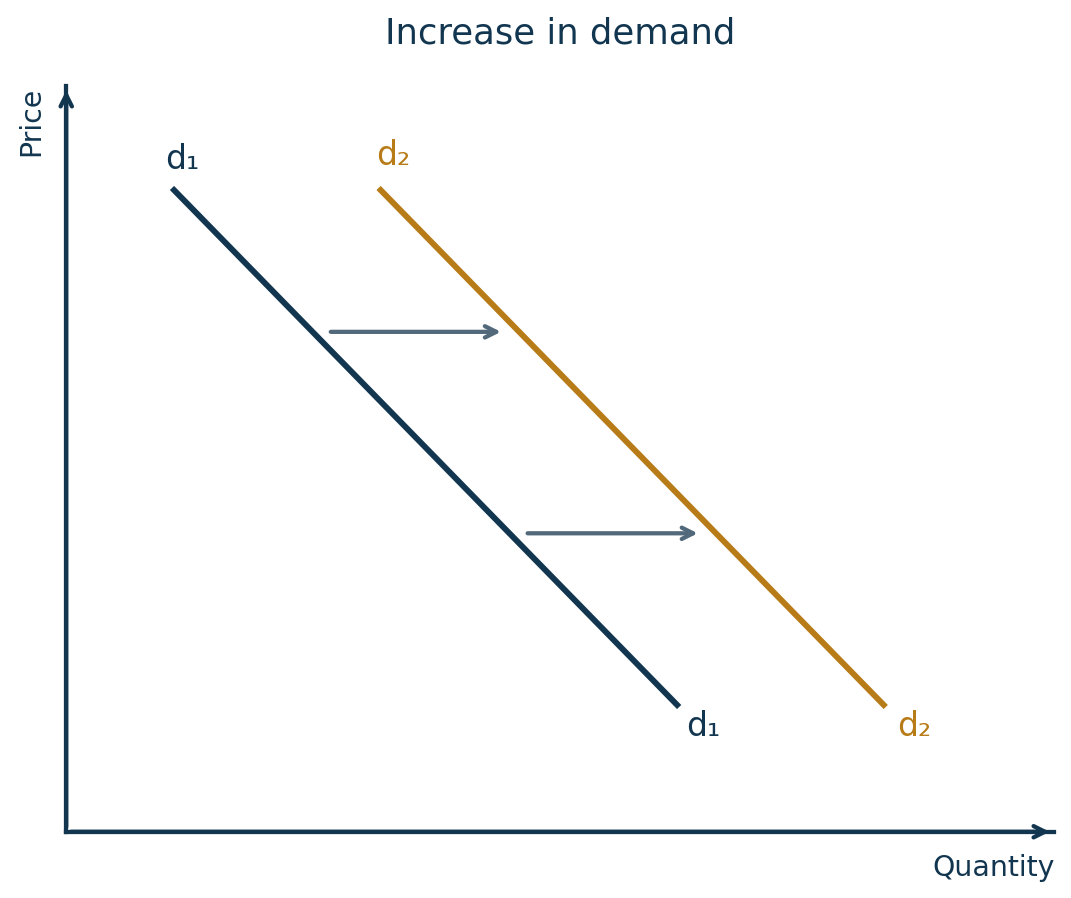
(9 marks)
Answer
- Higher consumer incomes, where the commodity is a normal good, increase the quantity buyers are willing and able to purchase at each price.
- A rise in the price of a substitute makes the commodity relatively more attractive and increases its demand.
- A fall in the price of a complementary good encourages purchases of both goods.
- More favourable tastes, fashion or successful promotion increase consumers’ willingness to buy the commodity.
- An increase in the number of buyers, such as through population growth, raises market demand.
- An expectation of a future price rise or shortage encourages consumers to buy more of the commodity now.
Question 14(b)
Outline four m-banking services that may be enjoyed by customers.
(8 marks)
Answer
- Checking account balances and obtaining recent transaction information through a phone.
- Transferring money between bank accounts or to other authorised recipients.
- Paying bills or making payments to merchants through mobile banking.
- Requesting withdrawals or deposits through an authorised mobile-linked banking service or agent.
Question 15(a)
Highlight six disadvantages of high population growth rate in an economy.
(9 marks)
Answer
- High dependency burdens can reduce household savings when many dependants must be supported by relatively few earners.
- Demand for jobs may rise faster than employment opportunities, increasing unemployment and underemployment.
- Schools, hospitals, housing, water and other services may become overcrowded or inadequate.
- Pressure on land and natural resources can encourage overuse and environmental degradation.
- Food and other essential supplies may fail to keep pace with demand, increasing shortages and import needs.
- Public resources may be diverted towards immediate consumption and basic services, leaving less for productive investment.
Question 15(b)
Explain four positive effects of inflation in a country.
(8 marks)
Answer
Possible benefits of moderate inflation depend on economic conditions:
- Production and employment may increase when selling prices rise faster than some costs and firms have unused capacity, improving expected returns from additional output.
- Investment may be encouraged when firms expect growing demand and sufficient future revenues to justify expanding productive capacity.
- Borrowers with fixed nominal debts may repay them in money with lower purchasing power, reducing the real debt burden when inflation is higher than anticipated.
- Nominal tax receipts may rise as money incomes, profits and spending increase, giving government more cash revenue, although its real purchasing power also depends on rising costs.