Tourism Economics — July 2022
Paper code: 2912/201
Independent revision answers prepared from the supplied paper. These are not an official KNEC marking scheme.
Question 1(a)
Tabere Tours and Travel Limited ensures that each employee specializes in one task in its operations. Explain five benefits that may accrue to the firm from the specialization. (10 marks)
Answer
- Greater skill: repeating a task helps an employee master the work and perform it accurately.
- Higher productivity: experienced employees complete their specialised tasks more quickly, increasing output per worker.
- Time saving: employees spend less time changing tools, workstations or activities.
- Better use of aptitude: the firm can assign tasks according to employees’ abilities, improving the quality of service.
- Easier training and mechanisation: a well-defined task is easier to teach and may justify specialised equipment that lowers unit costs.
Question 1(b)
Explain five economic factors that may influence consumer buying behaviour of tourism products in an economy. (10 marks)
Answer
- Disposable income: higher income after tax usually increases the amount households can spend on holidays and leisure.
- Prices of tourism products: higher fares, accommodation charges or package prices reduce purchasing power and can reduce demand.
- Prices of related products: the price of a competing destination or complementary service can change the attractiveness and total cost of a trip.
- Interest rates and access to credit: expensive borrowing or limited credit can discourage expenditure on travel.
- Exchange rates: appreciation of a traveller’s currency can make foreign travel cheaper, while depreciation raises its domestic-currency cost.
Question 2(a)
Ms. Joan Smith intends to set up a tourist lodge in Kenya. Explain five factors that may be considered in determining the location of such a facility. (10 marks)
Answer
- Proximity to attractions and target markets: a location near the experiences visitors want can support demand and reduce transfer time.
- Accessibility: suitable roads, air connections and signs make it easier for guests, employees and suppliers to reach the lodge.
- Availability of services and inputs: water, power, communications, labour and food supplies affect operating reliability and cost.
- Land and development costs: acquisition or lease costs, terrain and construction requirements determine whether the project is affordable.
- Environmental, planning and safety conditions: the site must be suitable for sustainable development, meet applicable permissions and avoid unacceptable hazards.
Question 2(b)
With the aid of a diagram, explain the way in which a monopolist touring firm determines the equilibrium price of its products. (10 marks)
Answer
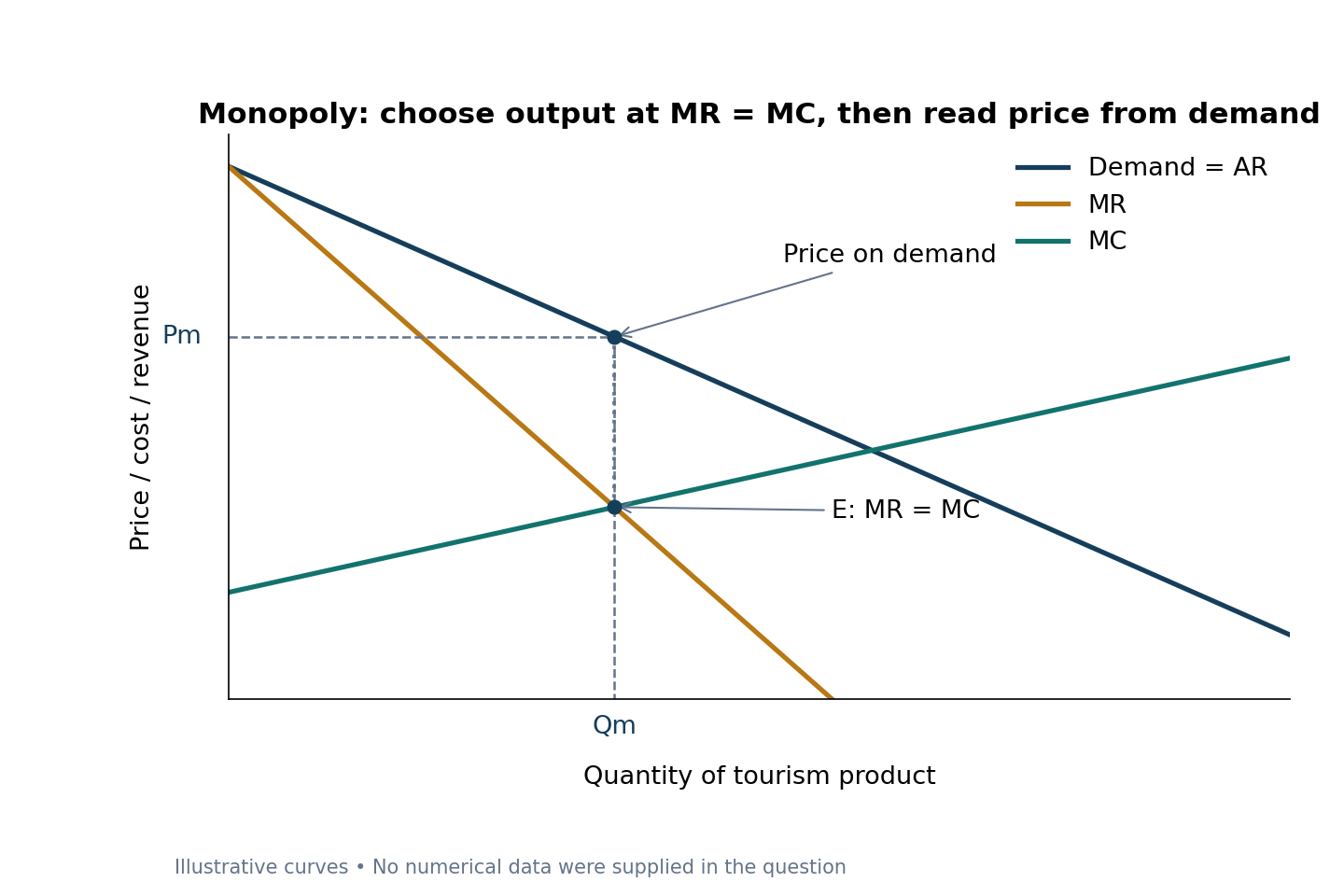
- The monopolist faces the market demand curve, also called average revenue (AR). To sell more units it normally has to lower price, so marginal revenue (MR) lies below AR.
- It chooses output Qm where MR equals marginal cost (MC), with MC crossing MR from below. Producing additional units beyond this point would add more cost than revenue.
- From Qm, move vertically to the demand curve. The corresponding height on the price axis is Pm, the maximum market price at which that output can be sold.
- The MR–MC intersection determines output; its height is not the selling price. Price is read from AR at the selected output.
- Profit depends on average total cost at Qm. Monopoly power alone does not prove that the firm earns a profit.
Question 3(a)
There has been a rapid increase in prices of tourism products in a certain country in the recent past. Explain five factors that may have contributed to this trend. (10 marks)
Answer
- Demand rising faster than capacity: a surge in visitors competing for limited rooms, vehicles or seats allows prices to rise.
- Higher input costs: increases in fuel, food, wages or electricity raise the cost of supplying tourism services.
- Currency depreciation: imported equipment, fuel and supplies become more expensive in domestic currency.
- Higher taxes or service charges: additional costs imposed on suppliers may be passed on to customers.
- Supply disruption: extreme weather, insecurity or closure of facilities can reduce available capacity and raise prices for remaining services.
Question 3(b)
Explain five ways in which the tourism sector may contribute to the economic development of a country. (10 marks)
Answer
- Creates direct and indirect employment, raising household incomes and reducing unemployment.
- Earns foreign exchange from international visitor spending, supporting external payments.
- Generates tax and other public revenue that can finance infrastructure and social services.
- Stimulates related industries such as agriculture, construction, handicrafts and transport through supplier linkages.
- Encourages investment and regional infrastructure development, bringing business opportunities to areas with visitor attractions.
Question 4(a)
Explain five services offered by commercial banks that aid in the development of tourism products in a country. (10 marks)
Answer
- Loans and overdrafts provide capital for facilities, equipment and working-capital requirements.
- Deposit and savings accounts keep business receipts secure and help firms accumulate investment funds.
- Payment and collection services enable customers and tourism firms to settle transactions efficiently.
- Foreign-exchange services help firms receive international payments and pay overseas suppliers.
- Trade-finance and guarantee services, such as letters of credit or performance guarantees, can support equipment purchases and commercial contracts.
Question 4(b)
Safari Limited has recently expanded one of its camp site to increase its capacity. Explain five diseconomies of scale that may arise from such expansion. (10 marks)
Answer
- Coordination difficulties: more departments, staff and facilities make scheduling and communication harder, increasing administrative costs.
- Management overload: managers may lose close control of daily operations, leading to slower decisions and inefficiency.
- Reduced employee motivation: a larger impersonal organisation may weaken teamwork and increase supervision and turnover costs.
- Congestion and resource pressure: overstretched water, sanitation, kitchens or access routes can cause delays and higher maintenance costs.
- Declining service consistency: serving more guests can produce errors and complaints, increasing corrective costs and reducing productivity.
Question 5(a)
Explain five economic characteristics of tourism products. (10 marks)
Answer
- Intangibility: many benefits are experiences that cannot be physically inspected before purchase, making information and reputation important.
- Perishability: an unsold room-night or empty tour seat cannot be stored and sold for the same date later.
- Inseparability: many services are produced and consumed together, so guests must be present and staff performance directly affects the experience.
- Variability: quality can differ with the provider, employee, time and circumstances, making standardisation difficult.
- Composite nature and complementarity: the visitor’s trip combines transport, accommodation, attractions and other services; weakness or price changes in one component affect the overall product.
Question 5(b)
Explain five factors that may influence the elasticity of demand of tourism products in an economy. (10 marks)
Answer
- Availability of substitutes: demand is more price elastic when travellers can easily choose other destinations or activities.
- Necessity or luxury: discretionary leisure trips usually respond more strongly to price than essential travel.
- Share of the travel budget: a product taking a large share of expenditure tends to receive more price-sensitive scrutiny.
- Time available to adjust: travellers can usually change destinations or plans more easily in the longer run.
- Definition and differentiation of the product: demand for one hotel or operator can be more elastic than demand for tourism as a whole, especially when competing suppliers offer similar experiences.
Question 6(a)
With the aid of a diagram, explain how a consumer maximises satisfaction from a given expenditure on two goods, using indifference curve analysis. (10 marks)
Answer
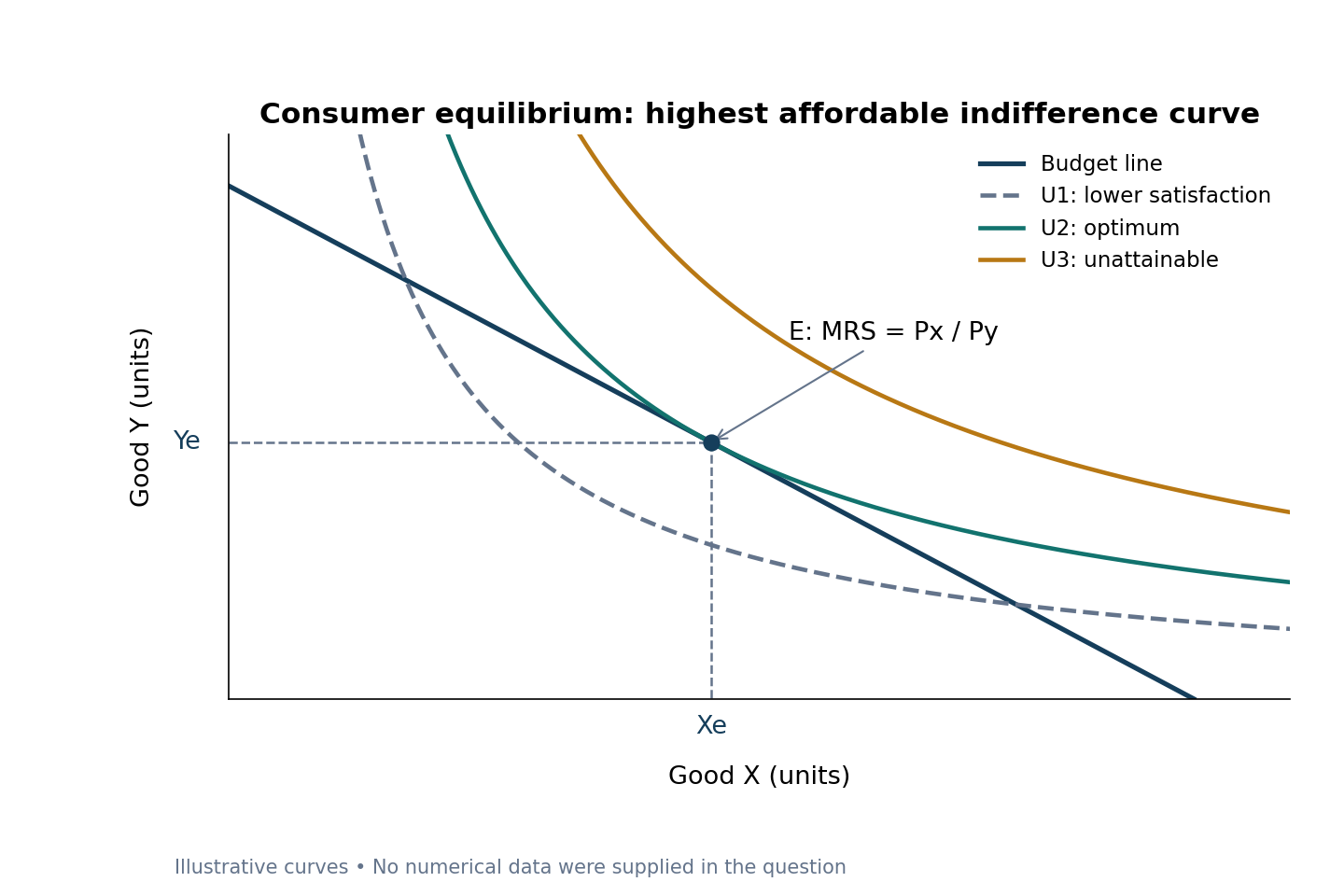
- The budget line shows combinations of goods X and Y that exhaust the available income: Px × X + Py × Y = M.
- Each indifference curve shows combinations giving the consumer the same satisfaction. Higher curves represent greater satisfaction under the usual assumption that more is preferred to less.
- The consumer selects E, on the highest indifference curve attainable within the budget. A higher curve lies outside purchasing power.
- At an interior optimum, the curve is tangent to the budget line: MRSxy = Px / Py, or MUx / Px = MUy / Py.
- At E the willingness to exchange one good for the other matches their market price ratio. Moving along the budget line away from E lowers satisfaction. A corner optimum is possible when these interior conditions do not hold.
Question 6(b)
Explain five characteristics of money. (10 marks)
Answer
- General acceptability: people are willing to accept it in exchange for goods and in settlement of debts.
- Durability: it withstands repeated use without rapidly deteriorating.
- Portability: it can be carried or transferred conveniently relative to the value represented.
- Divisibility: it can be divided into smaller denominations to make transactions of different sizes.
- Relative stability of value: reasonably predictable purchasing power makes it useful for pricing, saving and deferred payments.
Question 7(a)
Explain five challenges that may be encountered by tours and travel companies while seeking finance from a financial institution for their operations. (10 marks)
Answer
- Insufficient acceptable collateral may prevent the company from satisfying the lender’s security requirements.
- High interest and transaction charges may make the proposed borrowing unaffordable.
- Seasonal or unpredictable cash flows can make it difficult to demonstrate reliable loan repayments.
- Incomplete accounts, weak business plans or limited credit history may prevent the lender from assessing the business confidently.
- Lengthy appraisal procedures and restrictive lending conditions may delay access to funds or limit how they can be used.
Question 7(b)
With the aid of a diagram, explain the effect of an increase in supply of tourist products on the price, if the demand of the products remains constant. (10 marks)
Answer
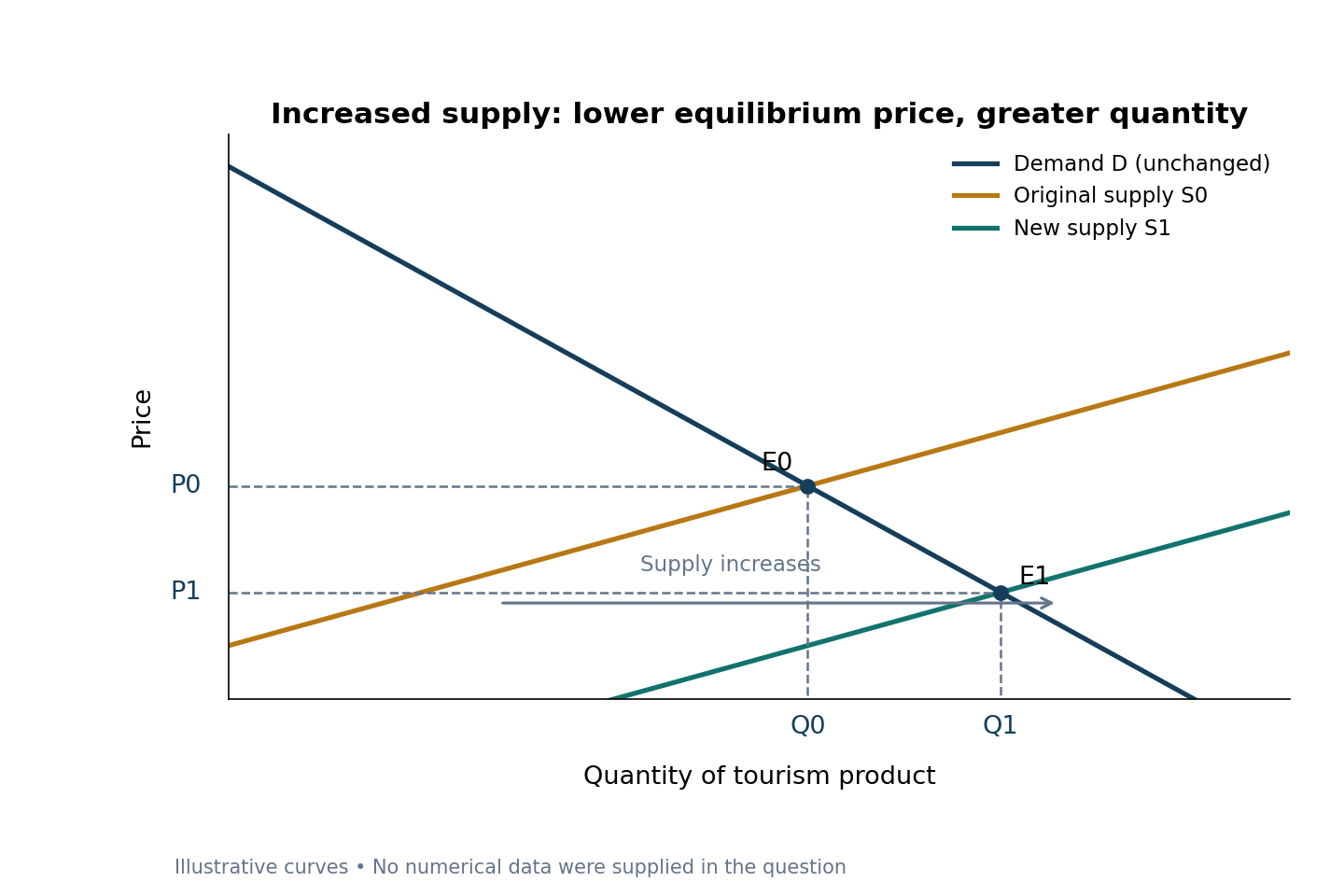
- Initially demand D intersects supply S0 at E0, giving price P0 and quantity Q0.
- An increase in supply means suppliers offer more at every given price, shifting the curve right to S1.
- At the original price P0, quantity supplied now exceeds quantity demanded, creating downward pressure on price.
- As price falls, consumers buy more and suppliers move along the new supply curve until the excess supply disappears.
- The new equilibrium E1 has a lower price P1 and a higher quantity Q1, assuming ordinary upward-sloping supply and downward-sloping demand.