Power Production Systems — March/April 2024
KNEC Diploma in Mechanical Engineering — Module III. Paper code: 2502/305. Time: 3 hours.
These independent revision answers are not official KNEC marking schemes. Attempt each question before reading its answer. All optional questions are included for study.
Plant option. Answer FIVE of the SEVEN questions. Each whole question carries 20 marks.
Pressures are treated as absolute for steam-table calculations. Water enthalpy is approximated by 4.18T kJ/kg and the given steam cp is used where specified. Boiler procedures are examination outlines, not instructions for operating unidentified equipment.
Question 1(a)
(i) State four advantages of fire tube boilers over water tube boilers. (ii) With the aid of a diagram, describe the operation of a fire tube boiler.
(11 marks)
Answer
- Simpler construction for many small and medium steam duties.
- Lower initial cost at comparable modest pressure and capacity.
- Large water content provides thermal storage that can buffer short load fluctuations.
- Generally less demanding feedwater control and simpler operation at modest duties, although proper water treatment remains essential.
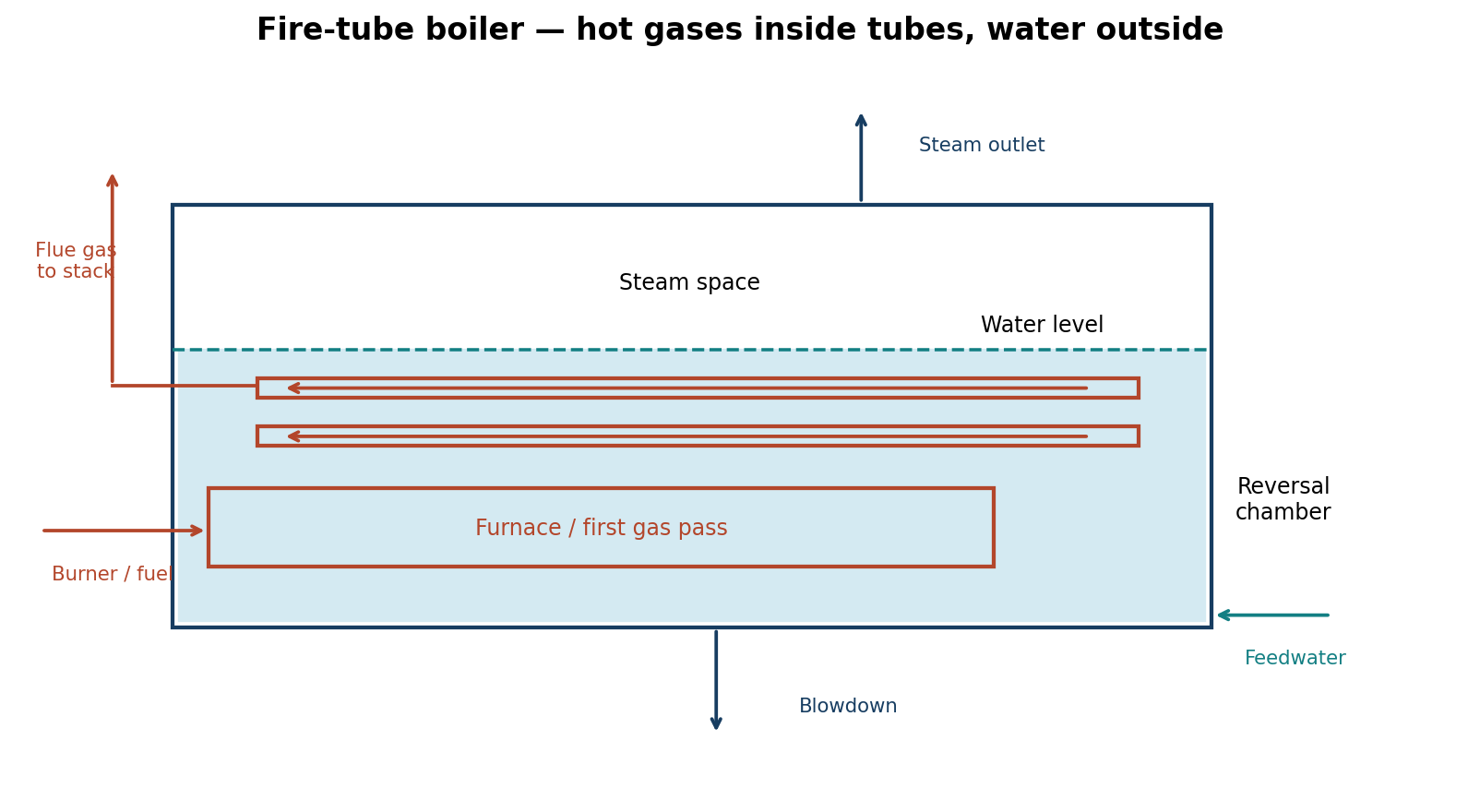
Fuel burns with air in the furnace. Hot gases travel through the furnace and return tubes before leaving through the flue. Heat passes through the tube walls to the surrounding water, producing steam that collects above the water level and leaves through the steam outlet. Feedwater replaces the water evaporated; controls maintain water level and pressure, while safety valves limit overpressure.
Question 1(b)
In a boiler trial 250 kg of coal of calorific value 29800 kJ/kg was used. 2000 kg of water was evaporated at a steam pressure of 11 bar, dryness fraction 0.95 and feed water temperature of 34°C. Determine the: (i) equivalent evaporation “from and at 100°C” per kg of coal; (ii) efficiency of the boiler.
(9 marks)
Answer
| Step | Working / result |
|---|---|
| Assumptions | 11 bar absolute; hfeed ≈ 4.18 × 34 = 142.12 kJ/kg. |
| Properties at 11 bar | hf = 781.198, hfg = 1999.469 kJ/kg. |
| Wet-steam enthalpy | h = hf + 0.95hfg = 2680.694 kJ/kg. |
| Heat absorbed per kg steam | h − hfeed = 2538.574 kJ/kg. |
| Equivalent evaporation | (2000/250)(h − 142.12)/2257 = 8.998 kg/kg coal. |
| Boiler efficiency | η = 2000(h − 142.12)/(250 × 29800) = 68.15%. |
Question 2(a)
Outline the procedure of laying up a boiler under the following methods: (i) wet storage; (ii) dry storage.
(8 marks)
Answer
| Method | Outline |
|---|---|
| Wet storage | After shutdown and cleaning, fill with appropriately treated, oxygen-controlled water under the approved preservation programme; exclude air and monitor the specified water chemistry. Suitable arrangements depend on expected storage duration and freezing risk. |
| Dry storage | After shutdown and cleaning, drain completely and dry the internal surfaces. Maintain a dry sealed environment using the specified desiccant or dry-air arrangement; inspect and renew protection periodically. Remove preservation materials and inspect before recommissioning. |
Question 2(b)
With the aid of diagrams, describe the operation of the following boiler accessories: (i) economizer; (ii) tubular air pre-heaters.
(8 marks)
Answer
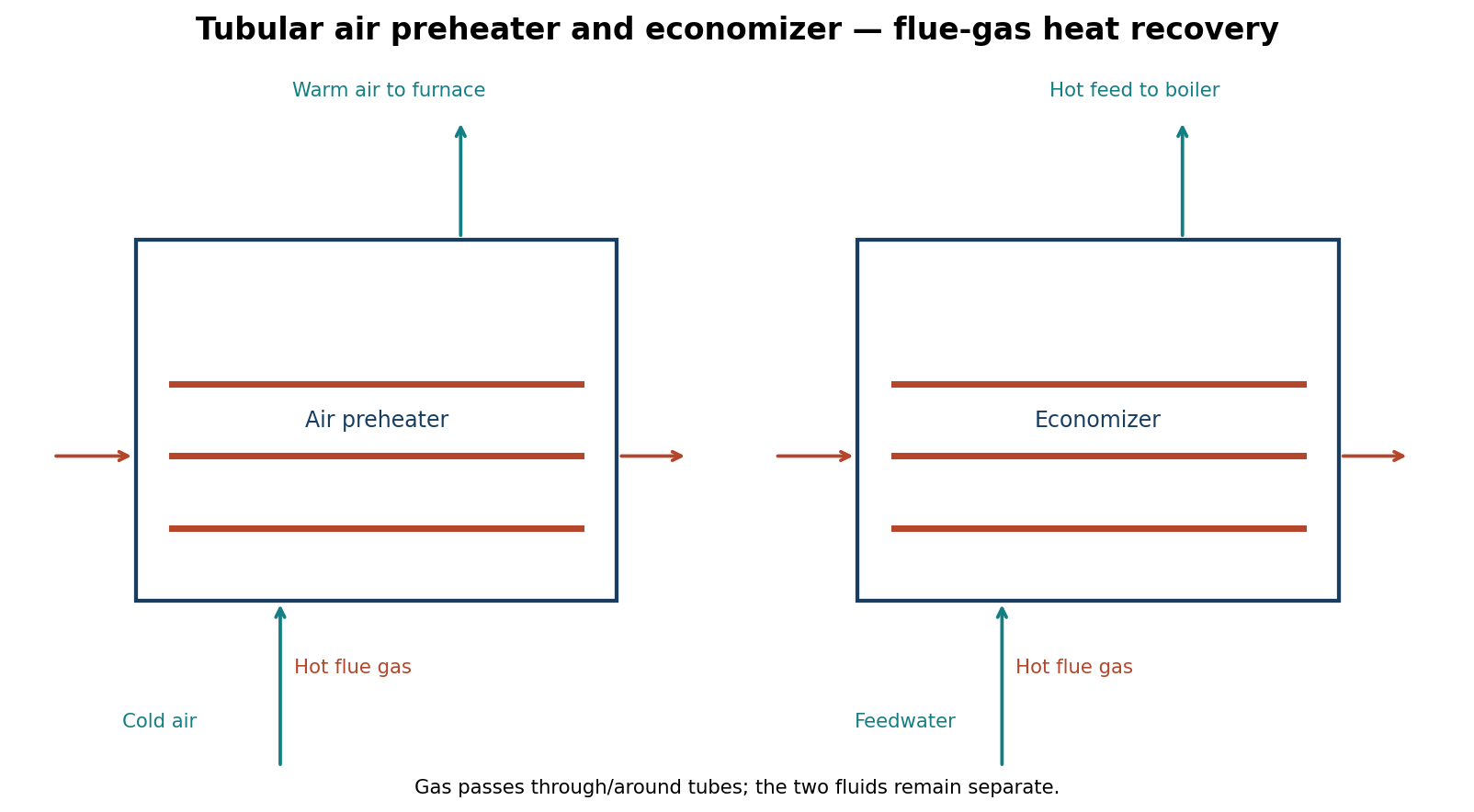
(i) Feedwater flows through economizer tubes exposed to hot outgoing flue gas. Heat recovered from the gas raises the feedwater temperature before it enters the boiler, reducing the fuel required for steam generation.
(ii) In a tubular air preheater, flue gas and incoming air pass on opposite sides of tubes. Heat passes through the tube walls to the air, which then enters the furnace. Gas and air remain separate.
Question 2(c)
Outline the procedure for hydraulic testing of a boiler.
(4 marks)
Answer
- Plan the statutory examination with the authorised examiner and use the approved test specification. Shut down, cool, depressurise and isolate the boiler and connected energy sources.
- Prepare and inspect the pressure boundary and fittings. Fit calibrated gauges, a controlled hydraulic pump and the approved test fittings; vent trapped air while filling with suitable water.
- Raise pressure gradually to the examiner-approved test pressure. Hold for the specified period and examine for leakage, distortion or other defects from a safe position. Do not tighten or repair pressurised parts.
- Release pressure in a controlled manner, drain or preserve as appropriate, restore the correct fittings, and record the results and any required repairs before return to service.
Hydrostatic testing uses water, not a compressed-air substitute. Test pressure and duration come from the applicable specification and authorised examiner; they are not supplied in this question.
Question 3(a)
(i) Highlight four types of heat losses in a boiler. (ii) Outline the procedure for boiler shut down.
(11 marks)
Answer
- Sensible heat carried away by hot dry flue gas.
- Heat in water vapour from fuel hydrogen, fuel moisture and combustion-air moisture.
- Chemical energy lost through incomplete combustion and unburnt fuel in ash.
- Radiation and convection from the boiler casing and hot fittings.
For a planned shutdown: reduce load gradually under the plant procedure; stop fuel admission and complete the required controlled purge; maintain safe water level and approved circulation as the boiler cools. Isolate it from common steam and fuel systems using the specified sequence. Allow controlled cooling without forcing cold water into hot pressure parts. Once cold and depressurised, isolate and lock out connected energy sources, drain only as required, and carry out cleaning, inspection or preservation. Record the shutdown and any defects. An emergency trip uses the plant’s separate emergency procedure.
Question 3(b)
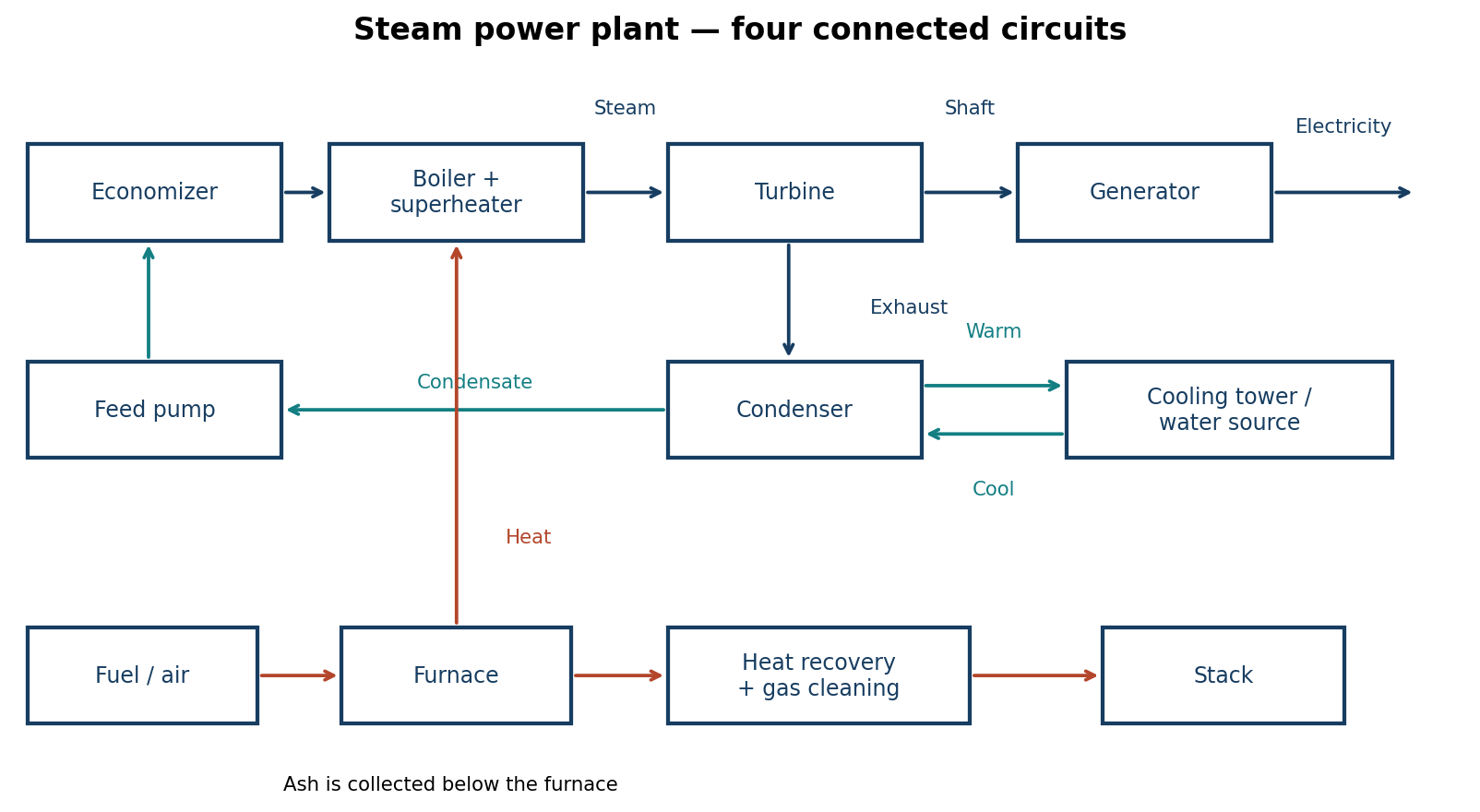
(i) State four uses of steam. (ii) With the aid of a diagram, explain the circuits of a steam power plant.
(9 marks)
Answer
- Driving turbines for electrical generation or mechanical work.
- Industrial process heating.
- Sterilisation of suitable equipment and materials.
- Drying, cooking or space-heating processes.
| Circuit | Flow and purpose |
|---|---|
| Water and steam | Condenser → feed pump → economizer → boiler → superheater → turbine → condenser. The turbine drives the generator. |
| Fuel and ash | Fuel handling feeds the furnace; combustion releases heat and ash is collected and removed. |
| Air and flue gas | Air passes through the air preheater to the furnace. Gas passes through heat-recovery surfaces and gas cleaning equipment before discharge through the stack. |
| Cooling water | Cooling water absorbs heat in the condenser and rejects it to a cooling tower or suitable cooling-water source. It is separate from the steam circuit. |
Question 4(a)
(i) Describe the two levels of water effluent treatment process. (ii) With the aid of a diagram, describe the process of reverse osmosis in boiler feed water treatment.
(10 marks)
Answer
| Level | Description |
|---|---|
| Primary treatment | Physical removal of gross solids and settleable material by screening, grit removal and sedimentation. |
| Secondary treatment | Biological oxidation and separation of biodegradable organic matter, commonly followed by clarification. Further tertiary treatment or disinfection may be required for the intended discharge or reuse. |
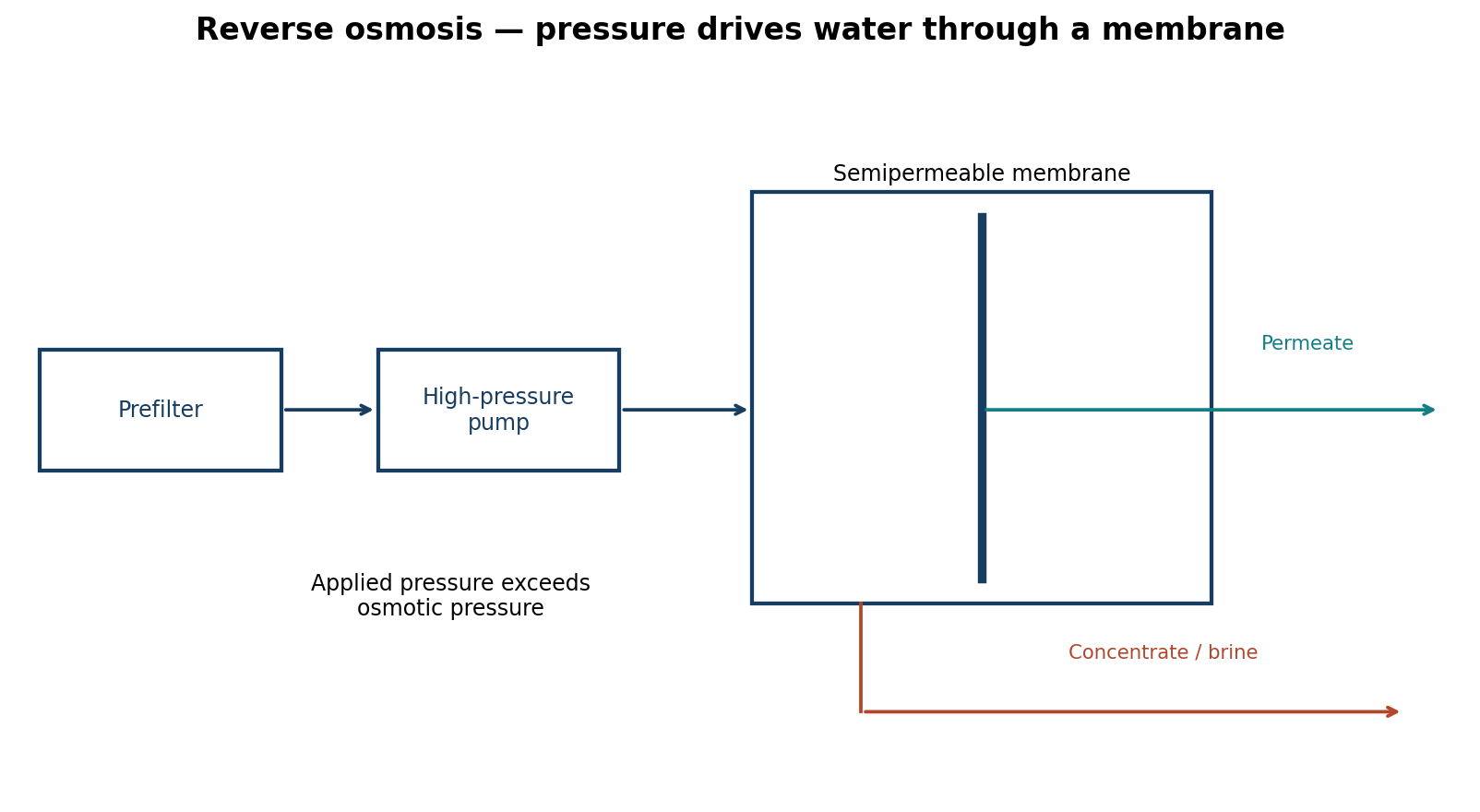
Pretreated feedwater is pressurised above its osmotic pressure and delivered to the membrane. Water permeates through while most dissolved salts are rejected into a concentrated stream. Permeate is collected for further treatment if needed; concentrate is removed at the designed recovery rate. Pretreatment limits fouling and scale, and outlet quality is monitored.
Question 4(b)
State five routine checks on a boiler during normal operation.
(5 marks)
Answer
- Water level and correct operation of level indication.
- Steam pressure and its agreement with the approved operating range.
- Burner flame, fuel supply and combustion/draught condition.
- Feedwater supply, treatment readings and relevant tank/pump condition.
- Leakage, unusual noise, overheating and the status of alarms and protective controls.
Question 4(c)
With the aid of a diagram, describe the operation of the Kaplan water turbine.
(5 marks)
Answer
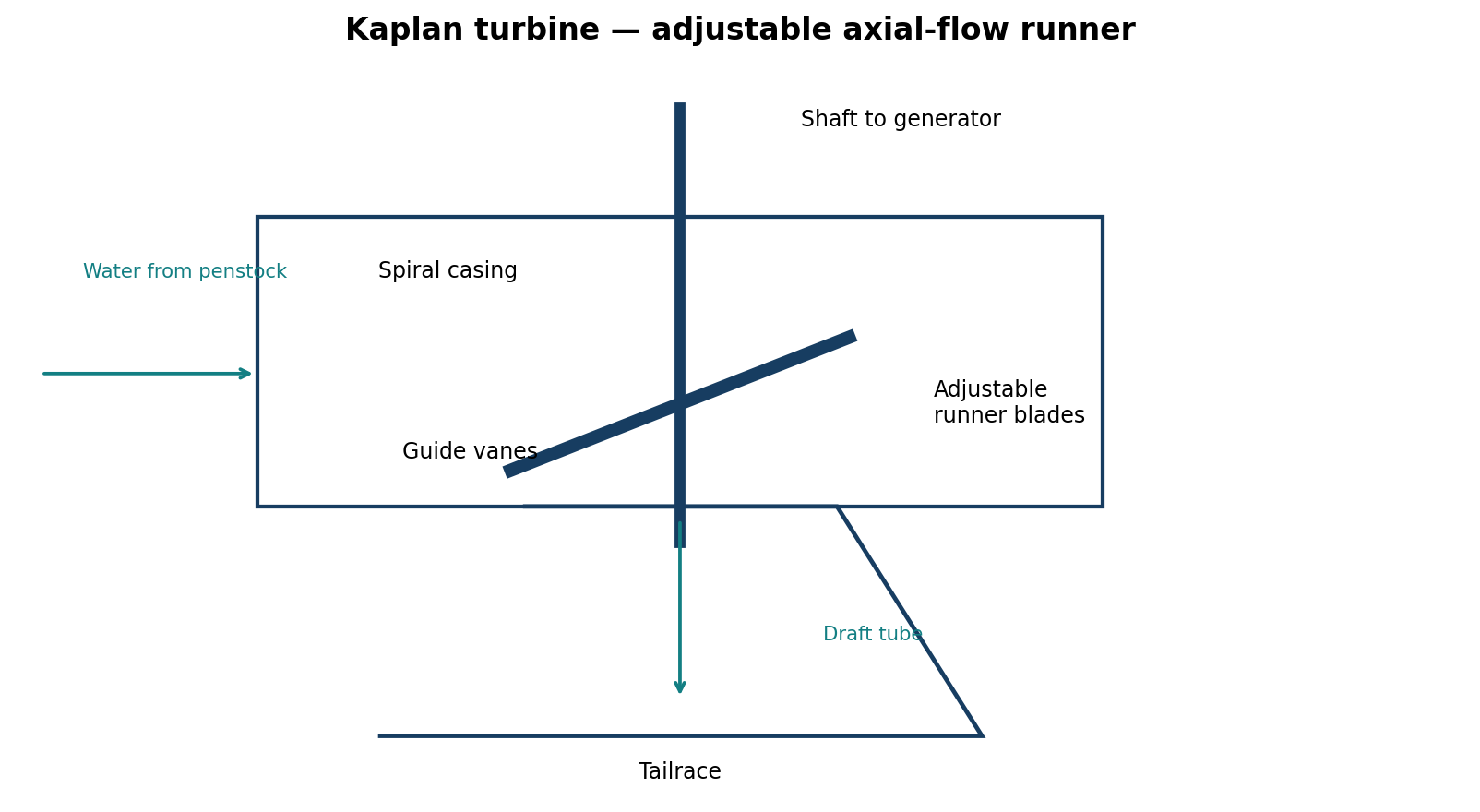
Water enters the spiral casing and guide vanes direct it onto the propeller-type runner. Pressure and velocity changes across the adjustable runner blades produce torque on the shaft. Guide-vane opening and runner-blade pitch are coordinated for the load. Water leaves axially through a draft tube, which recovers part of its kinetic energy before discharge to the tailrace.
Question 5(a)
(i) State four requirements of a flash steam recovery unit. (ii) With the aid of a diagram, describe how process steam is recovered using a flash vessel.
(9 marks)
Answer
- A source of hot pressurised condensate with useful flash-steam potential.
- A suitable lower-pressure steam demand and header connection.
- A correctly sized, pressure-rated flash vessel with separation space and controlled condensate drainage.
- Appropriate pressure control, protection, isolation and condensate return arrangements.
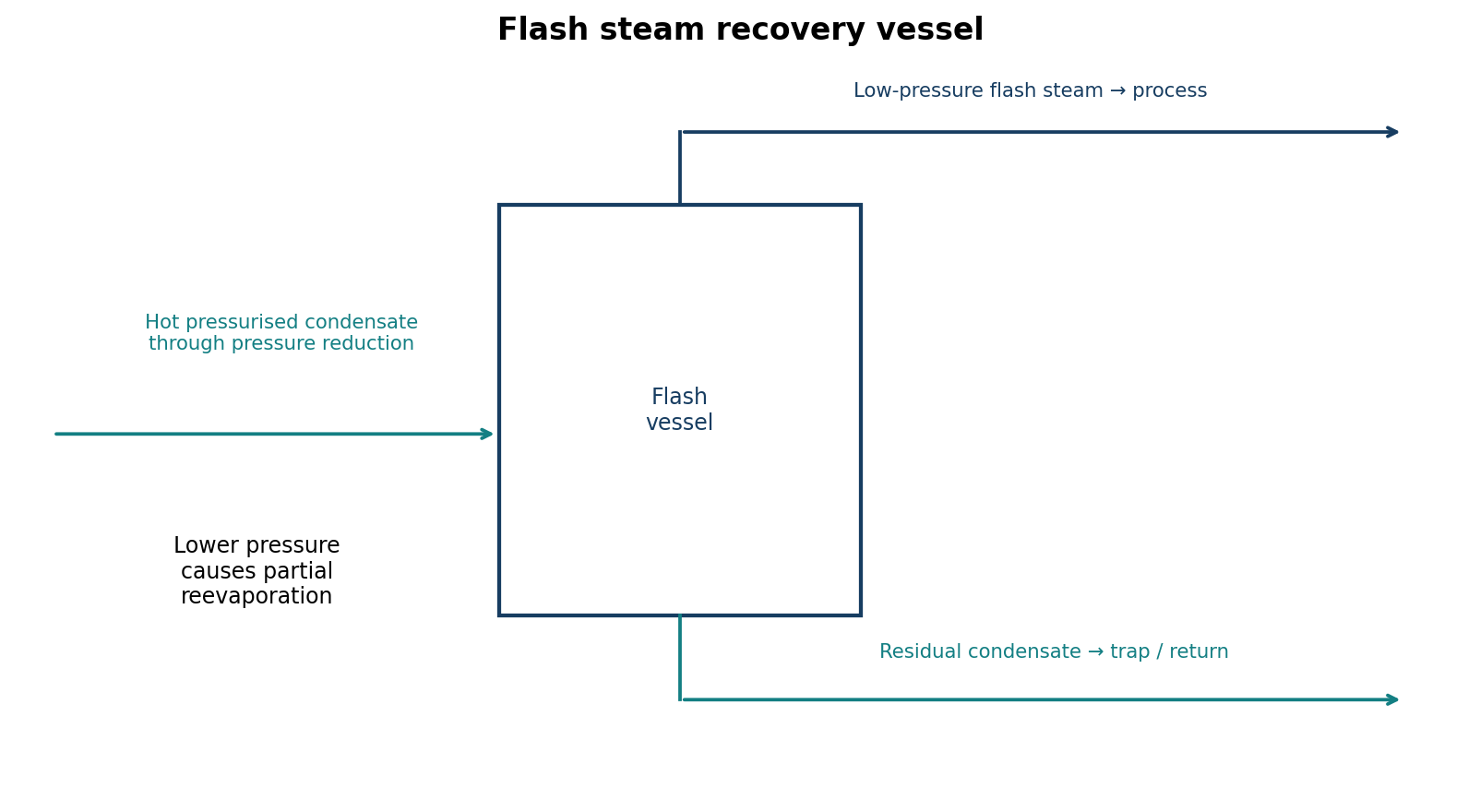
High-pressure condensate is admitted into a vessel maintained at a lower pressure. Its enthalpy exceeds that of saturated liquid at the new pressure, so a portion flashes to steam. The vessel separates this steam for a lower-pressure process. Residual condensate leaves through an appropriate trap or level-controlled drain. The flash fraction is approximately [h₁ − hf₂]/hfg₂ for an adiabatic pressure reduction.
Question 5(b)
Highlight four maintenance practices carried out on cooling towers.
(4 marks)
Answer
- Clean and inspect fill, distribution nozzles and strainers to maintain even water flow.
- Inspect fans, drives, bearings and supports and service them according to the manufacturer’s schedule.
- Control water chemistry, corrosion, scale and biological growth through the approved water-management programme.
- Inspect basins, drift eliminators, make-up and blowdown systems; remove deposits and repair leaks or damaged parts.
Question 5(c)
With the aid of diagrams, describe the operation of the following stokers: (i) spreader; (ii) chain gate.
(7 marks)
Answer
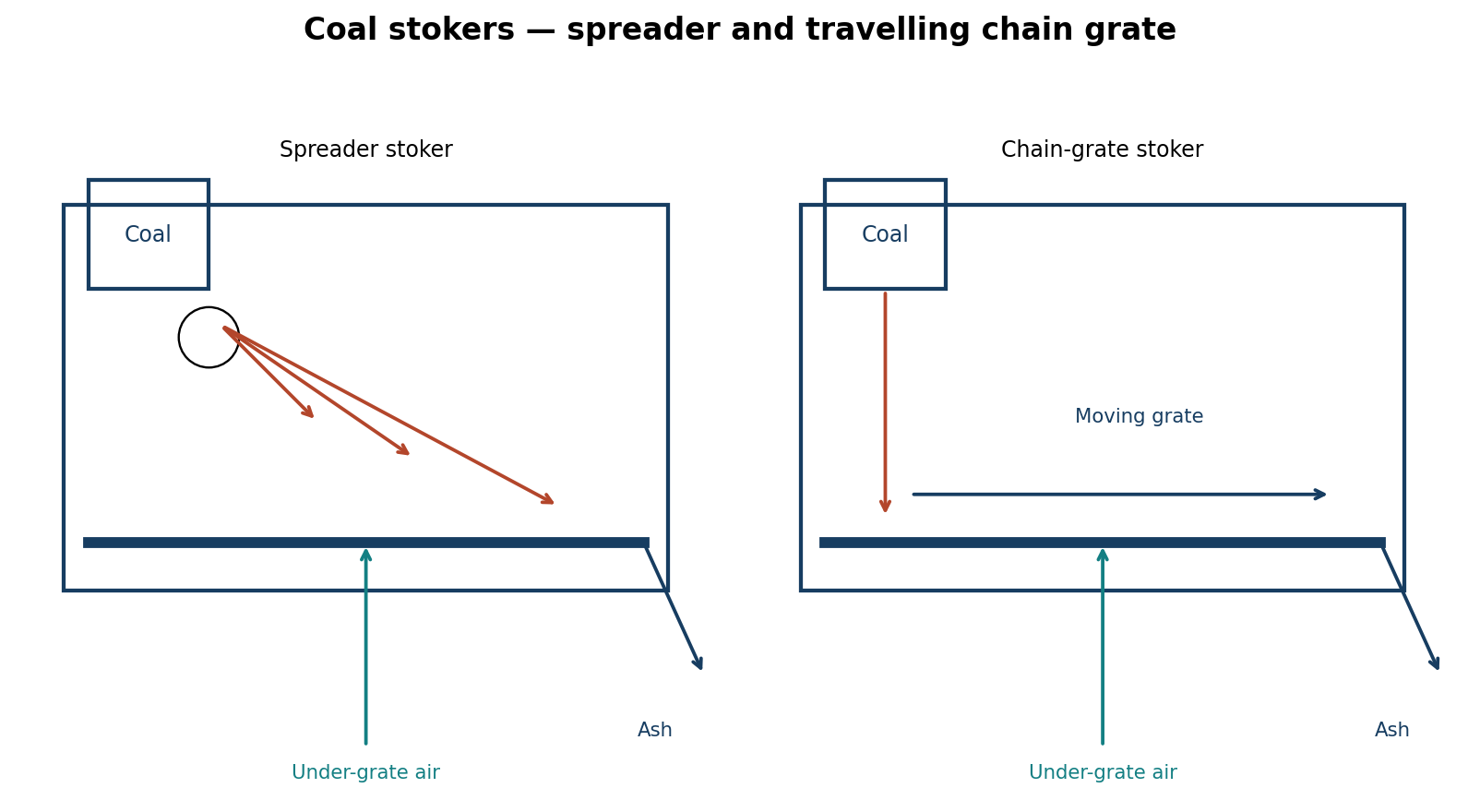
(i) A spreader throws fuel across the furnace above a grate. Fine particles may burn in suspension while larger particles finish burning on the grate; air enters through the grate and as over-fire air as designed. Ash is removed from below or at the grate discharge.
(ii) In a chain-grate stoker, a continuous moving grate carries a controlled fuel bed from the feed hopper through the furnace. Air rises through the grate and fuel bed. Grate speed and bed depth regulate residence time and firing rate; burnt residue drops off at the far end.
Question 6(a)
(i) State four safety measures to ensure when locating a nuclear power plant. (ii) With the aid of a diagram, explain the construction and operation of a nuclear power plant.
(11 marks)
Answer
- Select a site with acceptably low seismic, flooding and other external-hazard risks, established by the required assessments.
- Provide a dependable cooling-water or other heat-rejection arrangement with appropriate protection.
- Provide suitable separation and land-use control, emergency access and an practicable emergency-planning arrangement.
- Provide secure access control and evaluate effects on neighbouring people and the environment under the regulator’s siting requirements.
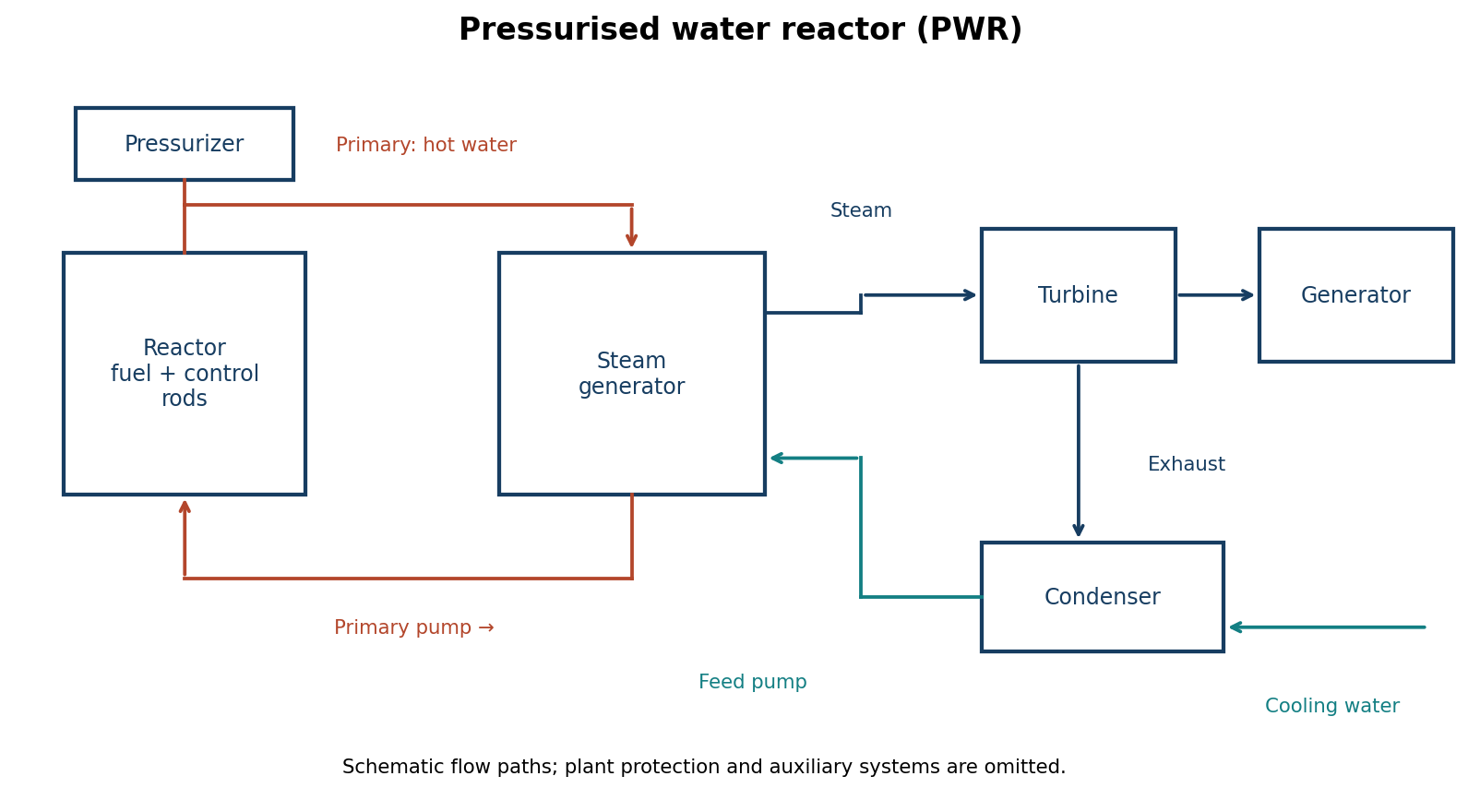
Controlled fission in the fuel releases heat. Coolant transports the heat to a steam generator, where a separate water circuit produces steam. Steam expands through the turbine, which drives an electrical generator. The condenser turns exhaust steam into water for return by the feed pump. Control rods regulate the chain reaction; shielding, containment and engineered cooling systems protect the plant and its surroundings.
Question 6(b)
(i) In a steam plant with a boiler, economizer and super heater, 5000 kg/h was generated at 14 bar. 675 kg/h of coal with a calorific value of 29800 kJ/kg was used. Feed water enters at a temperature of 30°C. If the temperature of steam leaving the superheater is 320°C determine the overall efficiency of the plant. Take Cp = 2.1 kJ/kg K. (ii) Explain three benefits of an economizer.
(9 marks)
Answer
| Step | Working / result |
|---|---|
| Saturated properties at 14 bar absolute | Tsat = 195.047°C; hg = 2788.893 kJ/kg. |
| Superheated enthalpy | hs = hg + 2.1(320 − Tsat) = 3051.294 kJ/kg. |
| Feedwater enthalpy | hfeed ≈ 4.18 × 30 = 125.4 kJ/kg. |
| Useful heat per hour | 5000(3051.294 − 125.4) = 14629467.8 kJ/h. |
| Fuel heat per hour | 675 × 29800 = 20,115,000 kJ/h. |
| Overall plant efficiency | η = useful heat/fuel heat = 72.73%. |
- Recovers heat that would otherwise leave in the flue gas, saving fuel.
- Raises boiler efficiency and reduces fuel-related emissions per unit steam output.
- Preheats feedwater, reducing the temperature difference imposed on the boiler when feed enters.
Question 7(a)
(i) State four benefits of energy monitoring and targeting. (ii) Outline two types of energy audit.
(8 marks)
Answer
- Establishes an energy-use baseline and realistic targets for the actual production output.
- Identifies avoidable losses, leaks and deteriorating equipment performance.
- Measures the savings achieved after efficiency improvements.
- Supports budgeting, cost control and reductions in fuel use and associated emissions.
| Audit | Outline |
|---|---|
| Preliminary / walk-through audit | Uses bills, production data and a site survey to identify major energy uses and obvious saving opportunities. |
| Detailed / investment-grade audit | Uses measured performance, energy balances and technical/economic analysis to quantify and assess specific improvement projects. |
Question 7(b)
With the aid of a combined separating and throttling calorimeter diagram, outline the procedure for determining the total dryness fraction of steam.
(7 marks)
Answer
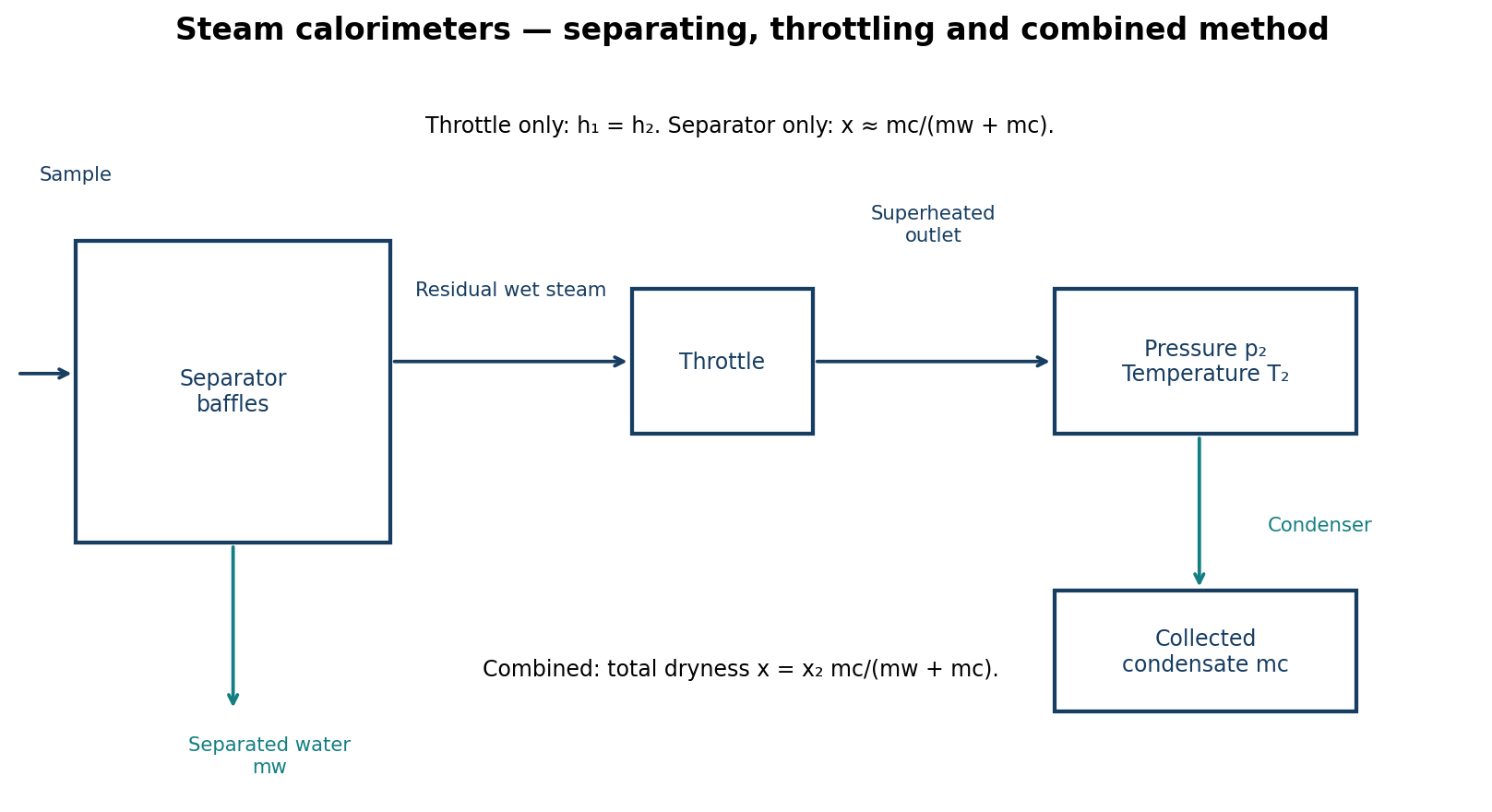
| Method | Procedure and relationship |
|---|---|
| Throttling | Measure inlet absolute pressure p₁ and outlet absolute pressure p₂ and temperature T₂. The insulated throttle has essentially no shaft work and negligible kinetic-energy change, so h₁ ≈ h₂. When outlet steam is demonstrably superheated, h₂ = hg(p₂) + cp[T₂ − Tsat(p₂)] and x = [h₂ − hf(p₁)]/hfg(p₁). |
| Separating | Pass a representative wet-steam sample through baffles so droplets fall into a measuring vessel. Collect separated water mw and condense and weigh the remaining steam mc over the same interval. If the residual steam is dry, x ≈ mc/(mw + mc). Residual wetness makes this assumption inaccurate. |
| Combined | First separate water mw, then throttle the residual sample to a superheated outlet. Determine its residual dryness x₂ by the throttling equation. If the downstream sample condenses to mass mc, total inlet dryness is x = x₂mc/(mw + mc). |
Question 7(c)
With the aid of a diagram, explain the operation of a ball float type steam trap.
(5 marks)
Answer
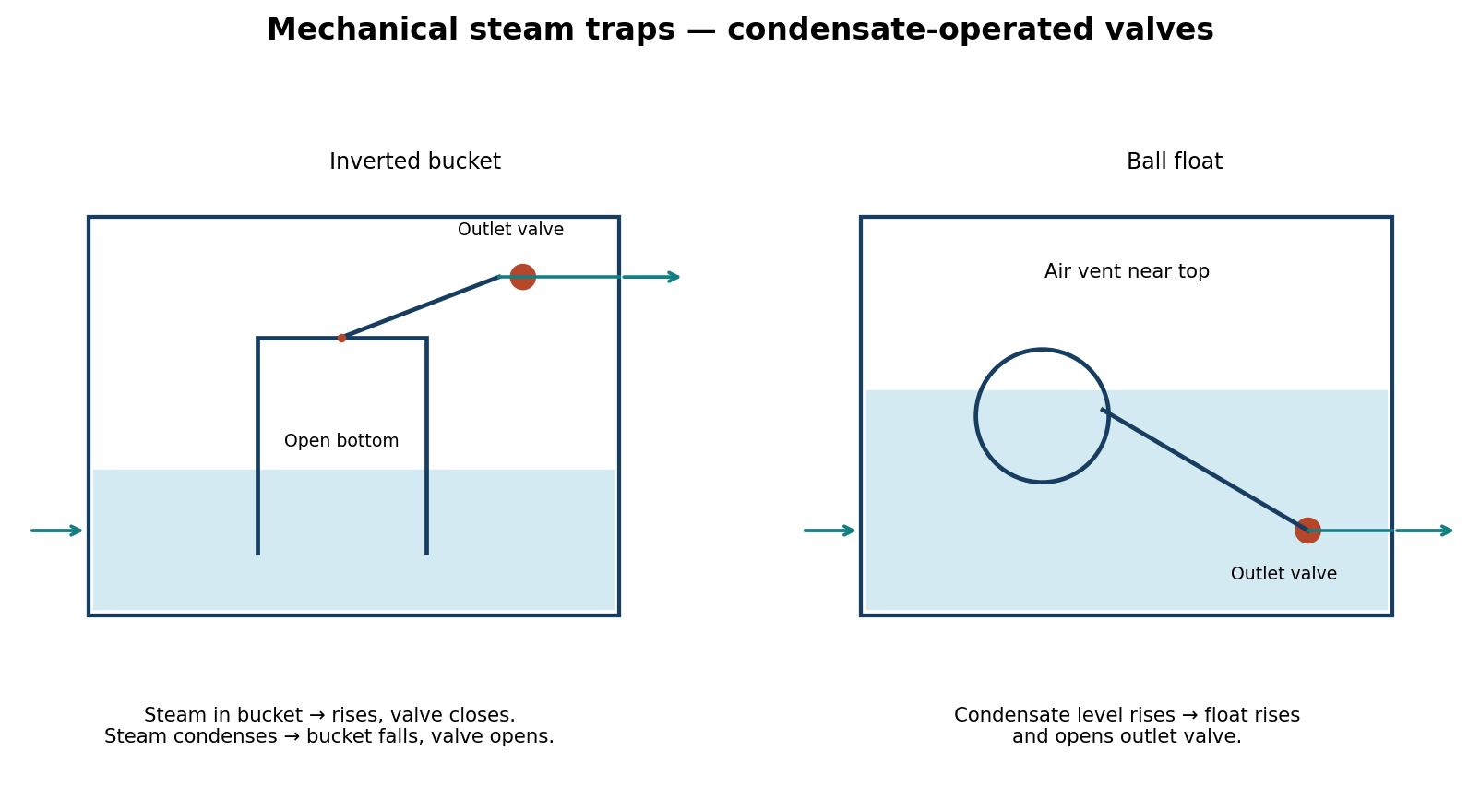
Condensate entering the body raises the liquid level and lifts the sealed ball float. The linkage opens the outlet valve, discharging condensate continuously as it arrives. As the level falls the float lowers and throttles or closes the valve, retaining a water seal that prevents live steam loss. A separate thermostatic vent commonly removes air and non-condensable gases.