Information Communication Technology (Theory) — Undated
KNEC Diploma in Supply Chain Management, Module I. Original examination questions with explained model answers for revision.
Date not shown in supplied scan
Paper codes: Not shown in supplied scan Time: Not shown in supplied scan Instructions: Not shown in supplied scan
Question 1(a) — 3 marks
Outline three uses of computers in learning institutions.
Model answer
Preparing and presenting teaching materials.
Maintaining student records and examination results.
Conducting research and accessing electronic learning resources.
Question 1(b) — 4 marks
Explain two advantages of storing information in a database.
Model answer
Efficient retrieval: queries and indexes help locate selected information quickly without searching every document manually.
Better consistency and control: related tables, validation and controlled updates reduce duplication and contradictory records.
Question 1(c) — 2 marks
A secretary previewed a document before printing. Explain one importance of this action.
Model answer
Previewing checks how the document will appear on paper, allowing errors in layout, margins or page breaks to be corrected before paper and ink are used.
Question 1(d)(i) — 3 marks
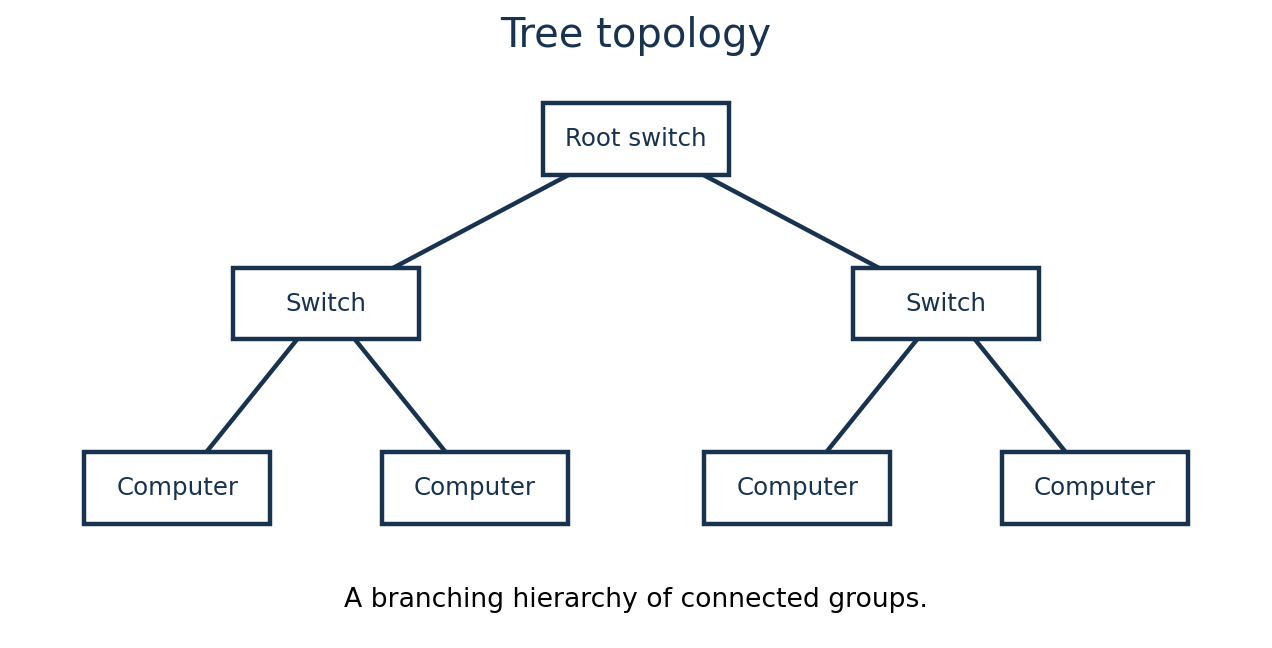
With the aid of a diagram in each case, describe the following Local Area Network topologies: tree.
Model answer
A tree topology connects devices in a branching hierarchy, with groups attached to intermediate connection points that link towards a root/backbone. The diagram shows a root switch serving two lower-level groups.
Question 1(d)(ii) — 3 marks
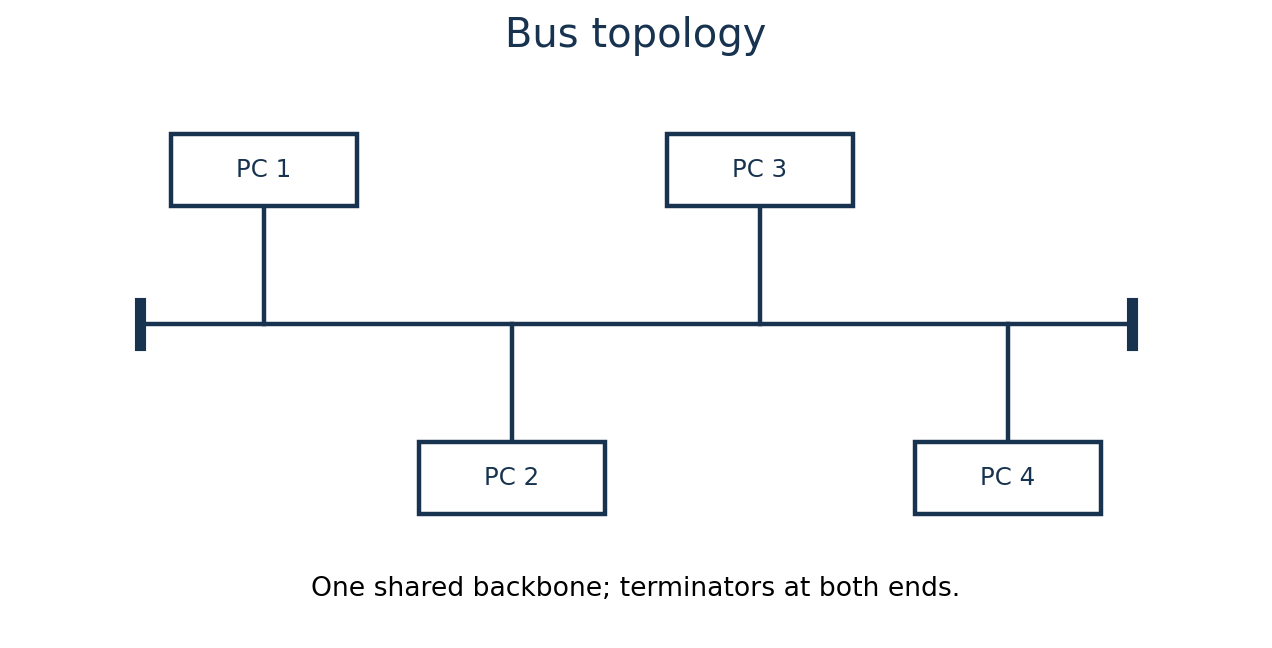
With the aid of a diagram in each case, describe the following Local Area Network topologies: bus.
Model answer
A bus topology connects devices to one shared communication backbone. In a traditional coaxial bus, terminators at both ends absorb signals and prevent reflections.
Question 2(a) — 4 marks
Explain two functions of a control unit in a computer Central Processing Unit.
Model answer
Fetches instructions from memory and decodes them to determine the operation required.
Issues timing and control signals that coordinate the ALU, memory and input/output during instruction execution.
Question 2(b) — 4 marks
Differentiate between optical character reader and optical magnetic reader as used in computers.
Model answer
The supplied paper prints “optical magnetic reader”, which is not a standard device name. Both plausible intended terms are distinguished here so that the wording is not silently changed.
Optical character recognition (OCR) identifies printed/scanned characters and converts them into machine-readable text.
If the intended term is optical mark reader (OMR), it detects filled positions/marks on forms rather than interpreting printed characters.
If magnetic ink character reader (MICR) was intended, it reads specially magnetised ink characters, commonly on cheques, using magnetic sensing rather than ordinary optical recognition.
Question 2(c) — 4 marks
Peter intends to create a worksheet in a spreadsheet program. Describe two data types that he could use.
Model answer
Text/labels: character strings used for headings, names or descriptions and not directly treated as arithmetic values.
Numeric values: quantities such as costs or counts on which calculations can be performed.
Question 2(d) — 3 marks
A student used a line chart to represent data in a spreadsheet program. Outline three characteristics of this chart.
Model answer
Values are represented by plotted points connected by line segments.
The horizontal axis commonly shows time or ordered categories and the vertical axis shows numeric values.
It makes trends and changes across the ordered observations easy to compare.
Question 3(a) — 3 marks
Outline three advantages of random file access method.
Model answer
Retrieves a selected record without reading all earlier records.
Supports quick individual-record updating.
Suits interactive enquiry systems where records are requested in no fixed sequence.
Question 3(b) — 4 marks
Intech Company has been using emails for communication with its clients. Explain two challenges that the company is likely to face.
Model answer
Connection/service dependence: Internet or mail-service outages delay access and message delivery.
Unwanted or malicious messages: spam, phishing and infected attachments consume time and can compromise information if mishandled.
Question 3(c) — 4 marks
A supermarket attendant was serving customers using a point of sale terminal. Describe two computer peripheral devices he is most likely to use.
Model answer
Barcode scanner: reads product codes to retrieve the corresponding item and price.
Receipt printer: produces an itemised record of purchases and payment for the customer.
Question 3(d)(i) — 2 marks
Describe each of the following types of system software: Utility program.
Model answer
A utility is system-support software that maintains, protects or manages the computer, for example a backup utility or antivirus program.
Question 3(d)(ii) — 2 marks
Describe each of the following types of system software: Operating system.
Model answer
An operating system manages processor, memory, devices and files and supplies the interface/platform on which users and application programs operate.
Question 4(a) — 3 marks
Outline three factors to consider when acquiring computer software.
Model answer
Suitability for required tasks.
Compatibility with existing hardware and systems.
Total cost, including licensing, support and training.
Question 4(b) — 4 marks
Amos intends to use a spreadsheet program in his office. Explain two benefits he would accrue from this.
Model answer
Automatic calculations and recalculation reduce repetitive arithmetic when input values change.
Tables, charts and sorting/filtering help organise and analyse office data for decisions and reports.
Question 4(c) — 4 marks
Differentiate between relative and absolute cell references as used in spreadsheet program.
Model answer
A relative reference changes by the same row/column offset when copied; A1 copied one row down becomes A2.
An absolute reference fixes its row and column with dollar signs; $A$1 remains unchanged when copied.
Question 4(d) — 4 marks
Ann used CD-RW for her examination project. Explain two reasons that made her prefer this medium.
Model answer
It can be erased and rewritten, allowing corrections or updated project files to replace earlier versions.
It is portable and inexpensive for transferring a modest amount of data between computers with compatible optical drives.
Question 5(a) — 3 marks
Outline three types of text wrapping styles in a word processing program.
Model answer
Square.
Tight.
Top and Bottom.
Question 5(b) — 4 marks
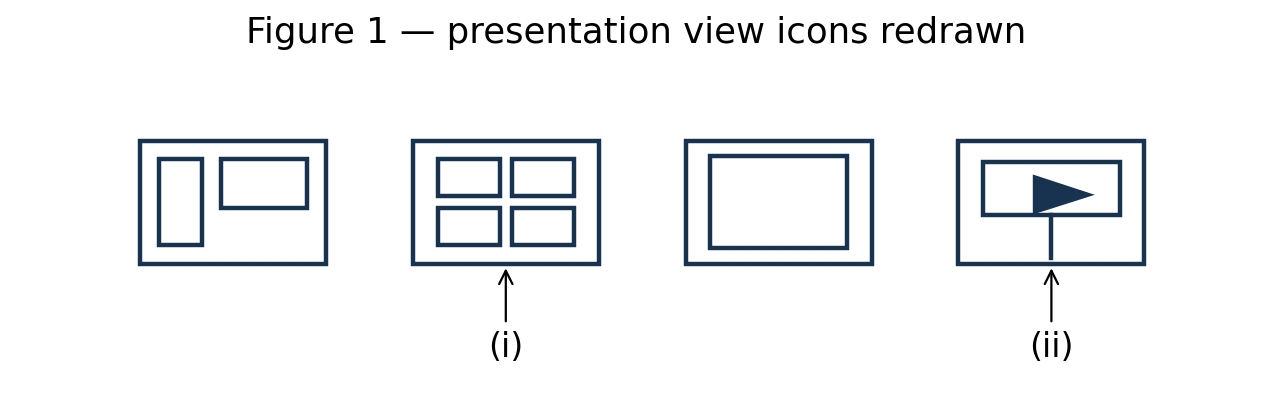
Figure 1 shows a section of a toolbar in the view menu of a presentation program. Use it to answer the question that follows: Explain the functions of each of the features labelled (i) and (ii).
Model answer
(i) Slide Sorter view: shows slide thumbnails for reviewing and rearranging the slide sequence.
(ii) Slide Show view: runs the presentation for an audience with slide navigation and configured effects.
Question 5(c) — 4 marks
Joseph used a mail merge feature to generate letters for his clients. Explain two reasons that could have made him use this feature.
Model answer
To create personalised letters for many clients quickly from a common main document.
To keep shared wording/formatting consistent while obtaining variable details from one reusable recipient list.
Question 5(d) — 4 marks
Masomo Technical college has opted for a tailor-made software. Explain two advantages of this type of software.
Model answer
Specific fit: its features and workflow can be designed around the college’s exact requirements.
Control of future changes: agreed access to the source and development support can allow the college to add functions and integrate its existing systems.
Question 6(a) — 3 marks
Outline three text case options available in a word processing program.
Model answer
Sentence case.
UPPERCASE.
lowercase.
Question 6(b) — 6 marks
Wezesha Company has connected all its branches to a wide area network. Explain three benefits the company could accrue from this move.
Model answer
Shared records: geographically separate branches can access consistent central business information.
Faster coordination: staff can exchange messages, documents and transaction data without physical delivery.
Resource consolidation: central applications and backup services can support several branches, reducing unnecessary duplication.
Question 6(c) — 4 marks
Differentiate between password and biometric access methods of securing data.
Model answer
Password access verifies a secret that the user knows and enters.
Biometric access verifies a physical/behavioural characteristic such as a fingerprint against an enrolled reference; it relies on something associated with the person rather than a memorised secret.
Question 6(d) — 2 marks
Zawadi Company intends to use E-commerce in its business operations. Outline two benefits the company would accrue from this.
Model answer
Access to a wider market beyond its physical location.
Ability to receive orders online outside normal shop opening hours.
Finish Course Early?
You have not completed all required lessons and assessments.
Your Progress
0%
Select the fields to be shown. Others will be hidden. Drag and drop to rearrange the order.