Engineering Mathematics III — June/July 2024
KNEC Diploma in Mechanical Engineering — Module III. Paper code: 2502/303. Time: 3 hours.
These independent revision answers are not official KNEC marking schemes. Attempt each question before reading its answer. All optional questions are included for study.
Answer FIVE of the EIGHT questions. Each whole question carries 20 marks.
The original integral notation and printed interpolation data are retained. Where the source is self-referential or singular, the answer explains the problem and clearly separates any conditional corrected interpretation.
Question 1(a)
Determine the angle between the vectors A = 2i + 5j − 7k and B = 3i + 4j + 5k.
(6 marks)
Answer
| Step | Working |
|---|---|
| Dot product | A·B = 2 × 3 + 5 × 4 + (−7) × 5 = −9. |
| Magnitudes | |A| = √(4 + 25 + 49) = √78; |B| = √(9 + 16 + 25) = √50. |
| Angle | cosθ = −9/√3900. |
| Answer | θ = 98.286054°, approximately 98.2861°. |
Question 1(b)
A scalar field φ(x,y,z) = 4x²y³z⁴ while a vector field F(x,y,z) = 3x²yz i − 2xyz j + 4xy²z³ k. Determine, at the point (1,−1,1): (i) ∇φ; (ii) ∇·F; (iii) ∇×F.
(14 marks)
Answer
| Part | Differentiation | Value at (1,−1,1) |
|---|---|---|
| (i) Gradient | ∇φ = (8xy³z⁴)i + (12x²y²z⁴)j + (16x²y³z³)k | −8i + 12j − 16k |
| (ii) Divergence | ∇·F = ∂(3x²yz)/∂x + ∂(−2xyz)/∂y + ∂(4xy²z³)/∂z = 6xyz − 2xz + 12xy²z² | −6 − 2 + 12 = 4 |
| (iii) Curl, i component | ∂Fz/∂y − ∂Fy/∂z = 8xyz³ + 2xy | −10 |
| Curl, j component | ∂Fx/∂z − ∂Fz/∂x = 3x²y − 4y²z³ | −7 |
| Curl, k component | ∂Fy/∂x − ∂Fx/∂y = −2yz − 3x²z | −1 |
| Answer (iii) | Collect the three curl components | ∇×F = −10i − 7j − k |
Question 2(a)
Solve the differential equation: x² dy/dx = y² + 11xy + 9x².
(9 marks)
Answer
| Step | Working |
|---|---|
| Substitution | For x ≠ 0, let v = y/x, so y = vx and dy/dx = v + x dv/dx. |
| Substitute | v + x dv/dx = v² + 11v + 9 ⇒ x dv/dx = (v + 1)(v + 9). |
| Separate | dv/[(v + 1)(v + 9)] = dx/x. |
| Partial fractions | 1/[(v + 1)(v + 9)] = (1/8)[1/(v + 1) − 1/(v + 9)]. |
| Integrate | (1/8)ln|(v + 1)/(v + 9)| = ln|x| + K. |
| General family | (y + x)/(y + 9x) = Cx⁸, on an interval where the expressions are defined. |
| Explicit form | y = x(9Cx⁸ − 1)/(1 − Cx⁸). |
| Exceptional straight-line solutions | y = −x is included by C = 0. The divided-out solution y = −9x must be added separately. |
Question 2(b)
Use the method of undetermined coefficient to solve the differential equation d²y/dt² + 8dy/dt + 15y = 2cos5t.
(11 marks)
Answer
| Step | Working |
|---|---|
| Complementary function | m² + 8m + 15 = (m + 3)(m + 5); yc = C₁e⁻³ᵗ + C₂e⁻⁵ᵗ. |
| Trial particular integral | yp = A cos5t + B sin5t. |
| Derivatives | yp′ = −5A sin5t + 5B cos5t; yp″ = −25A cos5t − 25B sin5t. |
| Equate cosines | −10A + 40B = 2. |
| Equate sines | −40A − 10B = 0 ⇒ B = −4A. |
| Constants | A = −1/85; B = 4/85. |
| Answer | y = C₁e⁻³ᵗ + C₂e⁻⁵ᵗ − (1/85)cos5t + (4/85)sin5t. |
Question 3(a)
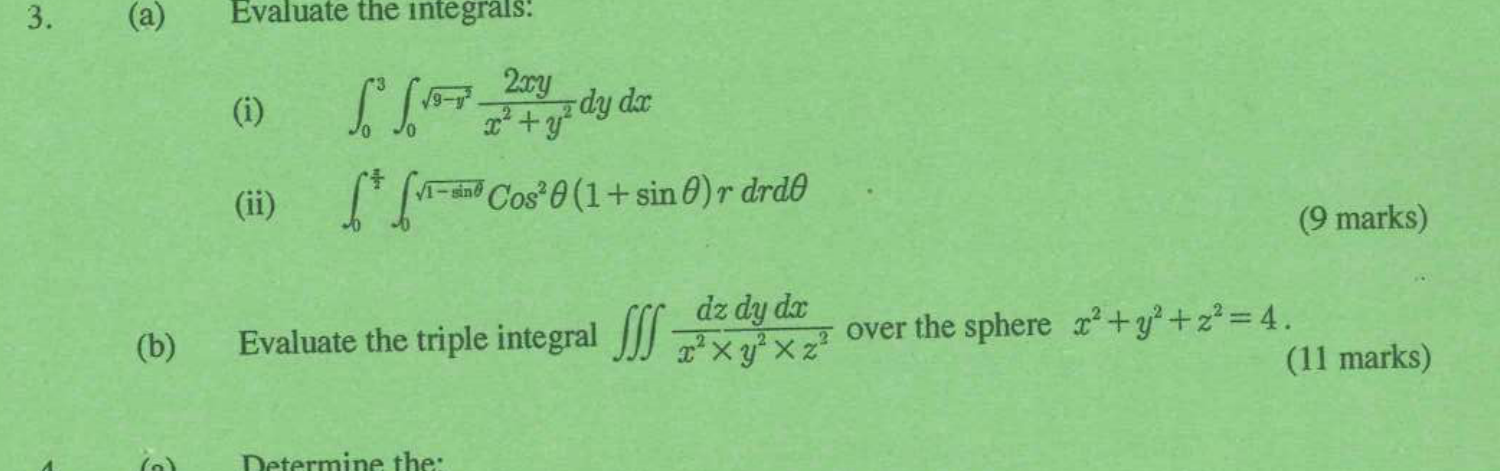
Evaluate the integrals: (i) ∫₀³ ∫₀^[√(9−y²)] [2xy/(x²+y²)] dy dx; (ii) ∫₀^(π/2) ∫₀^[√(1−sinθ)] cos²θ(1+sinθ) r dr dθ.
(9 marks)
Answer
(i) The scan shows an upper limit √(9−y²) on an integration with respect to y. That is self-referential as a standard iterated-integral limit. Retain the printed expression and state the interpretation: if the intended upper limit is √(9−x²), the region is the first-quadrant quarter disk of radius 3.
| Part (i), under that stated correction | Working |
|---|---|
| Inner integration | ∫ 2xy/(x²+y²) dy = x ln(x²+y²). |
| Apply y = 0 to √(9−x²) | x ln9 − x ln x² = x ln(9/x²). |
| Outer integration | Let u = x², du = 2x dx: (1/2)∫₀⁹ ln(9/u) du. |
| Evaluate | (1/2)[u ln(9/u) + u]₀⁹ = 9/2. |
| Conditional answer | 4.5, provided the intended upper limit is √(9−x²). The question as printed requires correction before a unique standard interpretation is asserted. |
| Part (ii) | Working |
|---|---|
| Integrate in r | ∫₀^[√(1−sinθ)] r dr = (1/2)(1 − sinθ). |
| Simplify | (1/2)cos²θ(1 + sinθ)(1 − sinθ) = (1/2)cos⁴θ. |
| Reduce power | cos⁴θ = (3 + 4cos2θ + cos4θ)/8. |
| Answer | (1/2)∫₀^(π/2)cos⁴θ dθ = 3π/32 ≈ 0.294524. |
Question 3(b)
Evaluate the triple integral ∭ [dz dy dx/(x² × y² × z²)] over the sphere x² + y² + z² = 4.
(11 marks)
Answer
With the multiplication signs printed in the denominator, the volume integral over the ball has no finite value. Its non-negative integrand has non-integrable singularities on the coordinate planes.
| Reason | Working |
|---|---|
| Choose a subregion inside the ball | For example, take 0 < x < ε and 0.4 < y,z < 0.5, with ε small enough to remain inside x²+y²+z² < 4. |
| Bound the integrand below | On this subregion 1/(y²z²) is bounded below by a positive constant, so the integral is at least a positive constant times ∫₀ᵋ x⁻² dx. |
| Improper integral | lim(a→0⁺)[−1/x]ₐᵋ = +∞. |
| Answer for the printed product | The integral diverges to +∞; ordinary spherical-coordinate cancellation cannot remove the coordinate-plane singularities. |
If the intended denominator were x² + y² + z² instead, that would be a different question: spherical coordinates give ∫₀²∫₀^π∫₀^(2π)sinθ dφ dθ dr = 8π. This conditional result must not be substituted for the printed product.
Question 4(a)
Determine the: (i) Laplace transform of f(t) = t²cos4t; (ii) inverse Laplace transform of f(s) = (3s + 5)/[(s + 2)(s + 7)].
(12 marks)
Answer
| Part | Working |
|---|---|
| (i) Base transform | L{cos4t} = s/(s² + 16). |
| Multiply by t² | L{t²f(t)} = d²F/ds². |
| First derivative | d[s/(s² + 16)]/ds = (16 − s²)/(s² + 16)². |
| Answer (i) | L{t²cos4t} = 2s(s² − 48)/(s² + 16)³, Re(s) > 0. |
| (ii) Partial fractions | (3s + 5)/[(s + 2)(s + 7)] = A/(s + 2) + B/(s + 7). |
| Constants | A + B = 3; 7A + 2B = 5 ⇒ A = −1/5, B = 16/5. |
| Answer (ii) | f(t) = −(1/5)e⁻²ᵗ + (16/5)e⁻⁷ᵗ, t ≥ 0. |
Question 4(b)
Use Laplace transforms to solve the differential equation d²y/dt² + 2dy/dt + y = te⁻ᵗ, given that when t = 0, y = 1 and dy/dt = 2.
(8 marks)
Answer
| Step | Working |
|---|---|
| Transform | (s²Y − s − 2) + 2(sY − 1) + Y = 1/(s + 1)². |
| Collect | (s + 1)²Y − s − 4 = 1/(s + 1)². |
| Rearrange | Y = (s + 4)/(s + 1)² + 1/(s + 1)⁴. |
| Split | Y = 1/(s + 1) + 3/(s + 1)² + 1/(s + 1)⁴. |
| Invert | y = e⁻ᵗ + 3te⁻ᵗ + (t³/6)e⁻ᵗ. |
| Answer | y = e⁻ᵗ(1 + 3t + t³/6). |
| Check | At t = 0, y = 1 and y′ = 2; (D + 1)²y = te⁻ᵗ. |
Question 5(a)
Determine the half-range Fourier sine series of the function defined by f(t) = 6 + t, 0 ≤ t ≤ 4.
(8 marks)
Answer
| Step | Working |
|---|---|
| Half-range sine series | f(t) ~ Σ(n=1…∞) bn sin(nπt/4), for 0 < t < 4. |
| Coefficient | bn = (2/4)∫₀⁴(6 + t)sin(nπt/4) dt. |
| Let k = nπ/4 | An antiderivative is −(6 + t)cos(kt)/k + sin(kt)/k². |
| Apply endpoints | bn = (1/2)[(6 − 10(−1)ⁿ)/k] = [12 − 20(−1)ⁿ]/(nπ). |
| Answer | f(t) ~ Σ [12 − 20(−1)ⁿ]/(nπ) sin(nπt/4). |
| Parity form | For odd n, bn = 32/(nπ); for even n, bn = −8/(nπ). |
| Endpoint interpretation | The odd periodic extension has jump discontinuities at 0 and 4; the sine series takes the midpoint value 0 there, rather than the original endpoint values. |
Question 5(b)
A periodic function, symmetrical about the y-axis, is defined by h(t) = π + t for −π ≤ t ≤ 0, and h(t) = π − t for 0 ≤ t ≤ π, with period 2π. Determine its Fourier series.
(12 marks)
Answer
| Step | Working |
|---|---|
| Even symmetry | h(t) = π − |t| on [−π,π], so bn = 0. |
| Constant coefficient | a₀ = (2/π)∫₀^π(π − t) dt = π. |
| Cosine coefficients | an = (2/π)∫₀^π(π − t)cos(nt) dt. |
| Integration by parts | ∫₀^π(π − t)cos(nt) dt = [1 − (−1)ⁿ]/n². |
| Coefficients | an = 2[1 − (−1)ⁿ]/(πn²): zero for even n, 4/(πn²) for odd n. |
| Answer | h(t) = π/2 + (4/π)[cos t + cos3t/3² + cos5t/5² + …]. |
Question 6(a)
Use the Newton-Raphson formula to solve the equation 2x⁵ + 4x⁴ − 3x − 2 = 0 near x = 1.18 correct to 10 decimal places.
(10 marks)
Answer
Let f(x) = 2x⁵ + 4x⁴ − 3x − 2, so f′(x) = 10x⁴ + 16x³ − 3. Iterate xn+1 = xn − f(xn)/f′(xn), starting with x₀ = 1.18.
| Iteration n | xn | f(xn) | xn+1 |
|---|---|---|---|
| 0 | 1.18000000000000 | 6.7906266 | 1.02088057754674 |
| 1 | 1.02088057754674 | 1.4997676 | 0.96061285880516 |
| 2 | 0.96061285880516 | 0.16018881 | 0.95248065440791 |
| 3 | 0.95248065440791 | 0.0026189298 | 0.95234322259913 |
| 4 | 0.95234322259913 | 7.3757313e-07 | 0.95234318387219 |
| 5 | 0.95234318387219 | 5.8553764e-14 | 0.95234318387219 |
| 6 | 0.95234318387219 | 3.6902382e-28 | 0.95234318387219 |
The converged root is x = 0.9523431839 to ten decimal places. The specified 1.18 is the starting approximation; the converged root is about 0.95234.
Question 6(b)
Table 1 represents a polynomial f(x). Use the Gregory Newton forward difference interpolation formula to determine f(4.3) and f(9.4).
| x | 0 | 1 | 2 | 3 | 4 | 5 | 6 | 7 | 8 |
|---|---|---|---|---|---|---|---|---|---|
| f(x) | 6 | 1 | 6 | 39 | 118 | 261 | 487 | 811 | 1254 |
(10 marks)
Answer
Use every printed value, including f(6) = 487. With h = 1 and x₀ = 0, put u = x and use f(x) = f₀ + uΔf₀ + u(u−1)Δ²f₀/2! + … + u(u−1)…(u−7)Δ⁸f₀/8!.
| x | f | Δf | Δ²f | Δ³f | Δ⁴f | Δ⁵f | Δ⁶f | Δ⁷f | Δ⁸f |
|---|---|---|---|---|---|---|---|---|---|
| 0 | 6 | -5 | 10 | 18 | 0 | 0 | 1 | -7 | 28 |
| 1 | 1 | 5 | 28 | 18 | 0 | 1 | -6 | 21 | |
| 2 | 6 | 33 | 46 | 18 | 1 | -5 | 15 | ||
| 3 | 39 | 79 | 64 | 19 | -4 | 10 | |||
| 4 | 118 | 143 | 83 | 15 | 6 | ||||
| 5 | 261 | 226 | 98 | 21 | |||||
| 6 | 487 | 324 | 119 | ||||||
| 7 | 811 | 443 | |||||||
| 8 | 1254 |
| Step / result | Working |
|---|---|
| First forward differences | 6, −5, 10, 18, 0, 0, 1, −7, 28. |
| Polynomial | f(x) = 6 − 5u + 10u(u−1)/2! + 18u(u−1)(u−2)/3! + u(u−1)…(u−5)/6! − 7u(u−1)…(u−6)/7! + 28u(u−1)…(u−7)/8!. |
| f(4.3) | 153.2991875618125 |
| f(9.4) | 2314.032408064 |
The point 9.4 lies outside the supplied range 0–8, so this evaluation is extrapolation. All values except the printed 487 follow the cubic 3x³ − 4x² − 4x + 6, which would give f(6) = 486. Replacing 487 by 486 would instead give f(4.3) = 153.361 and f(9.4) = 2106.712. Those are conditional corrected-data results; the main answers above retain the printed table.
Question 7(a)
Solve the equation | 3−λ, 10, 5; −2, −3−λ, −4; 3, 5, 7−λ | = 0, where the vertical bars denote the 3 × 3 determinant.
(8 marks)
Answer
| Step | Working |
|---|---|
| Expand along row one | (3−λ)[(−3−λ)(7−λ) + 20] − 10[−2(7−λ) + 12] + 5[−10 − 3(−3−λ)] = 0. |
| Simplify | −λ³ + 7λ² − 16λ + 12 = 0. |
| Factor | λ³ − 7λ² + 16λ − 12 = (λ−2)²(λ−3). |
| Answer | λ = 2 (a repeated root) or λ = 3. |
Question 7(b)
Use the Cramers’ rule to solve the equations: 2x + 3y + 5z = 23; x + 3y + 2z = 13; 2x − 3y + 4z = 8.
(12 marks)
Answer
| Determinant | Matrix rows | Value |
|---|---|---|
| D | [2,3,5]; [1,3,2]; [2,−3,4] | −9 |
| Dx | [23,3,5]; [13,3,2]; [8,−3,4] | −9 |
| Dy | [2,23,5]; [1,13,2]; [2,8,4] | −18 |
| Dz | [2,3,23]; [1,3,13]; [2,−3,8] | −27 |
| Unknown | Cramer’s ratio | Answer |
|---|---|---|
| x | Dx/D = (−9)/(−9) | 1 |
| y | Dy/D = (−18)/(−9) | 2 |
| z | Dz/D = (−27)/(−9) | 3 |
Check: 2 + 6 + 15 = 23; 1 + 6 + 6 = 13; 2 − 6 + 12 = 8.
Question 8(a)
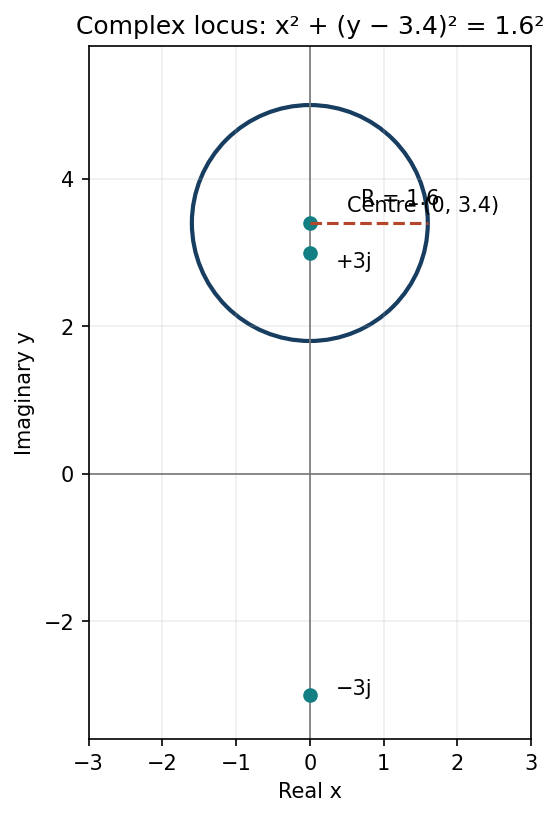
(i) Given that z = x + yi, show that the equation of the locus represented by |(z + 3j)/(z − 3j)| = 4 is a circle. (ii) Hence determine its I. centre; II. radius.
(8 marks)
Answer
| Step | Working |
|---|---|
| Complex-plane convention | The paper uses i and j for the imaginary unit; take them to denote the same √(−1). z ≠ 3j. |
| Modulus relation | √[x² + (y+3)²] = 4√[x² + (y−3)²]. |
| Square | x² + (y+3)² = 16[x² + (y−3)²]. |
| Collect | 15x² + 15y² − 102y + 135 = 0. |
| Complete square | x² + (y − 17/5)² = 64/25. |
| Centre and radius | Centre = (0,17/5) = (0,3.4); radius = 8/5 = 1.6. |
Question 8(b)
Use the method of undetermined coefficients to solve the differential equation d²x/dt² + 7dx/dt + 10x = 4e⁻²ᵗ, given that when t = 0, x = 1 and dx/dt = 5.
(12 marks)
Answer
| Step | Working |
|---|---|
| Complementary function | (m+2)(m+5) = 0; xc = Ae⁻²ᵗ + Be⁻⁵ᵗ. |
| Resonance | The forcing e⁻²ᵗ is already in the complementary function, so try xp = Ct e⁻²ᵗ. |
| Substitution | (D+2)(D+5)[Ct e⁻²ᵗ] = 3C e⁻²ᵗ ⇒ C = 4/3. |
| General solution | x = Ae⁻²ᵗ + Be⁻⁵ᵗ + (4/3)t e⁻²ᵗ. |
| Initial displacement | A + B = 1. |
| Initial velocity | −2A − 5B + 4/3 = 5. |
| Constants | A = 26/9; B = −17/9. |
| Answer | x = (26/9)e⁻²ᵗ − (17/9)e⁻⁵ᵗ + (4/3)t e⁻²ᵗ. |