Economics — July 2024
KNEC Diploma in Sales and Marketing — Module I. Paper code: 2902/105
The printed question page contains no Question 6(b). Every question shown on the supplied page is included, with its printed numbering retained.
Independent worked revision answers. These are not official KNEC marking schemes.
Question 1(a)
Highlight five limitations of the market economic system. (10 marks)
Answer
- Income inequality can produce very unequal access to goods and services.
- Public goods may be underprovided because suppliers cannot easily collect payment from all beneficiaries.
- External costs, such as pollution, may be ignored in private production and consumption decisions.
- Market power can allow dominant firms to restrict competition and charge higher prices.
- Economic instability can produce unemployment, idle resources and fluctuations in output.
Question 1(b)
Explain five reasons why national income statistics may not be appropriate for comparing the living standards of citizens in different countries. (10 marks)
Answer
- Population sizes differ, so aggregate national income does not show income available per person.
- Price levels and purchasing power differ, so equal money incomes can buy different quantities of goods.
- Income distribution differs, and a high average can conceal severe poverty for many citizens.
- Unpaid household work, subsistence output and informal activity may be recorded incompletely or differently.
- Living standards also depend on leisure, public services, health and environmental quality, which income totals do not fully measure.
Question 2(a)
Outline four conditions that are necessary for the law of diminishing marginal utility to apply. (8 marks)
Answer
- Consumption is considered over a sufficiently short period that the consumer’s tastes remain unchanged.
- Successive units are comparable in quality and measured in suitable, consistent quantities.
- Consumption proceeds without long breaks that restore the original intensity of the want.
- Other relevant influences, including income and consumption of related goods, are held constant.
Question 2(b)
Outline six roles of an entrepreneur in the production process. (12 marks)
Answer
- Identifies business opportunities and decides what to produce.
- Organises and combines land, labour and capital.
- Mobilises or arranges finance and other required resources.
- Makes operating and strategic decisions about production and sales.
- Introduces innovations in products, processes or business methods.
- Bears business uncertainty and receives profit or incurs loss.
Question 3(a)
Explain four measures that a government may take to increase the supply of a commodity in a country. (8 marks)
Answer
- Provide well-targeted production support or reduce relevant input taxes, lowering suppliers’ costs.
- Improve transport, power and storage infrastructure to reduce production and distribution bottlenecks.
- Support better technology, training and reliable access to inputs, raising productivity.
- Facilitate entry and expansion of viable producers, increasing market capacity and competition.
Question 3(b)
Explain six characteristics that money should exhibit in order to effectively perform its functions. (12 marks)
Answer
- Acceptability: users willingly accept it in exchange and debt settlement.
- Durability: it withstands repeated handling without rapid deterioration.
- Portability: its value can be carried or transferred conveniently.
- Divisibility: smaller denominations allow transactions of different sizes.
- Uniformity: units of the same denomination have consistent recognised value.
- Relative stability of value: reasonably predictable purchasing power supports saving and deferred payments.
Question 4(a)
Explain five negative consequences of expanding a firm beyond its optimal size. (10 marks)
Answer
- Coordination becomes harder as departments and activities multiply, increasing administrative costs.
- Communication passes through more layers, creating delays and errors.
- Managers can lose close control of operations, reducing effective supervision.
- Employees may feel less involved or recognised, lowering motivation and productivity.
- Congestion and overuse of internal facilities can cause delays, breakdowns and rising unit costs.
Question 4(b)
Tammy Limited is the only producer of product P in the region where it operates. Outline five ways in which the firm may have acquired this status. (10 marks)
Answer
- Exclusive legal rights, such as an applicable patent or licence.
- Control of an essential raw material or production resource.
- Economies of scale large enough to make competing entry uneconomic.
- Merger, acquisition or exit of competing firms, leaving a single producer.
- High entry barriers such as substantial capital requirements, specialised technology or exclusive access to distribution.
Question 5(a)
Outline five principles that should guide the government when incurring public expenditure. (10 marks)
Answer
- Public benefit: spending should address legitimate public needs and produce worthwhile social benefits.
- Economy: obtain required resources at a reasonable cost without sacrificing necessary quality.
- Efficiency: use funds and other resources to obtain the greatest practical output.
- Authorisation and accountability: spending must follow the approved budget and be properly recorded and scrutinised.
- Equity: consider fair access to benefits and the needs of different communities and income groups.
Question 5(b)
Highlight five negative effects of inflation in an economy. (10 marks)
Answer
- Reduces purchasing power, especially for people whose incomes adjust slowly.
- Erodes the real value of money savings and fixed nominal claims.
- Creates uncertainty that complicates investment and long-term planning.
- Can weaken export competitiveness when domestic prices rise faster than relevant foreign prices.
- Redistributes real income unpredictably between groups such as fixed-income recipients, debtors and creditors.
Question 6(a)
Country Y has decided to adopt protectionism policy in international trade. Explain five reasons that may have influenced this decision. (10 marks)
Answer
- Protect infant industries while they develop skills, scale and productive capacity.
- Preserve jobs in domestic industries facing strong import competition.
- Maintain strategically important production for national security or resilience.
- Respond to unfair trading practices such as demonstrable dumping, using appropriate procedures.
- Address external-payment pressures by limiting some import expenditure, while recognising the costs to consumers and other producers.
Question 7(a)
With the aid of a diagram, illustrate the effect of fixing the maximum price of a commodity above the equilibrium price. (10 marks)
Answer
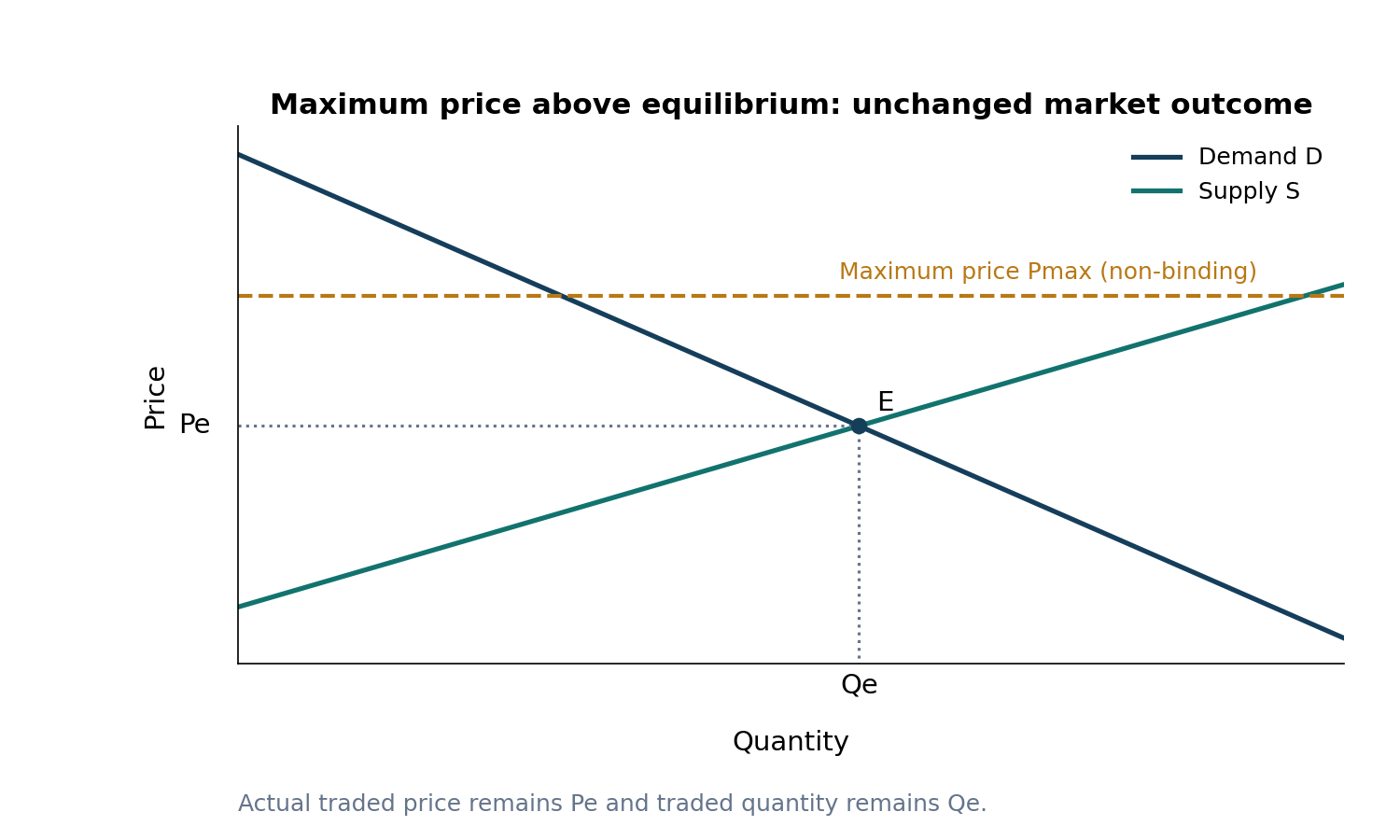
- Supply S and demand D initially intersect at E, determining equilibrium price Pe and quantity Qe.
- The government sets a maximum permitted price Pmax above Pe. Sellers remain allowed to charge the lower equilibrium price.
- The restriction therefore does not prevent the original equilibrium from operating: actual price remains Pe and quantity traded remains Qe.
- The ceiling itself creates neither a shortage nor a surplus because it does not force transactions to occur at Pmax.
- A shortage associated with a binding maximum price would require a ceiling below Pe; that is a different case from the one printed in this question.
Question 7(b)
Explain five structural changes that are exhibited by a country experiencing economic development. (10 marks)
Answer
- The relative contribution of low-productivity subsistence agriculture tends to decline as other activities grow.
- Manufacturing and modern services expand, increasing the diversity and value added of production.
- Labour moves toward more productive and skilled employment, often alongside urbanisation.
- Infrastructure, education and technology improve, supporting more productive economic relationships.
- Markets and institutions become more developed, with wider financial access, formal business activity and stronger links between sectors.