Information Communication Technology Theory — July 2024
KNEC Diploma in Sales and Marketing — Module I. Paper code: 2902/103A
Independent worked revision answers. These are not official KNEC marking schemes.
Question 1(a)
Outline three methods used to classify computers according to the way they process data. (3 marks)
Answer
- Analog computers.
- Digital computers.
- Hybrid computers.
Question 1(b)
Explain each of the following types of computer software stating an example of each: (i) operating system; (ii) utility programs. (5 marks)
Answer
- Operating system: system software that manages hardware and resources and provides services for applications and users; for example Microsoft Windows.
- Utility program: software performing a maintenance, protection or support task, such as a backup utility used to copy data for recovery.
Question 1(c)
A company has been advised to use uninterruptible power supply (UPS) devices for their computers. Outline four reasons for this advice. (4 marks)
Answer
- Provide temporary power during a supply interruption.
- Allow staff to save work and shut down safely.
- Reduce the risk of data loss or file corruption caused by abrupt power failure.
- Provide appropriate power protection or conditioning against specified disturbances, according to the UPS design.
Question 1(d)
Outline three advantages of using templates when creating a presentation in a presentation program. (3 marks)
Answer
- Saves preparation time through ready-made layouts and styles.
- Gives slides a consistent appearance.
- Provides a structured starting point that can be adapted to the content and audience.
Question 2(a)
The following are examples of storage media used in computer systems. Classify them as either primary or secondary: hard disk drives (HDDs), Read Only Memory, solid-state drives (SSDs), magnetic tapes, optical discs (like CDs, DVDs), Random Access Memory. (3 marks)
Answer
| Primary storage | Secondary storage |
|---|---|
| Read Only Memory (ROM); Random Access Memory (RAM). | Hard disk drives; solid-state drives; magnetic tapes; optical discs such as CDs and DVDs. |
Question 2(b)
With the aid of an illustration, describe a ring topology as used in computer networks with respect to each of the following: (i) physical structure; (ii) communication. (6 marks)
Answer
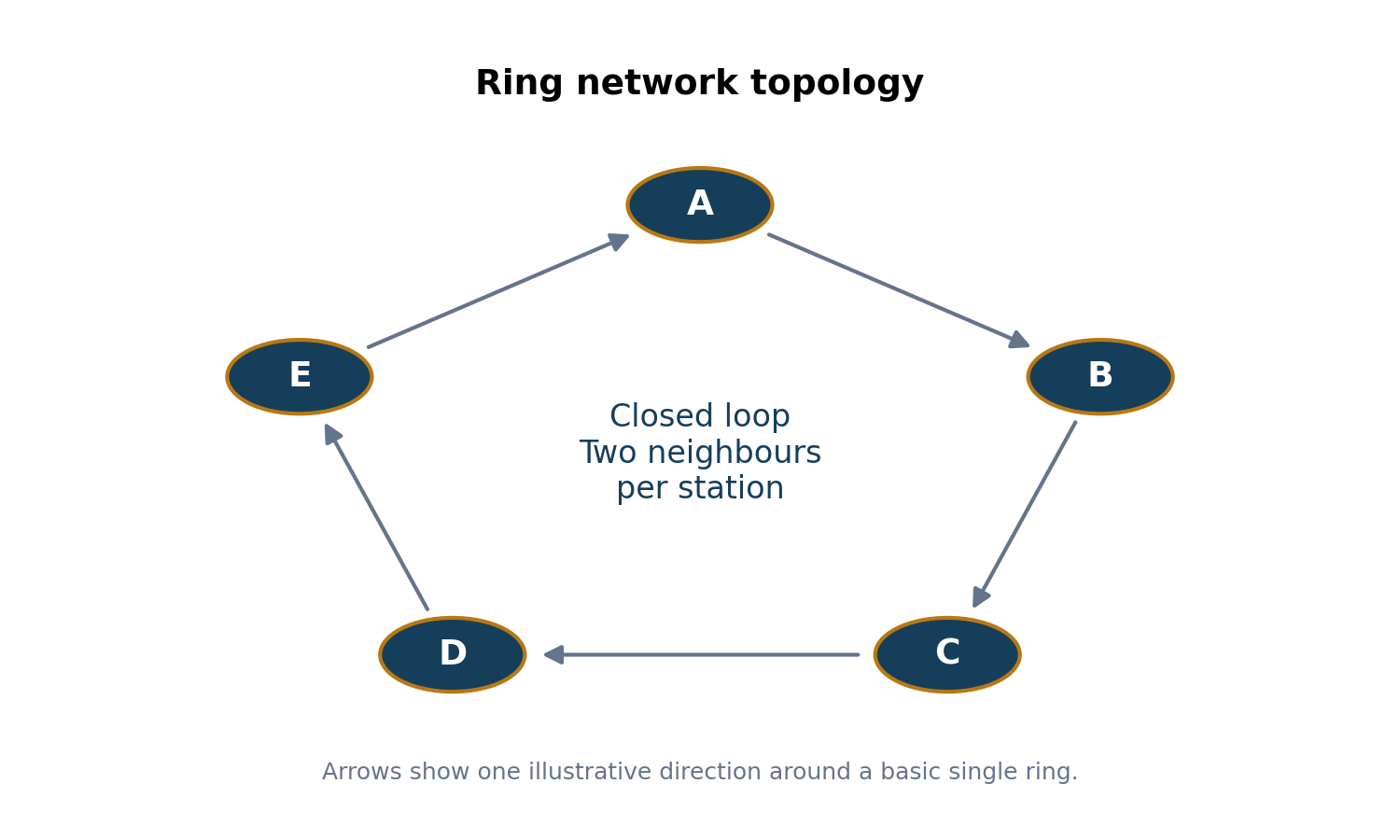
- Physical structure: each station connects to two neighbouring stations, and the final connection closes the loop.
- Communication: data is relayed around the ring until it reaches the intended recipient. In a basic single ring it travels in one direction; a token can regulate which station may transmit.
Question 2(c)
An organization opted to use in-house developed software for their operations. Explain three benefits the organization would derive from this software. (6 marks)
Answer
- Close fit to requirements: the software can be designed around the organisation’s own workflows and information needs.
- Control over changes: the organisation can prioritise modifications and integration with its existing systems.
- Internal knowledge and ownership: its development team can retain detailed knowledge of the system and manage access to its source code under the applicable ownership arrangements.
Question 3(a)
State six items that may be added to the header section of a word processing document. (3 marks)
Answer
- Organisation name.
- Document title.
- Company logo.
- Page number.
- Date.
- Author or department name.
Question 3(b)
Distinguish between viruses and worms with respect to how they spread in a computer system. (4 marks)
Answer
| Virus | Worm |
|---|---|
| Attaches to a host file or program and spreads when infected content is executed or otherwise activated. | Can replicate and spread between systems without attaching to a host program, often using network connections and exploitable weaknesses. |
Question 3(c)
Describe each of the following types of computers: (i) mainframe; (ii) micro-computers. (4 marks)
Answer
- Mainframe: a large, high-capacity computer designed for reliable processing of substantial transaction or data workloads and many concurrent users.
- Microcomputer: a computer built around a microprocessor and generally intended for individual use, such as a desktop or laptop.
Question 3(d)
Ken intends to include a table in a document created using a word processing program. Outline four ways he could insert a table in the document. (4 marks)
Answer
- Choose the required rows and columns from the Insert Table grid.
- Use the Insert Table dialogue and specify the number of rows and columns.
- Use Draw Table to draw the required cell boundaries.
- Convert suitably separated existing text into a table.
Question 4(a)
Outline four file organization methods used in data processing. (4 marks)
Answer
- Serial organisation.
- Sequential organisation.
- Indexed-sequential organisation.
- Direct or random organisation.
Question 4(b)
Distinguish between a dot matrix printer and a laser printer in respect to the printing mechanism used. (4 marks)
Answer
| Dot matrix printer | Laser printer |
|---|---|
| An impact printer: pins strike an inked ribbon against paper to form characters or graphics from dots. | A non-impact printer: a laser forms an electrostatic image on a drum; toner is transferred to paper and fused by heat and pressure. |
Question 4(c)
Explain a circumstance that necessitates the use of each of the following cell references in a spreadsheet program: (i) absolute; (ii) relative. (4 marks)
Answer
- Absolute reference, such as $B$1: use it when a copied formula must continue referring to one fixed cell, for example a rate stored in B1.
- Relative reference, such as B3: use it when references should adjust as a formula is copied to another row or column, for example calculating each row’s quantity multiplied by its unit price.
Question 4(d)
A database table used to manage students’ details has the following fields: StudentID, StudentName, Fee, DateAdmitted, Background Information, Photo. State the most appropriate data type for each of the fields. (3 marks)
Answer
| Field | Suitable data type |
|---|---|
| StudentID | Short Text for an identifier that may contain letters or leading zeros; AutoNumber is suitable if the system generates a numeric identifier. |
| StudentName | Short Text. |
| Fee | Currency. |
| DateAdmitted | Date/Time. |
| Background Information | Long Text / Memo. |
| Photo | Attachment; OLE Object is the corresponding older Access-style option. |
Question 5(a)
Outline the function of each of the following features of a spreadsheet software: (i) conditional formatting; (ii) macros; (iii) data validation. (3 marks)
Answer
- Conditional formatting applies specified formatting when a cell value or formula meets a condition.
- Macros automate a recorded or programmed sequence of tasks.
- Data validation restricts or checks entries against specified rules, such as a permitted list or value range.
Question 5(b)
Explain each of the following data processing modes: (i) multi-tasking; (ii) distributed. (4 marks)
Answer
- Multi-tasking: the operating system manages several tasks so they make progress over the same period, allocating processor time or using available processing resources.
- Distributed processing: processing work is shared among interconnected computers or locations that cooperate on the overall task.
Question 5(c)
A school installed servers for its computer network. Outline four functions of these devices in a computer network. (4 marks)
Answer
- Provide shared file storage and control access to stored resources.
- Manage user accounts, authentication and permissions.
- Provide shared applications or network services.
- Coordinate central backups or shared printing, according to the server roles configured.
Question 5(d)
With the aid of an example, describe two functions of the Arithmetic Logic Unit (ALU) in a computer system. (4 marks)
Answer
- Arithmetic: performs calculations such as addition, subtraction or multiplication; for example adding 500 and 200 to obtain 700.
- Logic and comparison: evaluates logical operations or comparisons; for example comparing a mark with 50 to determine whether the condition mark ≥ 50 is true.
Question 6(a)
Elimu Sacco secretary used the mail merge feature in a word processor to create mail inviting members for a meeting. Explain two types of files the secretary created in the application. (4 marks)
Answer
- Main document: the common invitation text with merge fields where each member’s details will appear.
- Data source: the file or table holding the member records, with fields such as name, address and membership number.
Question 6(b)
A company intends to acquire a computer software for its business operations. Explain three selection criteria the company should consider during the acquisition. (6 marks)
Answer
- Functional suitability: the software should perform the required tasks and produce the information the business needs.
- Compatibility and integration: it should work with the organisation’s hardware, operating systems, data formats and related systems.
- Total ownership cost and support: assess licence, implementation, training and maintenance costs together with the availability of reliable support and updates.
Question 6(c)(i)
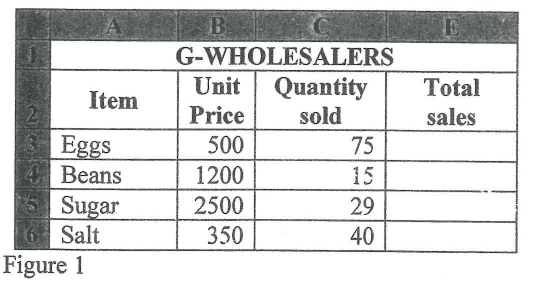
Figure 1 is a spreadsheet extract showing records of a shop. Use it to answer the questions that follow. Identify six types of cell formats that have been applied on the worksheet. (3 marks)
Answer
- Merged cells for the G-WHOLESALERS title across the top row.
- Bold font for the title and column headings.
- Centred alignment for the main heading and column labels.
- Wrapped text in labels such as Unit Price, Quantity sold and Total sales.
- Cell borders around the table entries.
- Right alignment of the numeric entries in the unit-price and quantity columns.
Question 6(c)(ii)
Write a formula that has cell references only to compute the total sales for eggs. (2 marks)
Answer
| Step | Entry or result |
|---|---|
| Cell for total sales | D3 |
| Formula using cell references only | =B3*C3 |
| B3 | 500 |
| C3 | 75 |
| Calculated total sales | 500 × 75 = 37,500 |