Economics — November 2021
KNEC Diploma in Sales and Marketing — Module I. Paper code: 2902/105
Independent worked revision answers. These are not official KNEC marking schemes.
Question 1(a)
Explain five benefits that a country may derive from adopting a planned economic system. (10 marks)
Answer
- Coordinated allocation: resources can be directed toward nationally chosen priorities rather than only private profitability.
- Essential provision: planning can support basic services and goods for groups with limited purchasing power.
- Reduced inequality: deliberate allocation and redistribution can improve access to resources and income.
- Long-term investment: major infrastructure and strategic industries can be developed through a coordinated programme.
- Reduced duplication: planned capacity and investment may avoid wasteful repetition of facilities.
Question 1(b)
Outline five factors that may influence the elasticity of demand of a product in the market. (10 marks)
Answer
- Availability and closeness of substitute products.
- Whether the good is a necessity or a luxury.
- The proportion of a consumer’s income spent on it.
- The time available for consumers to adjust their purchases.
- The number of uses of the product and how broadly it is defined.
Question 2(a)
The supply of tomatoes at Wakala market has been on the rise despite the price remaining constant. Explain five factors that may account for such a situation. (10 marks)
Answer
- Better production methods: improved seed, irrigation or cultivation can increase harvests at the same price.
- Lower input costs: cheaper fertiliser, labour or transport make a larger quantity profitable to supply.
- Favourable weather: suitable rain and temperature increase output without a price change.
- More producers: entry of additional farmers expands total market supply.
- Production support: appropriate subsidies or improved access to inputs can enable farmers to supply more at the existing price.
Question 2(b)
Explain five ways in which prices of goods may be determined in the market. (10 marks)
Answer
- Demand and supply: market interaction establishes a price where quantity demanded equals quantity supplied.
- Bargaining: buyer and seller negotiate until they agree on an acceptable price.
- Auction: competing bids determine the price under the auction’s rules.
- Cost-plus pricing: the seller adds a chosen margin to relevant cost.
- Administrative pricing: a producer or public authority sets an applicable price rather than leaving it entirely to immediate market bargaining.
Question 3(a)
Explain five factors that may limit the geographical movement of labour in an economy. (10 marks)
Answer
- Relocation costs: travel and moving expenses may exceed what a worker can afford.
- Housing shortages: suitable accommodation may be unavailable or expensive at the destination.
- Family and social ties: caring duties or attachment to a community can discourage movement.
- Inadequate information: workers may not know where suitable vacancies exist.
- Entry barriers: language difficulties, qualification recognition or applicable migration restrictions can prevent workers from taking jobs elsewhere.
Question 3(b)
Kato Enterprises intends to set up a new manufacturing plant in the country. Outline five factors that the enterprise may consider when selecting an appropriate location for the plant. (10 marks)
Answer
- Access to suitable raw materials and suppliers.
- Proximity and transport access to the target market.
- Availability and cost of appropriate labour.
- Reliable utilities, transport and communication infrastructure.
- Suitable land, total operating costs and applicable planning conditions.
Question 4(a)
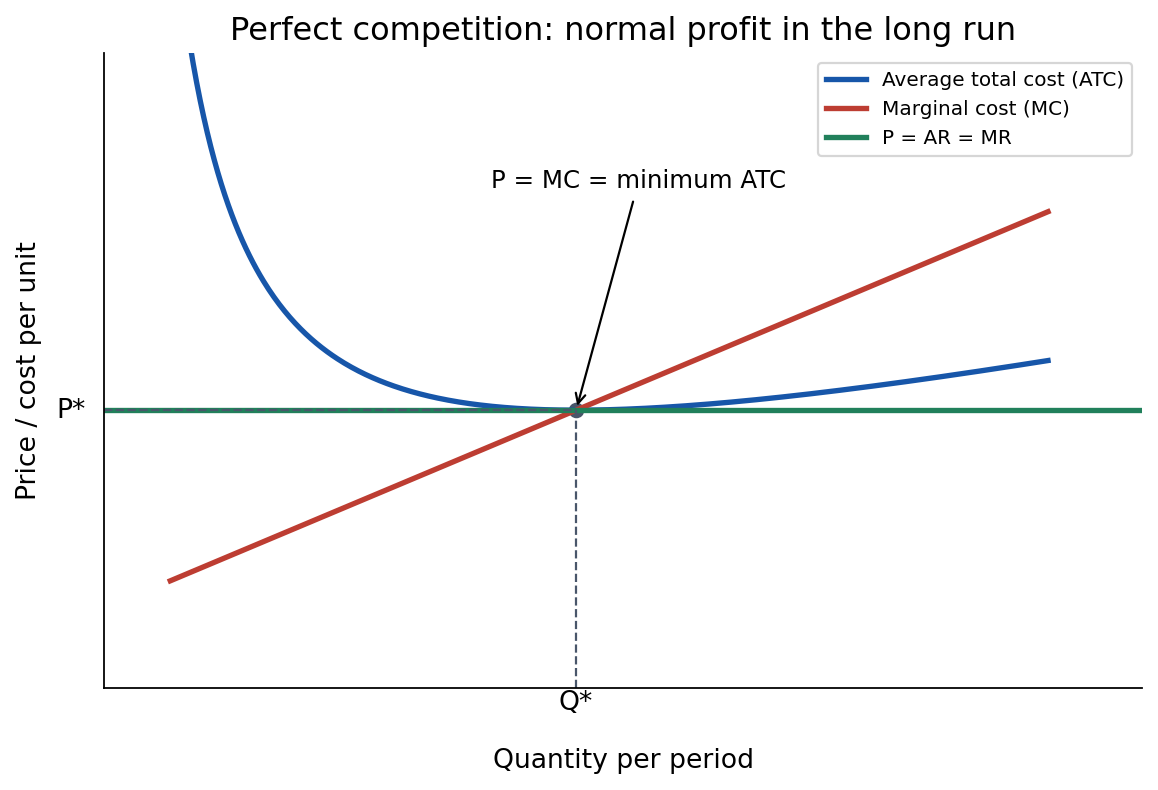
Using a diagram, explain how a perfectly competitive market may enjoy normal profits in the long run. (10 marks)
Answer
- A representative competitive firm is a price taker, with P = AR = MR.
- If firms earn abnormal profits, entry increases industry supply and tends to lower price.
- If firms incur sustained economic losses, exit reduces industry supply and tends to raise price.
- Long-run equilibrium is reached where the representative firm chooses Q* at P = MC = minimum ATC.
- Total revenue then equals total economic cost, including the normal return to enterprise: abnormal economic profit is zero, while normal profit remains covered.
Question 4(b)
Country X has been experiencing wide income disparities among the citizens. Explain five factors that may have contributed to such disparities. (10 marks)
Answer
- Unequal asset ownership: owners of land and capital receive returns unavailable to those without assets.
- Differences in education and skills: scarce qualifications often command higher earnings.
- Unequal employment opportunities: unemployment, regional differences and access to formal jobs create income gaps.
- Differences in bargaining power: workers or firms with stronger influence can obtain better remuneration.
- Unequal access to opportunities: discrimination, weak mobility or inherited advantages can prevent otherwise capable people from obtaining higher incomes.
Question 5(a)
Explain five ways in which commercial banks may contribute to economic development of a country. (10 marks)
Answer
- Mobilise savings: deposit services collect funds that can support productive investment.
- Provide credit: suitable loans and working-capital finance enable viable firms to expand output.
- Facilitate payments: efficient settlement supports trade and reduces transaction difficulty.
- Support international trade: appropriate payment and trade-finance services help firms buy and sell across borders.
- Provide financial services and advice: cash management and related services assist business planning and resource use.
Question 5(b)
The amount of tax imposed by the government of a certain country has been on the rise in the recent past. Explain five reasons that may account for such a trend. (10 marks)
Answer
- Growing expenditure needs: more spending on infrastructure and public services may require additional revenue.
- Debt obligations: interest and repayment commitments can increase the need for tax resources.
- Inflation and higher public costs: maintaining services may require larger nominal revenue when costs rise.
- Redistribution objectives: additional taxes on those with greater ability to pay may finance support for lower-income groups.
- Demand-management or corrective objectives: tax increases may seek to restrain excess demand or discourage activities with social costs.
Question 6(a)
Explain five negative effects of inflation in an economy. (10 marks)
Answer
- Lower real purchasing power: incomes that do not rise as fast as prices buy fewer goods and services.
- Loss to fixed-income earners and savers: unexpected inflation reduces the real value of fixed payments and cash savings.
- Uncertainty: unstable prices make budgeting, costing and investment decisions more difficult.
- Redistribution: unexpected inflation can transfer real wealth from lenders to borrowers under fixed nominal contracts.
- Weaker competitiveness: domestic prices rising faster than trading partners’ prices can reduce demand for exports and encourage imports.
Question 6(b)
Outline five methods that a government may use to restrict the importation of goods and services into the country. (10 marks)
Answer
- Import tariffs or duties.
- Import quotas limiting permitted quantities.
- Import licensing requirements.
- Embargoes or bans on specified imports.
- Applicable foreign-exchange restrictions that limit funding for imports.
Question 7(a)
Explain five policies that may be adopted by a government to reduce high level of unemployment in an economy. (10 marks)
Answer
- Support productive investment: suitable infrastructure and investment conditions encourage firms to create jobs.
- Develop relevant skills: training and retraining help workers meet available job requirements.
- Encourage enterprise: access to appropriate support and finance enables viable self-employment and small-business growth.
- Improve labour-market information: job matching and mobility support reduce the time spent between jobs.
- Use suitable demand policies: where unemployment reflects weak demand, appropriately designed spending or monetary measures can increase employment.
Question 7(b)
Outline five advantages of economic development to a country. (10 marks)
Answer
- Higher real incomes and improved material living standards.
- More productive employment opportunities.
- Better infrastructure and public services.
- Reduced poverty and wider access to education and health services.
- A more diverse and resilient productive economy.