Engineering Mathematics III — October/November 2023
KNEC Diploma in Mechanical Engineering — Module III. Paper code: 2501/303; 2502/303; 2503/303; 2508/303; 2509/303. Time: 3 hours.
Questions are transcribed from the supplied examination paper. The independent revision answers are not official KNEC marking schemes. All 8 questions, including optional questions, are answered.
This paper consists of EIGHT questions. Answer FIVE of the following EIGHT questions. All questions carry equal marks. Maximum marks for each part of a question are as shown.
All eight printed questions are answered. Calculation steps are set out in tables. The original Table 1 is retained before its correction. The triple integral in Question 5(a)(ii) is evaluated with its printed limits, including the reversed z bounds over part of the region. The Fourier force waveform is continued with the period shown by its repeating ramp.
Question 1(a)
Given the matrix A, determine: (i) the matrix B = AᵀA (ii) A⁻¹.
| 1 | -1 | -1 |
| 1 | 1 | 1 |
| 1 | -1 | 1 |
(10 marks)
Answer
(i) Form AᵀA
| 1 | 1 | 1 |
| -1 | 1 | -1 |
| -1 | 1 | 1 |
| Step | Working |
|---|---|
| Rule | Bᵢⱼ is the dot product of column i of A with column j of A. |
| Diagonal entries | B₁₁ = B₂₂ = B₃₃ = 1² + 1² + 1² = 3. |
| Off-diagonal entries | B₁₂ = −1 + 1 − 1 = −1; B₁₃ = −1 + 1 + 1 = 1; B₂₃ = 1 + 1 − 1 = 1. |
| Symmetry | B₂₁ = B₁₂, B₃₁ = B₁₃ and B₃₂ = B₂₃. |
| 3 | -1 | 1 |
| -1 | 3 | 1 |
| 1 | 1 | 3 |
(ii) Find the inverse
| Step | Working |
|---|---|
| Determinant | |A| = 1(1 + 1) − (−1)(1 − 1) + (−1)(−1 − 1) = 4. |
| Method | A⁻¹ = adj(A)/|A|. The adjugate is the transpose of the cofactor matrix. |
| 2 | 0 | -2 |
| 2 | 2 | 0 |
| 0 | -2 | 2 |
| 2 | 2 | 0 |
| 0 | 2 | -2 |
| -2 | 0 | 2 |
| 1/2 | 1/2 | 0 |
| 0 | 1/2 | −1/2 |
| −1/2 | 0 | 1/2 |
Check: multiplying A by this inverse gives the 3 × 3 identity matrix.
Question 1(b)
A mechanical system is subjected to the forces F₁, F₂ and F₃ in Newtons, satisfying the simultaneous equations: F₁ − F₂ + F₃ = 20; F₁ − F₂ − F₃ = −40; F₁ + F₂ + F₃ = 60. Use Cramer’s rule to solve the equations.
(10 marks)
Answer
Write M F = b with the equations in their printed order.
| 1 | -1 | 1 |
| 1 | -1 | -1 |
| 1 | 1 | 1 |
| 20 |
| -40 |
| 60 |
| Step | Working |
|---|---|
| Main determinant | Δ = 1(−1 + 1) − (−1)(1 + 1) + 1(1 + 1) = 4. |
| Replace column 1 | Δ₁ = 20(0) + [−40 + 60] + [−40 + 60] = 40. |
| Replace column 2 | Δ₂ = (20) − 20(2) + (100) = 80. |
| Replace column 3 | Δ₃ = (−60 + 40) + (60 + 40) + 20(2) = 120. |
| Cramer’s rule | F₁ = Δ₁/Δ = 40/4 = 10 N; F₂ = 80/4 = 20 N; F₃ = 120/4 = 30 N. |
| Substitute to check | 10 − 20 + 30 = 20; 10 − 20 − 30 = −40; 10 + 20 + 30 = 60. |
Question 2(a)
Find the: (i) Laplace transform of f(t) = t sin 3t. (ii) Inverse Laplace transform of F(s) = (2s + 1)/[(s − 1)(s² + 3)].
(9 marks)
Answer
(i) Transform of t sin 3t
| Step | Working |
|---|---|
| Known transform | L{sin 3t} = 3/(s² + 9). |
| Multiplication by t | L{t f(t)} = −dF(s)/ds. |
| Differentiate | L{t sin 3t} = −d[3/(s² + 9)]/ds = 6s/(s² + 9)². |
(ii) Inverse transform
| Step | Working |
|---|---|
| Partial fractions | F(s) = A/(s − 1) + (Bs + C)/(s² + 3). |
| Clear denominators | 2s + 1 = A(s² + 3) + (Bs + C)(s − 1). |
| Compare coefficients | A + B = 0; C − B = 2; 3A − C = 1. |
| Solve | A = 3/4, B = −3/4, C = 5/4. |
| Standard pairs | L⁻¹{1/(s − 1)} = eᵗ; L⁻¹{s/(s² + 3)} = cos(√3 t); L⁻¹{1/(s² + 3)} = sin(√3 t)/√3. |
Question 2(b)
Use Laplace transforms to solve the differential equation 2d²x/dt² + 3dx/dt + x = 3e^(−t/2) given that when t = 0, x = 0 and dx/dt = 1.
(11 marks)
Answer
| Step | Working |
|---|---|
| Define the transform | Let X(s) = L{x(t)}. With the initial conditions, L{x′} = sX and L{x″} = s²X − 1. |
| Transform the equation | 2(s²X − 1) + 3sX + X = 3/(s + 1/2). |
| Factor the operator | (2s + 1)(s + 1)X = 2 + 3/(s + 1/2). |
| Combine into one fraction | X(s) = (s + 2)/[(s + 1/2)²(s + 1)]. |
| Partial fractions | X(s) = −4/(s + 1/2) + 3/(s + 1/2)² + 4/(s + 1). |
| Invert term by term | L⁻¹{1/(s + a)} = e^(−at); L⁻¹{1/(s + a)²} = te^(−at). |
| Step | Working |
|---|---|
| Initial displacement | x(0) = 4 − 4 = 0. |
| Initial velocity | x′(t) = −4e^(−t) + (5 − 3t/2)e^(−t/2), so x′(0) = 1. |
| Equation check | Substitution of x, x′ and x″ gives 2x″ + 3x′ + x = 3e^(−t/2). |
Question 3(a)
(i) Show that one root of the equation x² − cos x − 1 = 0 lies between x = 1 and x = 2. (ii) Use the Newton-Raphson method to determine the root in (i), correct to three decimal places.
(10 marks)
Answer
Use radians for the trigonometric functions and their derivatives.
| Step | Working |
|---|---|
| Sign at the left endpoint | f(1) = 1 − cos 1 − 1 = −0.540302 < 0. |
| Sign at the right endpoint | f(2) = 4 − cos 2 − 1 = 3.416147 > 0. |
| Existence | f is continuous on [1, 2], so the sign change guarantees a root between 1 and 2. |
| Derivative | f′(x) = 2x + sin x. |
| Iteration | xₙ₊₁ = xₙ − [xₙ² − cos xₙ − 1]/[2xₙ + sin xₙ]. Choose x₀ = 1.5. |
| n | xₙ | f(xₙ) | f′(xₙ) | xₙ₊₁ |
|---|---|---|---|---|
| 0 | 1.500000000 | 1.179262798 | 3.997494987 | 1.204999555 |
| 1 | 1.204999555 | 0.094330464 | 3.343838168 | 1.176789319 |
| 2 | 1.176789319 | 0.000941631 | 3.276956859 | 1.176501970 |
| 3 | 1.176501970 | 0.000000098 | 3.276271812 | 1.176501940 |
Question 3(b)
Table 1 represents a cubic polynomial f(x), and an error in one of the entries is suspected. Use: (i) a table of finite differences to locate and correct the error. (ii) the Newton-Gregory forward difference interpolation formula to determine f(0.5).
| x | −2 | −1 | 0 | 1 | 2 | 3 | 4 | 5 |
|---|---|---|---|---|---|---|---|---|
| f(x) | 5 | 9 | 6 | 5 | 9 | 25 | 59 | 117 |
(10 marks)
Answer
(i) Locate and correct the error
| x | f(x) | Δf | Δ²f | Δ³f | Δ⁴f |
|---|---|---|---|---|---|
| -2 | 5 | 4 | -7 | 9 | -6 |
| -1 | 9 | -3 | 2 | 3 | 4 |
| 0 | 6 | -1 | 5 | 7 | -1 |
| 1 | 5 | 4 | 12 | 6 | 0 |
| 2 | 9 | 16 | 18 | 6 | |
| 3 | 25 | 34 | 24 | ||
| 4 | 59 | 58 | |||
| 5 | 117 |
| Step | Working |
|---|---|
| Property of a cubic | For equally spaced x, third differences are constant and fourth differences are zero. |
| Observed fourth differences | The printed data produce Δ⁴ = −6, 4, −1, 0. |
| Effect of correcting f(0) | If δ is added to f(0), these four values change by 6δ, −4δ, δ, 0 respectively. |
| Choose the correction | −6 + 6δ = 0, 4 − 4δ = 0 and −1 + δ = 0 all give δ = 1. |
| Correct entry | f(0) = 6 + 1 = 7. |
| x | f(x) | Δf | Δ²f | Δ³f | Δ⁴f |
|---|---|---|---|---|---|
| -2 | 5 | 4 | -6 | 6 | 0 |
| -1 | 9 | -2 | 0 | 6 | 0 |
| 0 | 7 | -2 | 6 | 6 | 0 |
| 1 | 5 | 4 | 12 | 6 | 0 |
| 2 | 9 | 16 | 18 | 6 | |
| 3 | 25 | 34 | 24 | ||
| 4 | 59 | 58 | |||
| 5 | 117 |
(ii) Newton-Gregory interpolation
| Step | Working |
|---|---|
| Base point and spacing | Choose x₀ = 0, h = 1, so u = (0.5 − 0)/1 = 0.5. |
| Forward values from the corrected table | f₀ = 7; Δf₀ = −2; Δ²f₀ = 6; Δ³f₀ = 6. |
| Formula | f(x) = f₀ + uΔf₀ + u(u − 1)Δ²f₀/2! + u(u − 1)(u − 2)Δ³f₀/3!. |
| Insert u = 0.5 | f(0.5) = 7 + 0.5(−2) + [0.5(−0.5)/2](6) + [0.5(−0.5)(−1.5)/6](6). |
| Evaluate | f(0.5) = 7 − 1 − 0.75 + 0.375 = 5.625. |
| Independent polynomial check | The corrected values lie on f(x) = x³ − 3x + 7, which also gives 5.625 at x = 0.5. |
Question 4(a)
Show that the general solution of the differential equation xy dy/dx = x² + y² may be expressed in the form x = Ae^(y²/(2x²)), where A is an arbitrary constant.
(7 marks)
Answer
| Step | Working |
|---|---|
| Homogeneous substitution | Set v = y/x, so y = vx and dy/dx = v + x dv/dx, for x ≠ 0. |
| Substitute | x(vx)(v + x dv/dx) = x² + v²x². |
| Cancel v²x² | v x³ dv/dx = x², hence v dv = dx/x. |
| Integrate | v²/2 = ln|x| + C. |
| Return to x and y | y²/(2x²) = ln|x| + C. |
| Rearrange and exponentiate | ln|x| = y²/(2x²) − C, so x = Ae^(y²/(2x²)), with the sign absorbed into A. |
This implicit form is used on intervals where the substitution is defined. A is a nonzero constant on such a solution branch.
Question 4(b)
The displacement x(t) of a body from a fixed position satisfies the differential equation d²x/dt² + x = cos t. Given that when t = 0, x = 0 and dx/dt = 0, use the method of undetermined coefficients to determine an expression for x(t).
(13 marks)
Answer
| Step | Working |
|---|---|
| Complementary solution | The auxiliary equation is m² + 1 = 0, so x_c = C₁ cos t + C₂ sin t. |
| Resonant trial | cos t is already in x_c. Multiply a sine/cosine trial by t; choose x_p = Kt sin t. |
| Differentiate | x_p′ = K sin t + Kt cos t; x_p″ = 2K cos t − Kt sin t. |
| Substitute the trial | x_p″ + x_p = 2K cos t = cos t, giving K = 1/2. |
| General form | x = C₁ cos t + C₂ sin t + (t/2)sin t. |
| Apply x(0) = 0 | C₁ = 0. |
| Apply x′(0) = 0 | x′ = −C₁ sin t + C₂ cos t + (1/2)sin t + (t/2)cos t, so C₂ = 0. |
Question 5(a)
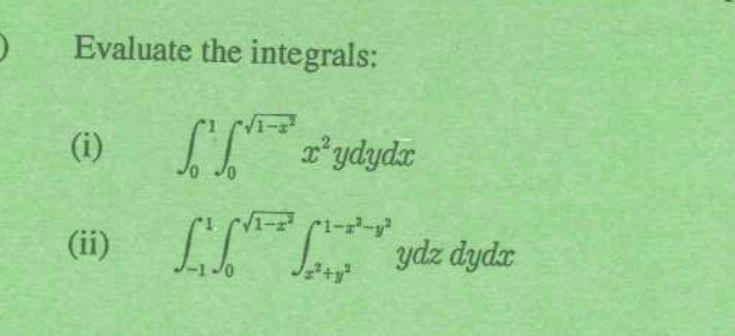
Evaluate the integrals: (i) ∫₀¹ ∫₀^√(1−x²) x²y dy dx (ii) ∫₋₁¹ ∫₀^√(1−x²) ∫_(x²+y²)^(1−x²−y²) y dz dy dx.
(13 marks)
Answer
(i) Double integral
| Step | Working |
|---|---|
| Integrate with respect to y | ∫₀^√(1−x²) x²y dy = [x²y²/2]₀^√(1−x²) = x²(1 − x²)/2. |
| Integrate with respect to x | I₁ = (1/2)∫₀¹(x² − x⁴) dx = (1/2)[x³/3 − x⁵/5]₀¹. |
| Evaluate | I₁ = (1/2)(1/3 − 1/5) = 1/15. |
(ii) Triple integral with the printed bounds
| Step | Working |
|---|---|
| Integrate with respect to z | ∫_(x²+y²)^(1−x²−y²) y dz = y(1 − 2x² − 2y²). |
| Identify the xy region | −1 ≤ x ≤ 1 and 0 ≤ y ≤ √(1 − x²) describe the upper half of the unit disk. |
| Use polar coordinates | x = r cos θ; y = r sin θ; dx dy = r dr dθ; 0 ≤ r ≤ 1 and 0 ≤ θ ≤ π. |
| Transform the integral | I₂ = ∫₀^π ∫₀¹ r² sin θ(1 − 2r²) dr dθ. |
| Separate the factors | I₂ = [∫₀^π sin θ dθ][∫₀¹(r² − 2r⁴)dr]. |
| Evaluate | I₂ = 2[1/3 − 2/5] = −2/15. |
Why is the result negative? The z upper bound 1 − r² is below the lower bound r² when r > 1/√2. The printed iterated integral therefore includes a negative contribution there. This is a signed integral, not the positive volume of a solid.
If one instead intended the integral of y over the actual region between the two paraboloids, that would be a different integral with 0 ≤ r ≤ 1/√2. It would equal √2/15. The stated answer above retains the original unit-disk limits.
Question 5(b)
Use a double integral to determine the volume of the solid in the first octant bounded by the coordinate planes and the plane x + 2y + z = 1.
(7 marks)
Answer
| Step | Working |
|---|---|
| Height of the solid | z = 1 − x − 2y, above the xy plane z = 0. |
| Projection onto the xy plane | 0 ≤ x ≤ 1 and 0 ≤ y ≤ (1 − x)/2. |
| Volume integral | V = ∫₀¹ ∫₀^((1−x)/2) (1 − x − 2y) dy dx. |
| Inner integration | [(1 − x)y − y²]₀^((1−x)/2) = (1 − x)²/4. |
| Outer integration | V = (1/4)∫₀¹(1 − 2x + x²)dx = (1/4)[x − x² + x³/3]₀¹ = 1/12. |
| Intercept check | The intercepts are 1, 1/2 and 1, so the tetrahedron formula also gives (1 × 1/2 × 1)/6 = 1/12. |
Question 6(a)
Given the vector A = 2i + 3j + 2k and B = −i + 4j + 5k, determine: (i) a unit vector perpendicular to A and B. (ii) the angle between A and B.
(9 marks)
Answer
(i) Perpendicular unit vector
| Step | Working |
|---|---|
| Use the cross product | A × B = (3×5 − 2×4)i − (2×5 − 2×(−1))j + (2×4 − 3×(−1))k. |
| Simplify | A × B = 7i − 12j + 11k. |
| Find its magnitude | |A × B| = √(7² + (−12)² + 11²) = √314. |
| Normalise | n̂ = (7i − 12j + 11k)/√314. The negative of this unit vector is also valid. |
| Check perpendicularity | A·(7,−12,11) = 14 − 36 + 22 = 0; B·(7,−12,11) = −7 − 48 + 55 = 0. |
(ii) Angle
| Step | Working |
|---|---|
| Dot product | A·B = 2(−1) + 3(4) + 2(5) = 20. |
| Magnitudes | |A| = √(4 + 9 + 4) = √17; |B| = √(1 + 16 + 25) = √42. |
| Apply the formula | cos θ = (A·B)/(|A||B|) = 20/√714. |
| Evaluate | θ = cos⁻¹(20/√714) = 41.5410°. |
Question 6(b)
The temperature T in a workshop is given by T(x, y, z) = x²y + y²z. Determine, at the point (1, 1, 2): (i) |∇T| (ii) the directional derivative of T in the direction of the vector A = 2i − 2j + k.
(7 marks)
Answer
| Step | Working |
|---|---|
| Differentiate the scalar field | ∇T = (∂T/∂x)i + (∂T/∂y)j + (∂T/∂z)k = 2xy i + (x² + 2yz)j + y² k. |
| Evaluate at (1,1,2) | ∇T = 2i + 5j + k. |
| Gradient magnitude | |∇T| = √(2² + 5² + 1²) = √30 ≈ 5.4772. |
| Unit direction | |A| = √(2² + (−2)² + 1²) = 3, so â = (2i − 2j + k)/3. |
| Directional derivative | D_âT = ∇T·â = [2(2) + 5(−2) + 1(1)]/3 = −5/3. |
The direction vector must be normalised. Its negative derivative means temperature decreases when moving in the stated direction at the point.
Question 6(c)
A vector field E = −yz i + xy j + zx k exists in a region of space. Determine ∇×E and at the point (1, −2, 1).
(4 marks)
Answer
The wording is retained. Find the curl as a field and then evaluate it at the given point.
| Component | Partial derivatives | Result |
|---|---|---|
| i | ∂(zx)/∂y − ∂(xy)/∂z | 0 − 0 = 0 |
| j | ∂(−yz)/∂z − ∂(zx)/∂x | −y − z |
| k | ∂(xy)/∂x − ∂(−yz)/∂y | y + z |
| Step | Working |
|---|---|
| Insert the point | At (1,−2,1), y + z = −1. |
| Curl at the point | (∇×E)(1,−2,1) = j − k. |
Question 7(a)
(i) Sketch the odd extension of the function f(t) = π² − t², 0 < t < π, on the interval −2π < t < 2π. (ii) Determine the half-range Fourier sine series of the function in (i).
(8 marks)
Answer
(i) Odd periodic extension
| Interval | Odd extension g(t) |
|---|---|
| −π < t < 0 | t² − π² |
| 0 < t < π | π² − t² |
| Outside the base interval | Repeat with period 2π: g(t + 2π) = g(t). |
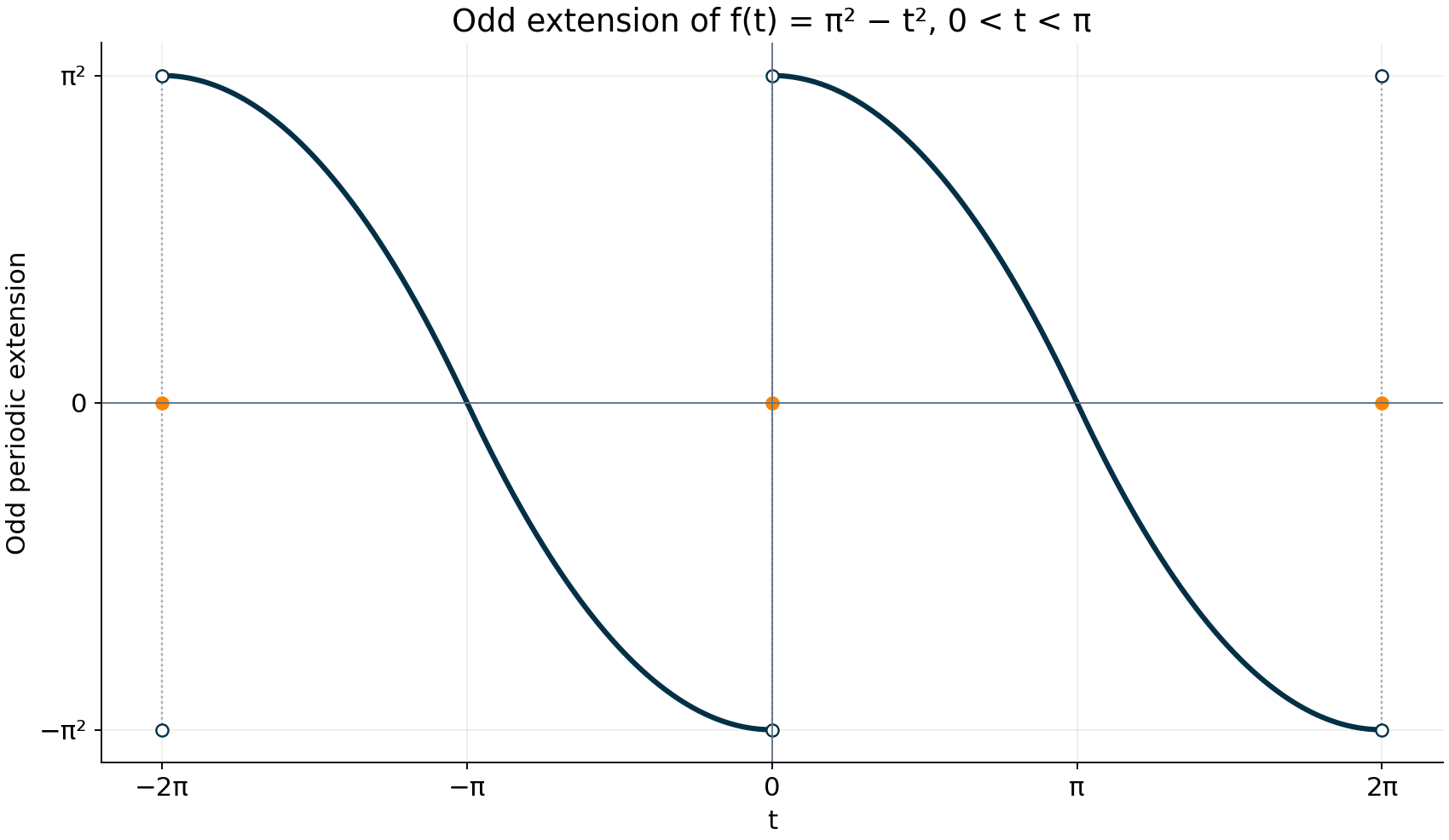
The one-sided limits at 0 are −π² and π². The odd midpoint value and the Fourier-series value there are 0. At t = ±π the value is 0.
(ii) Sine coefficients
| Step | Working |
|---|---|
| Series form | f(t) = Σₙ₌₁^∞ bₙ sin(nt), for 0 < t < π. The odd extension has no constant or cosine terms. |
| Coefficient integral | bₙ = (2/π)∫₀^π(π² − t²)sin(nt)dt. |
| First elementary integral | ∫₀^π sin(nt)dt = [1 − (−1)ⁿ]/n. |
| Integrate the quadratic term twice by parts | An antiderivative of t²sin(nt) is −t²cos(nt)/n + 2t sin(nt)/n² + 2cos(nt)/n³. |
| Evaluate that term | ∫₀^π t²sin(nt)dt = −π²(−1)ⁿ/n + 2[(−1)ⁿ − 1]/n³. |
| Combine | ∫₀^π(π² − t²)sin(nt)dt = π²/n + 2[1 − (−1)ⁿ]/n³. |
| Multiply by 2/π | bₙ = 2π/n + 4[1 − (−1)ⁿ]/(πn³). |
Equivalently, bₙ = 2π/n + 8/(πn³) for odd n and bₙ = 2π/n for even n. The equality to π² − t² holds inside 0 < t < π; at jumps of the periodic extension the series converges to the mean of the one-sided limits.
Question 7(b)
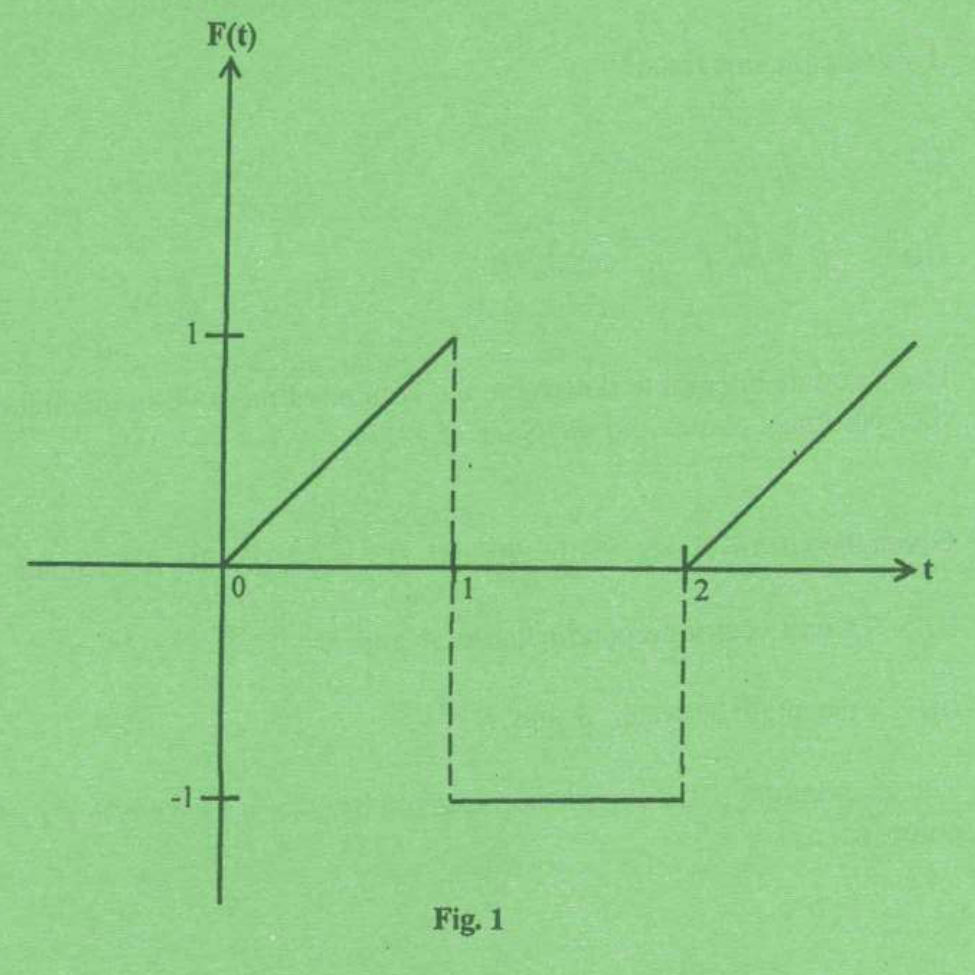
The force F(t) Newtons acting on a mechanical system varies with time t as shown in Figure 1. Determine the: (i) analytical description of F(t); (ii) Fourier series representation of F(t).
(12 marks)
Answer
(i) Analytical description
The repeated ramp starting at t = 2 indicates a period of 2. Using this periodic continuation, one base period is:
| Interval | F(t) |
|---|---|
| 0 ≤ t < 1 | t |
| 1 ≤ t < 2 | −1 |
| All subsequent periods | F(t + 2) = F(t). |
Values assigned exactly at a jump do not change the Fourier coefficients. Over any period 2k ≤ t < 2k + 2, replace t in the first branch by t − 2k.
(ii) Fourier coefficients
| Step | Working |
|---|---|
| Fundamental angular frequency | T = 2, hence ω₀ = 2π/T = π. The coefficient factor 2/T equals 1. |
| Mean coefficient | a₀ = ∫₀²F(t)dt = ∫₀¹t dt − ∫₁²1 dt = 1/2 − 1 = −1/2. |
| Constant term | a₀/2 = −1/4. |
| Cosine coefficient | aₙ = ∫₀¹t cos(nπt)dt − ∫₁²cos(nπt)dt. |
| Integrate by parts | ∫t cos(kt)dt = t sin(kt)/k + cos(kt)/k², with k = nπ. |
| Evaluate aₙ | aₙ = [(−1)ⁿ − 1]/(n²π²). The integral of cos(nπt) over [1,2] is zero. |
| Sine coefficient | bₙ = ∫₀¹t sin(nπt)dt − ∫₁²sin(nπt)dt. |
| Evaluate the ramp part | [−t cos(nπt)/(nπ) + sin(nπt)/(nπ)²]₀¹ = −(−1)ⁿ/(nπ). |
| Evaluate the constant part | [cos(nπt)/(nπ)]₁² = [1 − (−1)ⁿ]/(nπ). |
| Combine bₙ | bₙ = [1 − 2(−1)ⁿ]/(nπ). |
For a quick coefficient check: a₁ = −2/π², b₁ = 3/π, a₂ = 0 and b₂ = −1/(2π). At t = 1 the series converges to (1 + (−1))/2 = 0; at t = 0 or 2 it converges to (−1 + 0)/2 = −1/2.
Question 8(a)
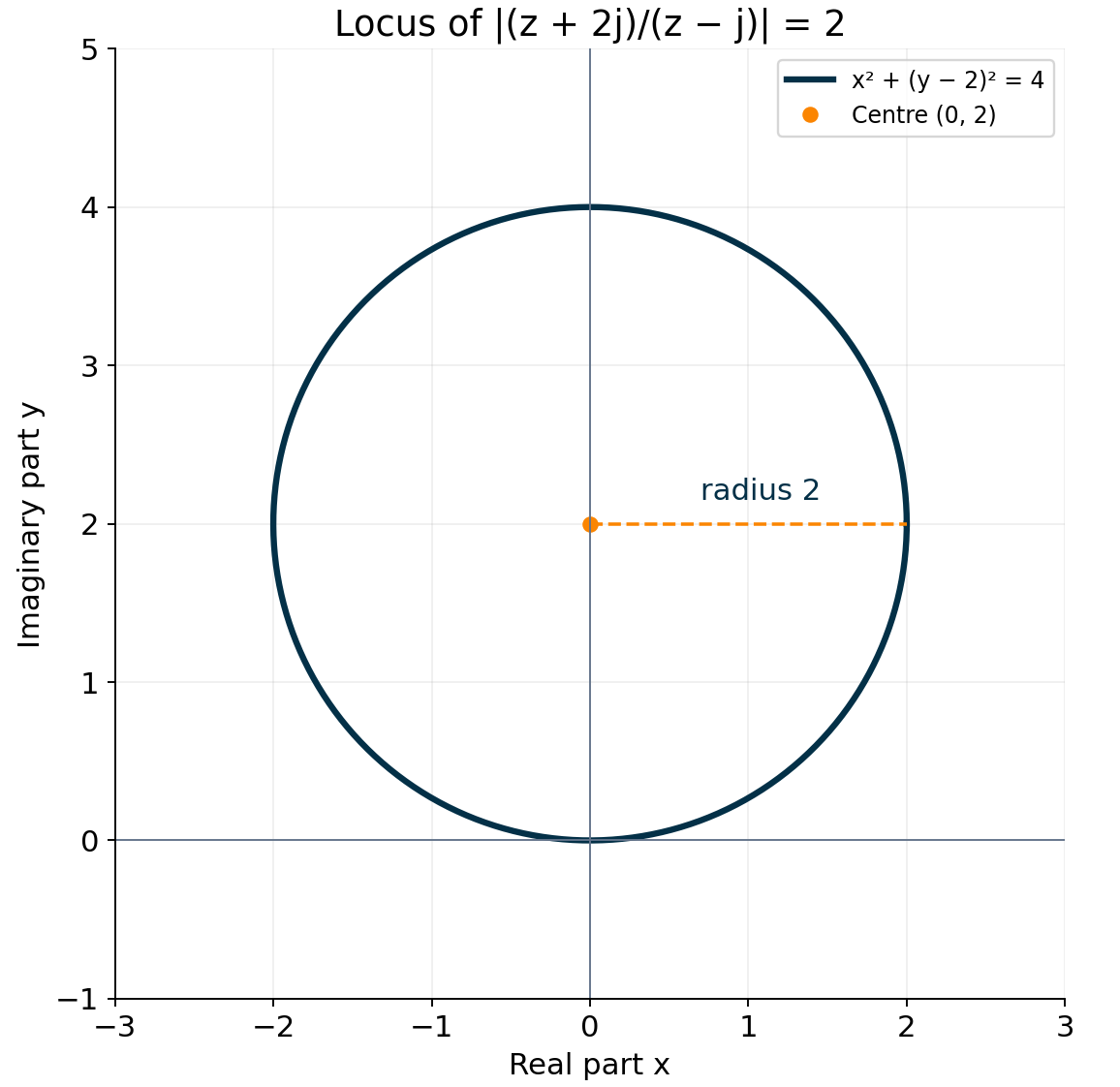
Given that z = x + jy. (i) show that the locus of |(z + 2j)/(z − j)| = 2 is a circle, and (ii) determine the centre and radius of the circle in (i).
(9 marks)
Answer
| Step | Working |
|---|---|
| Use the modulus quotient | |z + 2j| = 2|z − j|, with z ≠ j. |
| Substitute z = x + jy | √[x² + (y + 2)²] = 2√[x² + (y − 1)²]. |
| Square both sides | x² + (y + 2)² = 4[x² + (y − 1)²]. |
| Expand | x² + y² + 4y + 4 = 4x² + 4y² − 8y + 4. |
| Collect and divide by 3 | x² + y² − 4y = 0. |
| Complete the square | x² + (y − 2)² = 4. |
| Read the circle parameters | Centre = (0,2), or 2j in the complex plane. Radius = 2. |
The original quotient excludes z = j. That point is not on this circle, so no additional point needs to be removed from the circle.
Question 8(b)
Obtain the general solution of the differential equation x² dy/dx + (x² + 2x)y = x².
(11 marks)
Answer
| Step | Working |
|---|---|
| Put into linear form | For x ≠ 0, divide by x²: dy/dx + (1 + 2/x)y = 1. |
| Find the integrating factor | μ(x) = exp[∫(1 + 2/x)dx] = exp[x + 2ln|x|] = x²eˣ. |
| Multiply through | d(x²eˣy)/dx = x²eˣ. |
| Integrate by parts twice | ∫x²eˣ dx = x²eˣ − 2∫xeˣ dx = eˣ(x² − 2x + 2). |
| Include the integration constant | x²eˣy = eˣ(x² − 2x + 2) + C. |
| Divide by x²eˣ | y = 1 − 2/x + 2/x² + Ce^(−x)/x². |
This general solution is stated on intervals that exclude the singular point x = 0.