Communication — November 2024
Source: 01 COMMUNICATION NOV 2024-compressed.pdf | Paper code: 2912/104; 2918/104
Question 1
Outline three objectives of external communication in an organization. (3 marks)
Answer
- Provide information about the organisation and its services.
- Build and maintain relationships with external stakeholders.
- Obtain feedback and understand the needs of customers and other publics.
Question 2
List three benefits of effective communication in an organization. (3 marks)
Answer
- Better coordination of work.
- Fewer misunderstandings and avoidable errors.
- Improved staff relationships and customer service.
Question 3
State three advantages of advertising over the internet. (3 marks)
Answer
- Can reach geographically dispersed audiences.
- Can target selected groups and measure responses.
- Advertisements can be updated quickly.
Question 4
Outline four reasons why a firm may choose to use email to communicate with its customers. (4 marks)
Answer
- Fast delivery.
- A retrievable written record.
- Ability to attach documents.
- Convenient communication across different locations and working hours.
Question 5
State three advantages of using tables to present data. (3 marks)
Answer
- Organises figures in a compact form.
- Makes comparisons easier.
- Allows specific values to be located quickly.
Question 6
List three forms of technology that may be used to communicate within the office. (3 marks)
Answer
- Email.
- Internal messaging or collaboration platforms.
- Telephone or internet-based voice systems.
Question 7
Outline three roles played by members of a group during the group’s meeting. (3 marks)
Answer
- Contribute relevant information and ideas.
- Discuss proposals and participate in decisions.
- Support agreed actions and report on assigned responsibilities.
Question 8
List four areas from which interview questions may be picked. (4 marks)
Answer
- Education and professional qualifications.
- Relevant work experience.
- Job-related knowledge and skills.
- Motivation, conduct and suitability for the role.
Question 9
Outline three uses of notices in an organization. (3 marks)
Answer
- Announce meetings and events.
- Communicate changes in procedures or arrangements.
- Draw attention to instructions, deadlines or safety information.
Question 10
Outline three roles of the receiver in the communication process. (3 marks)
Answer
- Attend to and receive the message.
- Decode and interpret its meaning.
- Provide appropriate feedback or action.
Question 11(a)
Identify four measures a manager may put in place to promote communication between the employees of an organization and its publics. (8 marks)
Answer
- Train employees in customer communication so they provide clear and respectful information.
- Provide reliable contact channels and publish accurate contact details.
- Establish enquiry and complaint procedures with response responsibilities.
- Collect stakeholder feedback and use it to improve services and communication.
Question 11(b)
Describe four types of customers with whom an organization may communicate. (8 marks)
Answer
- Prospective customers are considering buying and need information.
- New customers have recently purchased and may need onboarding or assistance.
- Existing or repeat customers need continuing service and relationship management.
- Former or dissatisfied customers may need complaint resolution or information that restores confidence.
Question 12(a)
Maxwell Enterprises deals in the manufacture of yoghurt which it distributes to Mt. Kenya, Nyanza, Western, Rift Valley, Coast and Nairobi regions. Its sales from 2019 to 2023 were as follows: Mt Kenya 12%; Nyanza 20%; Western 30%; Rift Valley 16%; Coast 13%; Nairobi 9%. Draw a bar graph to illustrate the distribution in the six regions. (10 marks)
Answer
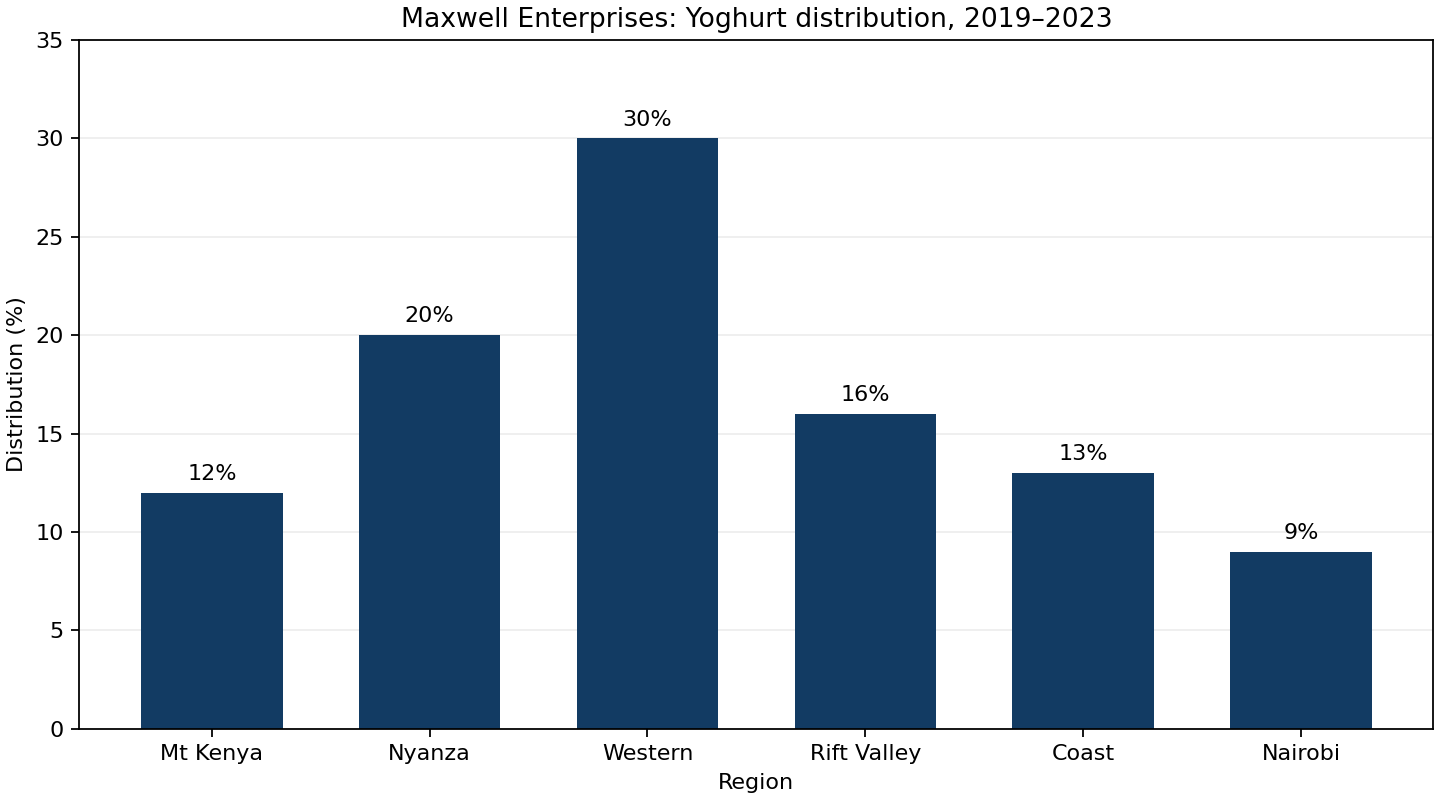
The vertical axis shows distribution percentages and the horizontal axis shows regions. Bars use one scale, a zero baseline and equal spacing.
Question 12(b)
Identify four reasons that may explain the low sales in Nairobi region. (6 marks)
Answer
- Strong competition from established yoghurt brands may reduce the firm’s market share.
- Limited distribution outlets may make the product difficult to find.
- Prices may be less attractive than competing products.
- Weak promotion or a product that does not match local preferences may limit demand. These are possible explanations; the percentages alone do not establish the actual causes.
Question 12(c)
Calculate the difference between the highest distribution and the lowest. (2 marks)
Answer
| Step | Working |
|---|---|
| Highest share | Western = 30% |
| Lowest share | Nairobi = 9% |
| Difference | 30 − 9 = 21 percentage points |
This is a difference of percentage points, rather than a relative percentage increase.
Question 13
Write an essay of about 250 words on the topic “Benefits of Installing Security Systems in Buildings”. (16 marks)
Answer
Security systems are an important part of managing buildings. Cameras, access controls, alarms and suitable lighting help owners protect people, property and essential operations. Their value is greatest when equipment is properly installed, maintained and supported by clear procedures.
One benefit is deterrence. Visible cameras and controlled entrances can discourage opportunistic theft, vandalism and unauthorised entry. Access systems also help restrict sensitive areas to approved people, protecting records, equipment and personal belongings.
Another benefit is early warning. Fire detection and intruder alarms can alert occupants or responders before an incident develops further. Prompt, organised action may reduce injury, damage and disruption. However, alarms are effective only when people know how to respond and emergency routes remain usable.
Security records can also assist investigations. Properly managed recordings and access logs help establish when an incident occurred and who entered a location. This supports factual enquiries, although evidence must be collected and handled lawfully.
A safer environment can strengthen confidence among employees, residents and customers. People are better able to concentrate on their activities when management takes reasonable precautions. Effective controls may also reduce losses and help a business resume operations after an incident.
Security systems nevertheless require responsible management. Personal information should be protected, surveillance should respect privacy, and authorised staff should review incidents fairly. Regular testing, staff training and maintenance are essential.
In conclusion, building security systems provide useful protection, early warning and information. When combined with sound management and emergency planning, they support safer premises and more reliable daily operations for everyone using the building.
Question 14: Reading passage
The African continent is richly endowed with huge potential in renewable energy that varies in type and spans diverse geographical areas. The resources and the settings in which they exist can point to country-specific renewable energy solutions to fit each state’s strengths and needs across
the continent. This gives Africa a unique opportunity to pursue sustainable energy development as a basis for long-term prosperity.
Over the years, the continent has continuously faced an enormous energy challenge due to its growing population and economic growth which have-sent energy demands soaring. This has necessitated a rapid increase in supply of all forms of energy needed. As a promising sign of things to come, several African countries have already succeeded in making the necessary steps to scale up the use of renewable energy. These include the adoption of support policies, investment promotions and regional collaborations. Kenya, Egypt, Ethiopia, Morocco and South Africa have been leading in this effort while smaller countries like Djibouti, Rwanda and Swaziland have set
ambitious renewable energy targets.
There are various sources from which renewable energy can be tapped with possible utilization
in power generation, heating, cooling, lighting and transportation, among others. Solar energy, which is sourced from the sun, can be harnessed for electricity generation. Many African countries
enjoy particularly long sunny days with a high intensity of solar irradiation, thus contributing to its rapid growth. Solar heaters can be used in low-to-medium temperature ranges for drying goods, cooling and heating water.
Another source is wind which is converted into energy using turbines. It is used to drive electrical generators, power pumps and other machinery. The use of wind power for off-grid applications
is common for pumping water in the agricultural sector. Hydropower is another source of energy
and is,.by far, the most important renewable power-generation option deployed today. Large- scale hydro resources are often utilized in combination with storage dams in the production of grid electricity. In Africa, The Congo River has the largest discharge, followed by the Zambezi, the Niger and the Nile.
Geothermal energy is readily available along the Great Rift Valley and Kenya hosts the main hub on the African continent in terms of its technological capacity. Geothermal heat could be applied directly to industrial processes that require low-temperature heat such as the flower industry. Wood fuel is another important primary energy source across the African continent. This is because it is used as firewood or in the form of charcoal for cooking and heating in the residential sector. Sizable amounts are also used by small and medium size industries for metal
and food processing as well as brick making. Biomass residues, which are generated at various stages of agricultural and wood production, are another source of energy mainly for domestic use. Examples include sawmill dust, wheat straw and maize stalks among others.
Several challenges have been experienced across the regions in the quest to produce sustainable energy levels. Droughts caused by climate change have affected hydro generating capacities resulting in extensive power outages, Furthermore, most governments have failed to accelerate the use of modern renewable energy sources despite the abundant resources across the continent. This has resulted in failure to bring to rural areas electricity and development opportunities,
Most countries also lack resources and an enabling environment with appropriate policies and governance to implement technological solutions. Further, there are trans-boundary issues such as trade, regulatory frameworks and other cross-border issues making it hard for some countries to access regional renewable resources at affordable prices. The rewards accruing to the countries working hard to overcome the challenges of exploiting renewable energy are immense. Africa can open up a sustainable energy landscape for generations to come by collaborating to exploit these energy sources.
Adopted from www.irena.org/publications, 2023. Passage reproduced from the supplied examination paper for this comprehension exercise.
Question 14(a)
State the meaning of each of the following words and phrases as used in the passage: (i) soaring; (ii) deployed; (iii) power outages; (iv) affordable. (4 marks)
Answer
- soaring: rising rapidly
- deployed: put into use
- power outages: interruptions to electricity supply
- affordable: available at a cost that can reasonably be paid
Question 14(b)
In about 120 words, and according to the passage, write a summary on the various sources of renewable energy found on the African continent. (10 marks)
Answer
Africa has several renewable energy sources. Solar radiation provides electricity and heat, while solar heaters support drying, water heating and other suitable uses. Wind turbines drive electricity generators, water pumps and machinery. Hydropower uses flowing water, often stored behind dams, to generate grid electricity. The Congo, Zambezi, Niger and Nile are important rivers mentioned in the passage. Geothermal resources along the Great Rift Valley provide energy and heat for suitable industrial processes, with Kenya serving as a major technological hub. Wood is widely used as firewood or charcoal for household cooking and heating and in some industries. Agricultural and wood-processing residues, including sawdust, wheat straw and maize stalks, provide additional biomass fuel, mainly for domestic use.
Question 14(c)
Highlight, according to the passage, four challenges that most African countries face in their quest to produce renewable energy. (4 marks)
Answer
- Drought reduces hydropower-generating capacity.
- Governments have been slow to accelerate modern renewable energy use.
- Insufficient resources and inadequate policies or governance hinder implementation.
- Cross-border trade and regulatory problems restrict affordable access to regional resources.