Information Communication Technology Theory — Undated Paper
Source: INFORMATION COMMUNICATION TECHNOLOGY (THEORY)_compressed.pdf | Paper code: 2912/103A; 2918/103A
Source note: The examination date is not printed on the supplied question pages. The unusual term in Question 2(b) is addressed in its answer.
Question 1(a)
Outline three uses of computers in learning institutions. (3 marks)
Answer
- Teaching and learning.
- Managing student and administrative records.
- Research and communication.
Question 1(b)
Explain two advantages of storing information in a database. (4 marks)
Answer
- Structured storage and queries allow required records to be retrieved efficiently.
- Validation, relationships and access controls can improve consistency and controlled sharing of information.
Question 1(c)
A secretary previewed a document before printing. Explain one importance of this action. (2 marks)
Answer
Print Preview shows the expected printed layout, helping the secretary identify problems such as incorrect margins, page breaks or missing content before using paper and ink.
Question 1(d)
With the aid of a diagram in each case, describe the following Local Area Network topologies. (i) tree; (ii) bus. (6 marks)
Answer
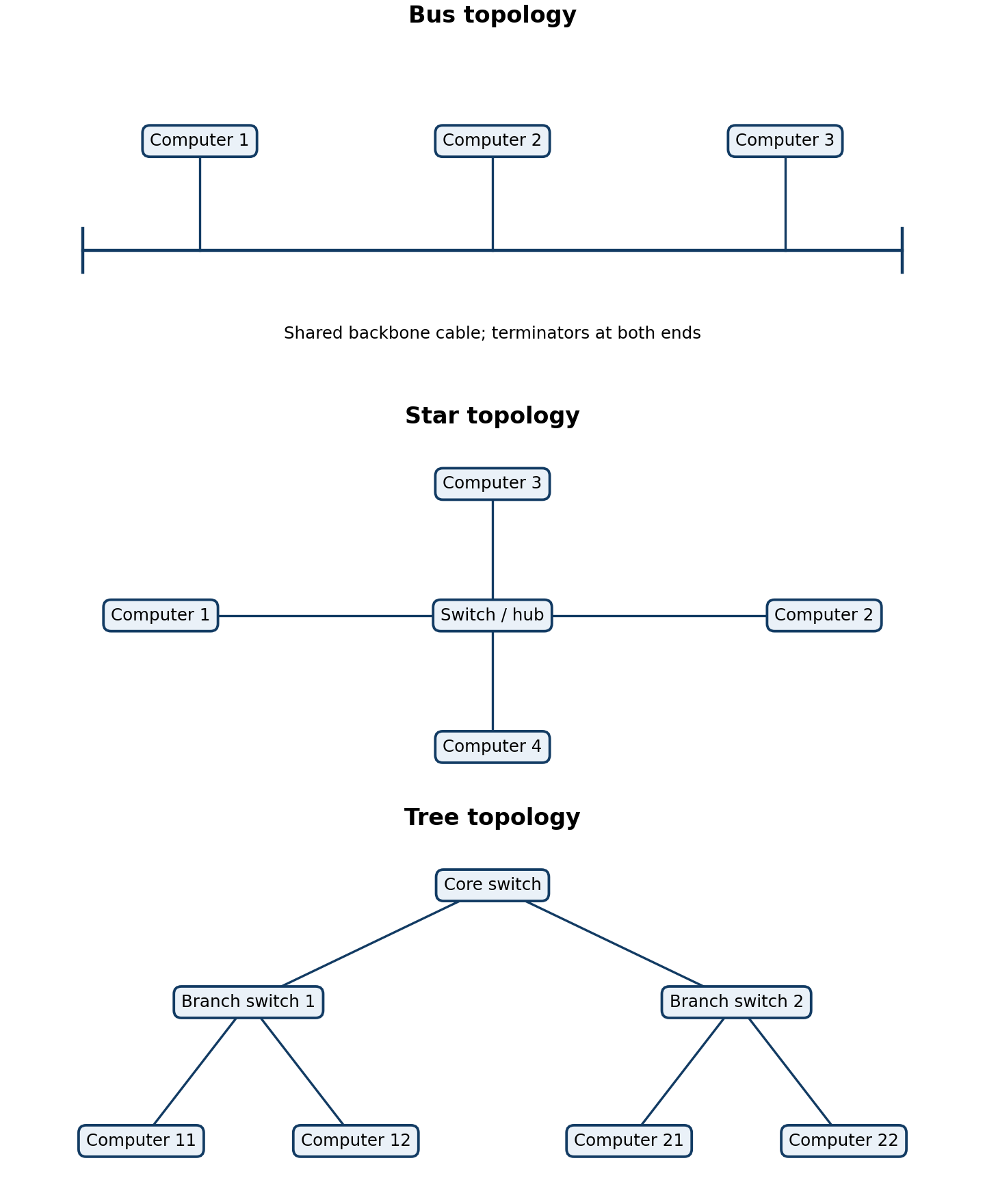
- Tree: devices or subnetworks are connected in a branching hierarchy, often with a core connection and lower-level switches.
- Bus: devices share one backbone cable, with termination at both ends in the classical bus arrangement.
Question 2(a)
Explain two functions of a control unit in a computer Central Processing Unit. (4 marks)
Answer
- Fetches and decodes program instructions so the required operation is identified.
- Issues control signals that coordinate data movement and execution between the processor, memory and other components.
Question 2(b)
Differentiate between optical character reader and optical magnetic reader as used in computers. (4 marks)
Answer
Terminology note: “Optical magnetic reader” is not a standard, unambiguous device name. If the intended comparison is OCR and OMR:
| Optical Character Recognition / Reader | Optical Mark Recognition / Reader |
|---|---|
| Recognises printed or scanned characters and converts them into machine-readable text. | Detects marks in predetermined positions on forms, such as shaded answer boxes. |
If the printed term instead intends MICR, Magnetic Ink Character Recognition reads specially printed magnetic-ink characters, commonly on cheques. It differs from OCR because it uses magnetic properties rather than relying only on an optical character image.
Question 2(c)
Peter intends to create a worksheet in a spreadsheet program. Describe two data types that he could use. (4 marks)
Answer
- Text: labels or other character-based entries, such as product names.
- Numbers: numeric values on which arithmetic calculations can be performed, such as prices or quantities.
Question 2(d)
A student used a line chart to represent data in a spreadsheet program. Outline three characteristics of this chart. (3 marks)
Answer
- Data values are shown as points joined by line segments.
- An ordered category or time variable is normally placed on the horizontal axis.
- The vertical axis represents values, making changes and trends visible.
Question 3(a)
Outline three advantages of random file access method. (3 marks)
Answer
- A required record can be accessed without reading all earlier records.
- Individual records can be retrieved or updated efficiently.
- It suits interactive systems needing prompt access to selected records.
Question 3(b)
Intech Company has been using emails for communication with its clients. Explain two challenges that the company is likely to face. (4 marks)
Answer
- Delivery or access problems can delay communication where connectivity is poor or messages are filtered.
- Phishing, malware and accidental disclosure can threaten users and confidential information if controls are inadequate.
Question 3(c)
A supermarket attendant was serving customers using a point of sale terminal. Describe two computer peripheral devices he is most likely to use. (4 marks)
Answer
- Barcode scanner: reads product codes to identify the item being sold.
- Receipt printer: produces a record of the transaction for the customer.
Question 3(d)
Describe each of the following types of system software: (i) Utility program; (ii) Operating system. (4 marks)
Answer
- Utility program: performs maintenance, protection or supporting tasks, such as backup or file compression.
- Operating system: manages hardware and system resources and provides services and an interface for applications and users.
Question 4(a)
Outline three factors to consider when acquiring computer software. (3 marks)
Answer
- Suitability for the required tasks.
- Compatibility with available hardware and operating systems.
- Total cost, licensing terms and support.
Question 4(b)
Amos intends to use a spreadsheet program in his office. Explain two benefits he would accrue from this. (4 marks)
Answer
- Formulas automate calculations and recalculate results when inputs change.
- Tables, sorting and charts support organisation, analysis and presentation of office data.
Question 4(c)
Differentiate between relative and absolute cell references as used in spreadsheet program. (4 marks)
Answer
| Relative reference | Absolute reference |
|---|---|
| Example: A1. | Example: $A$1. |
| Changes according to the new formula position when copied. | Keeps the specified column and row fixed when copied. |
Question 4(d)
Ann used CD-RW for her examination project. Explain two reasons that made her prefer this medium. (4 marks)
Answer
- Rewritability allows the contents to be erased and replaced when the project changes.
- A disc can provide portable storage for transfer or an additional copy where compatible drives are available.
Question 5(a)
Outline three types of text wrapping styles in a word processing program. (3 marks)
Answer
- Square.
- Tight.
- Top and Bottom.
Question 5(b)
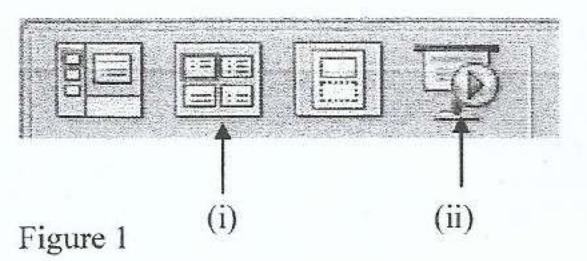
Figure 1 shows a section of a toolbar in the view menu of a presentation program. Use it to answer the question that follows: Explain the functions of each of the features labelled (i) and (ii). (4 marks)
Answer
- (i) Slide Sorter: displays slide thumbnails for reviewing and rearranging their order.
- (ii) Slide Show: starts presentation playback for an audience.
Question 5(c)
Joseph used a mail merge feature to generate letters for his clients. Explain two reasons that could have made him use this feature. (4 marks)
Answer
- It efficiently produces a personalised copy for each client from the same main letter.
- It reduces repeated typing and maintains consistent wording and presentation.
Question 5(d)
Masomo Technical college has opted for a tailor-made software. Explain two advantages of this type of software. (4 marks)
Answer
- It can be designed around the college’s specific processes and reporting requirements.
- The college can request suitable modifications or integrations as its needs change, subject to its development arrangements.
Question 6(a)
Outline three text case options available in a word processing program. (3 marks)
Answer
- UPPERCASE.
- lowercase.
- Sentence case.
Question 6(b)
Wezesha Company has connected all its branches to a wide area network. Explain three benefits the company could accrue from this move. (6 marks)
Answer
- Branch staff can communicate and exchange information more promptly.
- Authorised shared systems provide consistent access to business records.
- Central services and coordinated administration reduce unnecessary duplication across branches.
Question 6(c)
Differentiate between password and biometric access methods of securing data. (4 marks)
Answer
| Password method | Biometric method |
|---|---|
| Uses a secret that the user knows. | Uses a measured physical or behavioural characteristic, such as a fingerprint. |
| A forgotten or compromised password can be reset. | Biometric matching depends on enrolled characteristics and matching controls; unlike a password, a bodily characteristic is not easily replaced. |
Question 6(d)
Zawadi Company intends to use E-commerce in its business operations. Outline two benefits the company would accrue from this. (2 marks)
Answer
- Reach customers beyond the immediate physical trading area.
- Accept enquiries or orders outside normal shop-opening hours.