Information Communication Technology Theory — July 2021
Source: 02 INFORMATION COMMUNICATION TECHNOLOGY (THEORY) JULY 2021 _compressed.pdf | Paper code: 2912/103A; 2918/103A
Source note: Theory questions only. Handwritten notes were excluded; source figures are reproduced beside the relevant questions.
Question 1(a)
Outline two roles of computers in business. (2 marks)
Answer
- Process and store business records.
- Support communication and routine operations such as accounting, sales and stock control.
Question 1(b)
Explain two features a database. (4 marks)
Answer
- Structured organisation: related information is held in defined fields and records, often arranged in tables.
- Relationships and controlled retrieval: related tables can be linked and queried to obtain consistent information efficiently.
Question 1(c)
Maria, a company’s secretary was instructed to write a letter to be sent to many recipients. Describe the word processor feature she would use. (3 marks)
Answer
She would use mail merge. A main document contains the common letter and merge fields; a data source contains recipient details. Merging produces personalised copies for the different recipients.
Question 1(d)
Using diagrams in each case, describe the following LAN topologies: (i) bus; (ii) star. (6 marks)
Answer
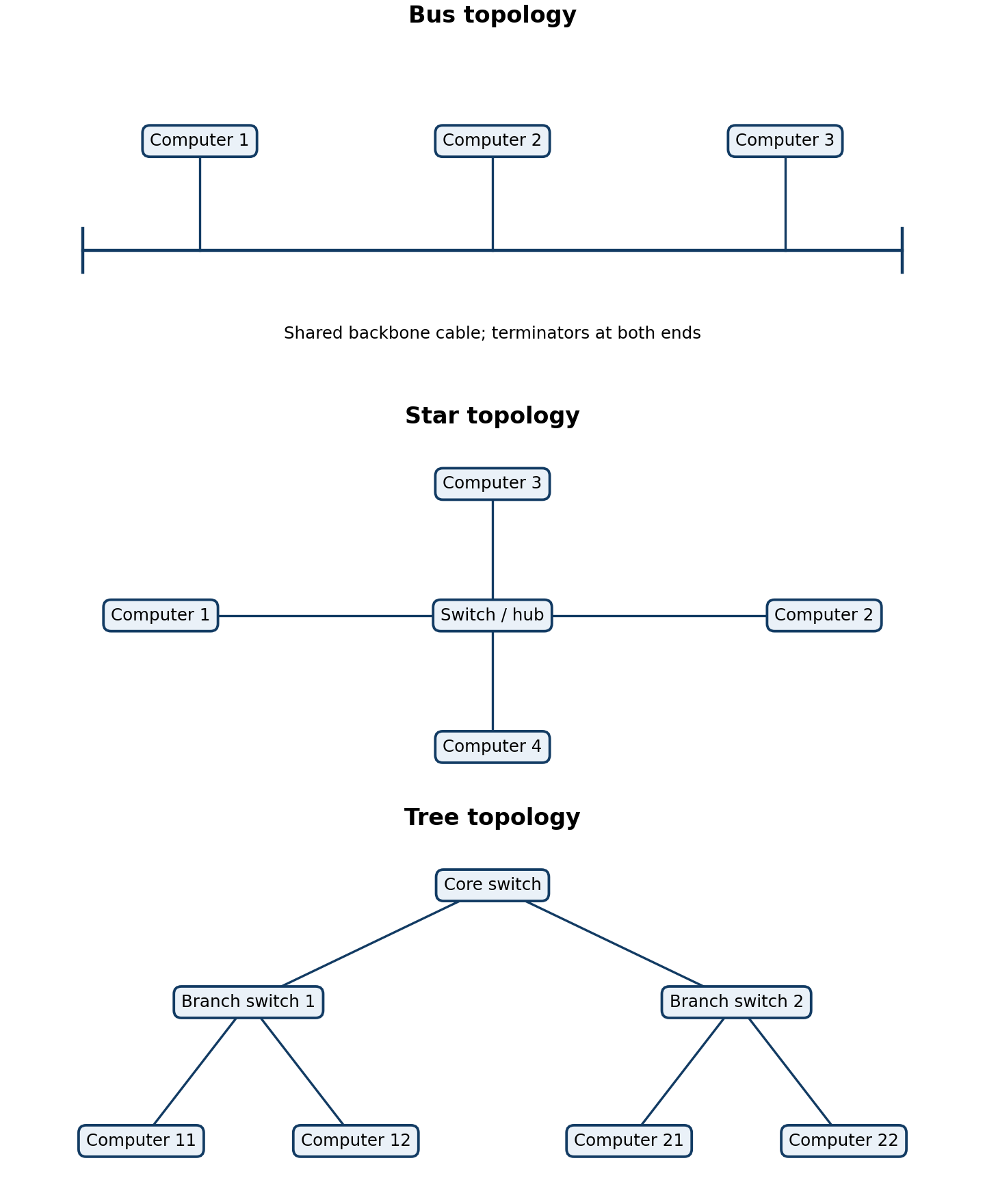
- Bus: devices connect to one shared backbone cable, normally terminated at both ends in the classical arrangement. Data travels along the shared medium.
- Star: each device has a separate connection to a central switch or hub, through which communication passes.
Question 2(a)
Explain the functions of the following components in a computer central processing unit: (i) control unit; (ii) arithmetic logic unit. (4 marks)
Answer
- Control unit: fetches and decodes instructions and coordinates their execution by issuing control signals.
- Arithmetic logic unit: carries out arithmetic calculations and logical operations or comparisons.
Question 2(b)
Differentiate between single clicking and right clicking mouse operations. (4 marks)
Answer
| Single clicking | Right clicking |
|---|---|
| Normally pressing and releasing the primary mouse button once. | Normally pressing and releasing the secondary mouse button once. |
| Usually selects an item or activates an interface control. | Usually opens a context menu of actions relevant to the item. |
Question 2(c)
Alice used cell references while performing calculation in a spreadsheet program. Describe two such references she could have used. (4 marks)
Answer
- Relative reference, such as A1: changes appropriately when a formula is copied to another location.
- Absolute reference, such as $A$1: fixes both column and row when the formula is copied.
Question 2(d)
During an ICT lesson, a student was required to insert a chart in a worksheet. Outline three types of charts that the student is likely to use. (3 marks)
Answer
- Column or bar chart.
- Line chart.
- Pie chart.
Question 3(a)
Outline three types of file access methods. (3 marks)
Answer
- Sequential access.
- Direct or random access.
- Indexed access.
Question 3(b)
Jantech Company has been communicating with its clients via email. Explain three benefits that the company has accrued from this move. (6 marks)
Answer
- Rapid delivery reduces communication delays.
- Messages and attachments create a convenient written record.
- One channel can reach clients in different locations without sending separate physical letters.
Question 3(c)
A computer technician was asked to install system software to a new computer. Outline two types of such software he is expected to install. (2 marks)
Answer
- An operating system.
- Device drivers appropriate for the hardware.
Question 3(d)
Describe each of the following computer devices: (i) bar code reader; (ii) keyboard. (4 marks)
Answer
- Barcode reader: an input device that scans a barcode and sends the encoded identification data to a computer.
- Keyboard: an input device with keys used to enter text, numbers and commands.
Question 4(a)
Outline three factors to consider when selecting computer hardware. (3 marks)
Answer
- Required performance and capacity.
- Compatibility with existing systems.
- Purchase cost, operating cost and available support.
Question 4(b)
Outline the syntax of if function in a spread sheet program. (4 marks)
Answer
=IF(logical_test, value_if_true, value_if_false)logical_test is the condition being checked; value_if_true is returned when it is true; value_if_false is returned otherwise. Some regional settings use semicolons in place of commas.
Question 4(c)
Differentiate between formulae and function as used in spreadsheet. (4 marks)
Answer
| Formula | Function |
|---|---|
| An expression entered to calculate a result, such as =A1+B1. | A predefined named operation used within a formula, such as SUM in =SUM(A1:B1). |
| May contain references, constants, operators and functions. | Uses the function’s specified name and arguments to perform a defined calculation. |
Question 4(d)
A student has been using folders to store his work during practical lessons. Explain two reasons that could have led to this action. (4 marks)
Answer
- Organisation: grouping related files makes work easier to find.
- Management: separate folders make it easier to copy, back up or control access to a set of files.
Question 5(a)
Outline three presentation views found in a presentation program. (3 marks)
Answer
- Normal view.
- Slide Sorter view.
- Slide Show view.
Question 5(b)
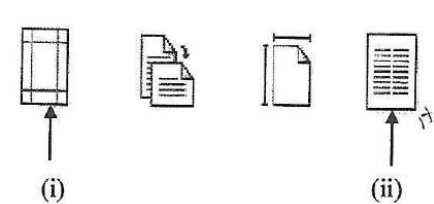
Figure 1 show a section of a tool bar in a word processing program. Explain the function of the features labelled (i) and (ii). (4 marks)
Answer
- (i) Margins: sets the blank space between the page edges and the document’s text area.
- (ii) Columns: arranges the selected text or document section in newspaper-style columns.
Question 5(c)
During an ICT lesson, a lecturer opted to use slides to make a presentation. Explain two reasons for his choice. (4 marks)
Answer
- Slides organise key points in a clear sequence that helps the audience follow the lesson.
- Text, images, charts and other media can illustrate ideas and improve understanding.
Question 5(d)
James, a programmer, has developed a tailor-made software for Maji Technical College. Explain two challenges that the software will pose to the College. (4 marks)
Answer
- Development, testing and future modification can be expensive.
- Dependence on a particular developer can make support and maintenance difficult if that developer is unavailable.
Question 6(a)
Outline three paragraph alignments used in a word processor. (3 marks)
Answer
- Left alignment.
- Centre alignment.
- Right alignment. Justified alignment is another valid option.
Question 6(b)
A network administrator at Zushi Company intends to secure the company’s network. Explain three benefits the company will accrue from this move. (6 marks)
Answer
- Confidentiality: reduces unauthorised access to information.
- Integrity: reduces the risk of unauthorised alteration.
- Availability: helps protect services and data from disruption.
Question 6(c)
Differentiate between text and memo data types in databases. (4 marks)
Answer
| Text / Short Text | Memo / Long Text |
|---|---|
| Stores relatively short alphanumeric values such as names or codes. | Stores longer descriptive material such as notes or comments. |
| In Access, Short Text supports up to 255 characters. | Long Text supports substantially longer content; exact limits depend on storage and use. |
Question 6(d)
Dashtech Company management opted to use the internet to market its products. Outline two challenges the company could face from using this approach. (2 marks)
Answer
- Strong competition and difficulty reaching the intended audience.
- Connectivity, security or trust problems that discourage customer engagement.