Operations Management — 2020
KNEC Diploma in Supply Chain Management, Module III. Original examination questions with explained answers for revision. Answers are independently prepared for study and are not an official KNEC marking scheme.
July 2020
Paper codes: 2903/302; 2922/302; 3304
Time: Not shown in supplied scan
Instructions: Cover instructions not included in supplied scan.
Question 1(a) — 10 marks
Explain five rules followed when designing a factory layout in a manufacturing firm.
Answer
- Arrange activities to support a clear logical flow of materials and work.
- Minimise unnecessary handling, travel and backward movement.
- Use available floor and vertical space efficiently without creating congestion.
- Provide safe access, suitable working conditions and room for maintenance.
- Allow appropriate flexibility for changes in volume, product mix and equipment.
Question 1(b) — 10 marks
For the maintenance system of a manufacturing firm to work efficiently, some records should be maintained by the maintenance department. Explain five such records.
Answer
- Asset registers identify each machine, its specifications, location and service requirements.
- Inspection and service schedules state planned maintenance dates and tasks.
- Work orders record faults, authorised work, labour used and completion details.
- Failure and repair histories show recurring faults, downtime and corrective actions.
- Spare-parts and cost records support replenishment, budgeting and repair-versus-replacement decisions.
Question 2(a) — 10 marks
(i) Explain the meaning of flexibility, as used in Operations Management. (2 marks)
(ii) Explain four reasons that justify the adoption of flexible manufacturing system in a firm. (8 marks)
Answer
- (i) Flexibility is the ability of an operating system to change products, volume, methods or timing with acceptable cost and delay.
- (ii) Product-mix flexibility helps the firm meet varied customer requirements.
- Volume flexibility allows output to respond to changing demand.
- Routing and machine flexibility support production when a particular resource is unavailable.
- Faster changeovers and reprogrammable equipment reduce the cost of introducing suitable new variants.
Question 2(b) — 10 marks
Explain the role of purchasing and supply in plant and equipment maintenance.
Answer
- Sources suitable spare parts, consumables and service providers before they are required.
- Confirms technical specifications and compatibility with the maintained equipment.
- Negotiates price, warranty, lead time and support terms that minimise total maintenance cost.
- Coordinates delivery and stock availability with planned maintenance schedules.
- Monitors supplier quality and reliability and supports claims or corrective action when supplied items fail.
Question 3(a) — 8 marks
Highlight five environmental factors that affect the performance of the transformation process in manufacturing operations.
Answer
The supplied question asks for five factors and prints 8 marks.
- Economic conditions affect demand, finance and input costs.
- Technological change affects available equipment and production methods.
- Legal and regulatory requirements affect safety, quality and permissible processes.
- Supplier and infrastructure conditions affect materials, energy and transport reliability.
- Social and customer expectations affect product requirements, labour relations and acceptable operating practices.
Question 3(b) — 12 marks
Quality Function Deployment’s House of Quality is imperative in the modern approach of product development. Describe the steps involved in building the House of Quality.
Answer
- Identify the target customers and gather their needs in the customers’ own language.
- Organise the needs and assign justified importance ratings.
- Translate needs into measurable technical design requirements.
- Build the relationship matrix showing how strongly each technical requirement contributes to each customer need.
- Examine technical correlations and benchmark relevant customer and technical performance.
- Calculate priorities, set technical targets and review the design choices with the cross-functional team.

Question 4(a) — 10 marks
(i) Highlight the difference between design capacity and effective capacity. (2 marks)
(ii) Explain four factors that should be considered when making capacity decisions in a manufacturing set up. (8 marks)
Answer
- (i) Design capacity is the maximum theoretical output under the designed conditions; effective capacity is the expected attainable output after normal operating allowances.
- (ii) Expected demand determines the capacity needed and its timing.
- Finance and total operating costs determine affordability and economic viability.
- Availability of labour, materials, utilities and suitable technology determines practical feasibility.
- Flexibility, expansion lead times and uncertainty determine the risk of too little or too much capacity.
Question 4(b) — 10 marks
Identify suitable production systems for the following product characteristics:
(i) One – of – a-kind products;
(ii) Moderate volume, multiple products;
(iii) High volume, high level standardization of commodity products;
(iv) Low volume, many products;
(v) High volume, some product variety.
Answer
- (i) One-of-a-kind products: project production, particularly for a large unique output completed at a defined site.
- (ii) Moderate volume, multiple products: batch production, producing a quantity of one product before changing to another.
- (iii) High volume, highly standardised commodity products: continuous-process production.
- (iv) Low volume, many products: job or job-shop production, using flexible resources for varied individual orders.
- (v) High volume, some product variety: mass or repetitive assembly-line production with compatible variants.
Question 5(a) — 10 marks
Explain five ways of increasing flexibility at low cost, in a manufacturing company.
Answer
- Cross-train employees so they can move between compatible tasks.
- Reduce setup and changeover time through better preparation and standard methods.
- Use modular products and common components where appropriate.
- Improve schedules, information sharing and supplier coordination to respond faster to changes.
- Use suitable general-purpose tools and rearrange existing work cells before committing to expensive additional equipment.
Question 5(b) — 10 marks
The demand of the products of Zaica Limited have experienced a steady rise in the recent past and the management wishes to increase the capacity of the firm. Highlight five ways by which the management may achieve this objective.
Answer
- Add appropriate shifts or overtime within lawful and safe working arrangements.
- Remove bottlenecks and improve methods to raise output from existing resources.
- Improve preventive maintenance to reduce avoidable downtime.
- Install additional equipment or expand facilities where demand justifies investment.
- Use qualified subcontractors or other approved external capacity while internal expansion is arranged.
Question 6(a) — 10 marks
The following table shows the coordinates of six sites and monthly demand of retail outlets to be served by a production unit.
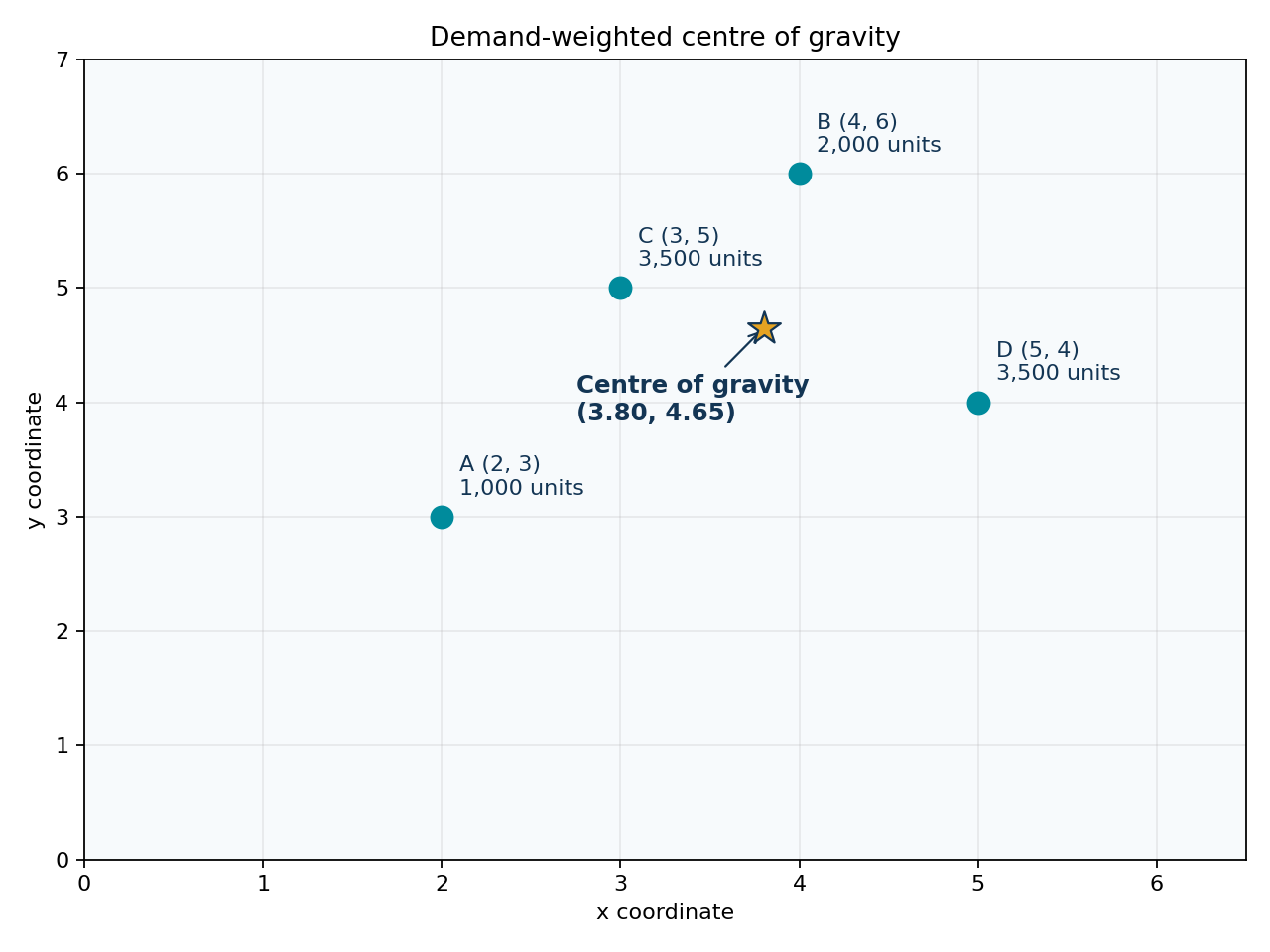
Destination Coordinates (x, y) Monthly demand (units) A (2, 3) 1,000 B (4, 6) 2,000 C (3, 5) 3,500 D (5, 4) 3,500 (i) Assess the coordinates of the center of gravity. (4 marks)
(ii) Draw a map showing the locations of destinations, including the center of gravity. (6 marks)
Answer
The text mentions six sites, but the supplied table contains four outlets, A–D. All four supplied rows are used; no additional sites are assumed.
| Destination | x | y | Demand w | x × w | y × w |
|---|---|---|---|---|---|
| A | 2 | 3 | 1,000 | 2,000 | 3,000 |
| B | 4 | 6 | 2,000 | 8,000 | 12,000 |
| C | 3 | 5 | 3,500 | 10,500 | 17,500 |
| D | 5 | 4 | 3,500 | 17,500 | 14,000 |
| Total | 10,000 | 38,000 | 46,500 |
x̄ = Σ(xw) ÷ Σw = 38,000 ÷ 10,000 = 3.8000
ȳ = Σ(yw) ÷ Σw = 46,500 ÷ 10,000 = 4.6500
The demand-weighted location is (3.80, 4.65). This is a coordinate-model recommendation; access, feasible land and actual transport costs should also be checked.
Question 6(b) — 10 marks
(i) Distinguish between manufacturing operations and service operations. (2 marks)
(ii) Explain four characteristics of a service. (8 marks)
Answer
- (i) Manufacturing operations mainly transform inputs into tangible goods; service operations mainly deliver activities or benefits to customers.
- (ii) Intangibility: the service cannot normally be examined as a physical product before purchase.
- Inseparability: production and consumption often occur together.
- Variability: service performance can differ with the provider and situation.
- Perishability: unused service capacity normally cannot be stored for later sale.
Question 7(a) — 10 marks
Describe the stages involved in the development of a product.
Answer
- Generate ideas from customers, research, employees, suppliers and market trends.
- Screen ideas and develop promising product concepts against customer and business needs.
- Assess technical and commercial feasibility, including demand, costs and resources.
- Design and develop prototypes, then test performance and obtain user feedback.
- Prepare production and launch arrangements, commercialise the product and review its market performance.
Question 7(b) — 10 marks
Outline five similarities between Job Production system and Batch Production system.
Answer
- Both can accommodate more product variety than a dedicated continuous line.
- Both commonly use general-purpose equipment for different jobs or batches.
- Both require routing and scheduling of work through relevant processes.
- Both may need skilled employees and setups when product requirements change.
- Both can experience waiting, variable lead times and work-in-progress between operations.