Engineering Mathematics III — October/November 2022
KNEC Diploma in Mechanical Engineering — Module III. Paper code: 2502/303 (also 2501/303, 2503/303, 2508/303, 2509/303). Independent revision answers, not official KNEC marking schemes.
The supplied scan starts at printed page 2 and contains all eight main questions, followed by normal-probability and Laplace-transform tables. Its cover/instructions page is absent. All supplied questions are answered; handwritten notes are excluded. Vector projection conventions, normal direction and the intended common-volume region are stated beside their answers.
Question 1(a)
Determine a unit vector C perpendicular to vectors A = 4i − 3j + 2k and B = 3i + 2j + 8k.
(6 marks)
Answer
| Step | Working |
|---|---|
| Cross product | A × B = i[(−3)(8) − (2)(2)] − j[(4)(8) − (2)(3)] + k[(4)(2) − (−3)(3)] |
| Simplify | A × B = −28i − 26j + 17k. |
| Magnitude | |A × B| = √(784 + 676 + 289) = √1749. |
| Unit vector | C = (−28i − 26j + 17k)/√1749. The negative of this vector is also valid. |
| Check | C·A = (−112 + 78 + 34)/√1749 = 0; C·B = (−84 − 52 + 136)/√1749 = 0. |
Question 1(b)
Determine the directional derivative of a vector field F(x,y,z) = x²yz i + xy²z j + xyz² k in the direction of the normal to the sphere Q(x,y,z), x² + y² + z² = 9 at the point (2,1,2).
(8 marks)
Answer
Choose the outward unit normal; choosing the inward normal reverses the final sign. A directional derivative of a vector field is taken component by component.
| Step | Working |
|---|---|
| Normal | ∇Q = (2x,2y,2z). At (2,1,2), ∇Q = (4,2,4), of magnitude 6. |
| Unit direction | n = (2/3,1/3,2/3). Thus D_n = (2/3)∂/∂x + (1/3)∂/∂y + (2/3)∂/∂z. |
| First component | ∇(x²yz) = (2xyz,x²z,x²y) = (8,8,4) at the point; n·∇F₁ = (16 + 8 + 8)/3 = 32/3. |
| Second component | ∇(xy²z) = (y²z,2xyz,xy²) = (2,8,2); n·∇F₂ = (4 + 8 + 4)/3 = 16/3. |
| Third component | ∇(xyz²) = (yz²,xz²,2xyz) = (4,8,8); n·∇F₃ = (8 + 8 + 16)/3 = 32/3. |
| Answer | D_n F = (32/3)i + (16/3)j + (32/3)k. |
Question 1(c)
Given the vectors A = 2i + 3j + 4k and B = 3i − 2j + 5k; determine the projection of A on B.
(6 marks)
Answer
| Step | Working |
|---|---|
| Dot product | A·B = 2(3) + 3(−2) + 4(5) = 20. |
| Length of B | |B| = √(9 + 4 + 25) = √38. |
| Scalar projection | comp_B A = (A·B)/|B| = 20/√38. |
| Vector projection | proj_B A = [(A·B)/|B|²]B = (10/19)(3i − 2j + 5k). |
| Answer | proj_B A = (30/19)i − (20/19)j + (50/19)k. |
Question 2(a)
Determine the Fourier sine series of the periodic function f(x) = 4x, 0 ≤ x ≤ π.
(8 marks)
Answer
| Step | Working |
|---|---|
| Sine expansion | f(x) ~ Σₙ₌₁∞ b_n sin(nx), using the odd 2π-periodic extension. |
| Coefficient | b_n = (2/π)∫₀π 4x sin(nx) dx. |
| Integrate by parts | ∫x sin(nx)dx = −x cos(nx)/n + sin(nx)/n². |
| Endpoints | b_n = (8/π)[−π(−1)ⁿ/n] = 8(−1)ⁿ⁺¹/n. |
| Answer | 4x ~ 8[sin x − (sin2x)/2 + (sin3x)/3 − …], 0 < x < π. |
| Endpoint meaning | At x = 0 the series is 0. At x = π it takes the midpoint 0 of the jump in the odd periodic extension, rather than 4π. |
Question 2(b)
Determine the Fourier series of the even function defined by f(x) = 6 + x, −π ≤ x ≤ 0; f(x) = 6 − x, 0 ≤ x ≤ π; f(x + 2π).
(12 marks)
Answer
The printed final line indicates periodic continuation: take f(x + 2π) = f(x). Thus f(x) = 6 − |x| on [−π,π].
| Step | Working |
|---|---|
| Symmetry | Even function ⇒ b_n = 0. |
| Constant coefficient | a₀ = (2/π)∫₀π(6 − x)dx = 12 − π. |
| Cosine coefficient | a_n = (2/π)∫₀π(6 − x)cos(nx)dx. |
| Antiderivative | (6 − x)sin(nx)/n − cos(nx)/n². |
| Endpoints | a_n = 2[1 − (−1)ⁿ]/(πn²). |
| Parity | a_n = 0 for even n; a_n = 4/(πn²) for odd n. |
| Answer | f(x) = 6 − π/2 + (4/π)[cos x + cos3x/3² + cos5x/5² + …]. |
Question 3(a)
Determine the Laplace transform of f(t) = 3t cos8t from first principles.
(9 marks)
Answer
Start from the defining integral rather than quoting a transform-table entry. Complex exponentials are used only as an integration aid; the result is real.
| Step | Working |
|---|---|
| Definition | L{3t cos8t} = 3∫₀∞ t e⁻ˢᵗ cos8t dt, for Re(s) > 0. |
| Complex integration | Let α = s − 8i. Since cos8t = Re(e⁸ⁱᵗ), the integral is 3 Re∫₀∞ t e⁻ᵅᵗdt for real s > 0. |
| Integrate by parts | ∫t e⁻ᵅᵗdt = −e⁻ᵅᵗ(t/α + 1/α²). The upper boundary is zero when Re(α)>0. |
| Apply limits | ∫₀∞t e⁻ᵅᵗdt = 1/α². |
| Real part | 1/(s − 8i)² = (s + 8i)²/(s² + 64)² = (s² − 64 + 16si)/(s² + 64)². |
| Answer | L{3t cos8t} = 3(s² − 64)/(s² + 64)², Re(s) > 0. |
Question 3(b)
Use Laplace transforms to solve the differential equation d²x/dt² + 9x = 3sin6t, given that when t = 0, x = 1 and dx/dt = −4.
(11 marks)
Answer
| Step | Working |
|---|---|
| Transform | s²X − sx(0) − x′(0) + 9X = 18/(s² + 36). |
| Initial values | (s² + 9)X − s + 4 = 18/(s² + 36). |
| Rearrange | X = (s − 4)/(s² + 9) + 18/[(s² + 9)(s² + 36)]. |
| Partial fractions | 18/[(s² + 9)(s² + 36)] = (2/3)[1/(s² + 9) − 1/(s² + 36)]. |
| Invert | x = cos3t − (4/3)sin3t + (2/9)sin3t − (1/9)sin6t. |
| Answer | x(t) = cos3t − (10/9)sin3t − (1/9)sin6t. |
| Check | x(0)=1; x′(0)=−10/3−2/3=−4. Substitution gives x″+9x=3sin6t. |
Question 4(a)
(i) Show that x = 6 is a solution to the equation |x−1, −6, 2; −6, x−2, −4; 2, −4, x−6| = 0. (ii) Hence determine the other values of x.
(8 marks)
Answer
| Step | Working |
|---|---|
| Substitute x = 6 | Determinant = |5,−6,2; −6,4,−4; 2,−4,0|. |
| Expand | 5(−16) + 6(8) + 2(24 − 8) = −80 + 48 + 32 = 0. |
| General expansion | (x−1)[(x−2)(x−6)−16] + 6[−6(x−6)+8] + 2[24−2(x−2)]. |
| Polynomial | x³ − 9x² − 36x + 324 = 0. |
| Factor | (x−6)(x²−3x−54) = (x−6)(x−9)(x+6). |
| Answer | The other values are x = 9 and x = −6. |
Question 4(b)
Use Cramer’s rule to solve the equations. q₁ + q₂ + 2q₃ = 4; 2q₁ − q₂ + 3q₃ = 9; 3q₁ − q₂ − q₃ = 2.
(12 marks)
Answer
| Determinant | Matrix rows | Value |
|---|---|---|
| D | [1,1,2]; [2,−1,3]; [3,−1,−1] | 17 |
| D₁ | [4,1,2]; [9,−1,3]; [2,−1,−1] | 17 |
| D₂ | [1,4,2]; [2,9,3]; [3,2,−1] | −17 |
| D₃ | [1,1,4]; [2,−1,9]; [3,−1,2] | 34 |
| Step | Working |
|---|---|
| Example expansion | D = 1(1+3) − 1(−2−9) + 2(−2+3) = 4+11+2=17. |
| Cramer ratios | q₁=D₁/D=1; q₂=D₂/D=−1; q₃=D₃/D=2. |
| Check | 1−1+4=4; 2+1+6=9; 3+1−2=2. |
Question 5(a)
Solve the differential equation dy/dx + y cot x = 5e^(cos x) given that when x = π/2, y = −4.
(5 marks)
Answer
| Step | Working |
|---|---|
| Linear equation | y′ + (cot x)y = 5e^(cos x). Work on the interval 0 < x < π containing π/2. |
| Integrating factor | IF = e^(∫cot x dx) = sin x on this interval. |
| Multiply | d(y sin x)/dx = 5e^(cos x) sin x. |
| Integrate | y sin x = −5e^(cos x) + C. |
| Initial condition | −4 = −5 + C ⇒ C = 1. |
| Answer | y = [1 − 5e^(cos x)]/sin x. |
Question 5(b)
A body of mass 1 kg falls from rest in air where resistance is proportional to the square of the velocity. Determine the velocity of the body at any time t.
(15 marks)
Answer
Let k > 0 be the resistance constant in R = kv². Take downwards as positive, with g constant; no numerical k is supplied, so the answer must retain it. Keep m in the derivation, then set m = 1 kg.
| Step | Working |
|---|---|
| Newton’s second law | m dv/dt = mg − kv², v(0)=0. |
| Terminal speed | v_T = √(mg/k). Hence dv/dt = g[1 − (v/v_T)²]. |
| Separate | dv/[1 − (v/v_T)²] = g dt. |
| Substitute | Let u=v/v_T. Then v_T∫du/(1−u²)=gt+C. |
| Integrate | (v_T/2) ln[(1+u)/(1−u)] = gt+C for 0≤u<1. |
| Initial value | u(0)=0 ⇒ C=0. Thus artanh(u)=gt/v_T. |
| Solve | u=tanh(gt/v_T). |
| Answer | v(t)=√(mg/k) tanh(√(gk/m)t), with m=1 kg. |
| For the stated mass | In coherent SI numerical units, v(t)=√(g/k) tanh(√(gk)t). The dimensions of k are kg/m. |
| Checks | v(0)=0; initial acceleration is g; as t→∞, v→√(mg/k) and resistance kv²→mg. |
Question 6(a)
Given that xₙ is an approximation to the root of the equation x − cos x = 0. Using Newton-Raphson method, show that a better approximation is given by: xₙ₊₁ = (xₙ sin xₙ + cos xₙ)/(1 + sin xₙ).
(9 marks)
Answer
| Step | Working |
|---|---|
| Function | f(x)=x−cos x; f′(x)=1+sin x, with angles in radians. |
| Newton formula | xₙ₊₁=xₙ−f(xₙ)/f′(xₙ). |
| Substitute | xₙ₊₁=xₙ−(xₙ−cos xₙ)/(1+sin xₙ). |
| Common denominator | xₙ₊₁=[xₙ(1+sin xₙ)−xₙ+cos xₙ]/(1+sin xₙ). |
| Result | xₙ₊₁=(xₙ sin xₙ + cos xₙ)/(1+sin xₙ), as required. |
| Condition | The denominator must be nonzero; convergence requires a suitable initial estimate. |
Question 6(b)
Table I satisfy a polynomial function f(x). Use a finite difference table and the Newton-Gregory backward difference interpolation to determine f(4.5).
(11 marks)
Answer
| x | -4 | -2 | 0 | 2 | 4 | 6 | 8 | 10 |
|---|---|---|---|---|---|---|---|---|
| f(x) | -135 | -13 | 5 | 63 | 305 | 875 | 1917 | 3575 |
| x | f(x) | Δf | Δ²f | Δ³f |
|---|---|---|---|---|
| -4 | -135 | 122 | -104 | 144 |
| -2 | -13 | 18 | 40 | 144 |
| 0 | 5 | 58 | 184 | 144 |
| 2 | 63 | 242 | 328 | 144 |
| 4 | 305 | 570 | 472 | 144 |
| 6 | 875 | 1042 | 616 | |
| 8 | 1917 | 1658 | ||
| 10 | 3575 |
| Step | Working |
|---|---|
| Equal spacing | h=2; use the final tabulated point xₙ=10, fₙ=3575. |
| Backward differences | ∇fₙ=1658; ∇²fₙ=616; ∇³fₙ=144; higher differences are zero. |
| Parameter | u=(x−xₙ)/h=(4.5−10)/2=−2.75. |
| Backward formula | f(x)=fₙ+u∇fₙ+[u(u+1)/2!]∇²fₙ+[u(u+1)(u+2)/3!]∇³fₙ. |
| Substitute | f(4.5)=3575+(−2.75)(1658)+[(−2.75)(−1.75)/2](616)+[(−2.75)(−1.75)(−0.75)/6](144). |
| Terms | 3575 − 4559.5 + 1482.25 − 86.625. |
| Answer | f(4.5)=411.125. |
| Independent check | The exact interpolating cubic is f(x)=3x³+5x²+7x+5; it gives 411.125 at x=4.5 and reproduces every printed value. |
Question 7(a)
Evaluate the double integral ∫₀π ∫₀^[a(1−cosθ)] r² sinθ dr dθ.
(8 marks)
Answer
| Step | Working |
|---|---|
| Integrate r | ∫₀^[a(1−cosθ)]r²dr = a³(1−cosθ)³/3. |
| Remaining integral | I=(a³/3)∫₀π(1−cosθ)³sinθ dθ. |
| Substitute | u=1−cosθ; du=sinθ dθ; limits u=0 to 2. |
| Integrate | I=(a³/3)[u⁴/4]₀². |
| Answer | I=4a³/3. |
Question 7(b)
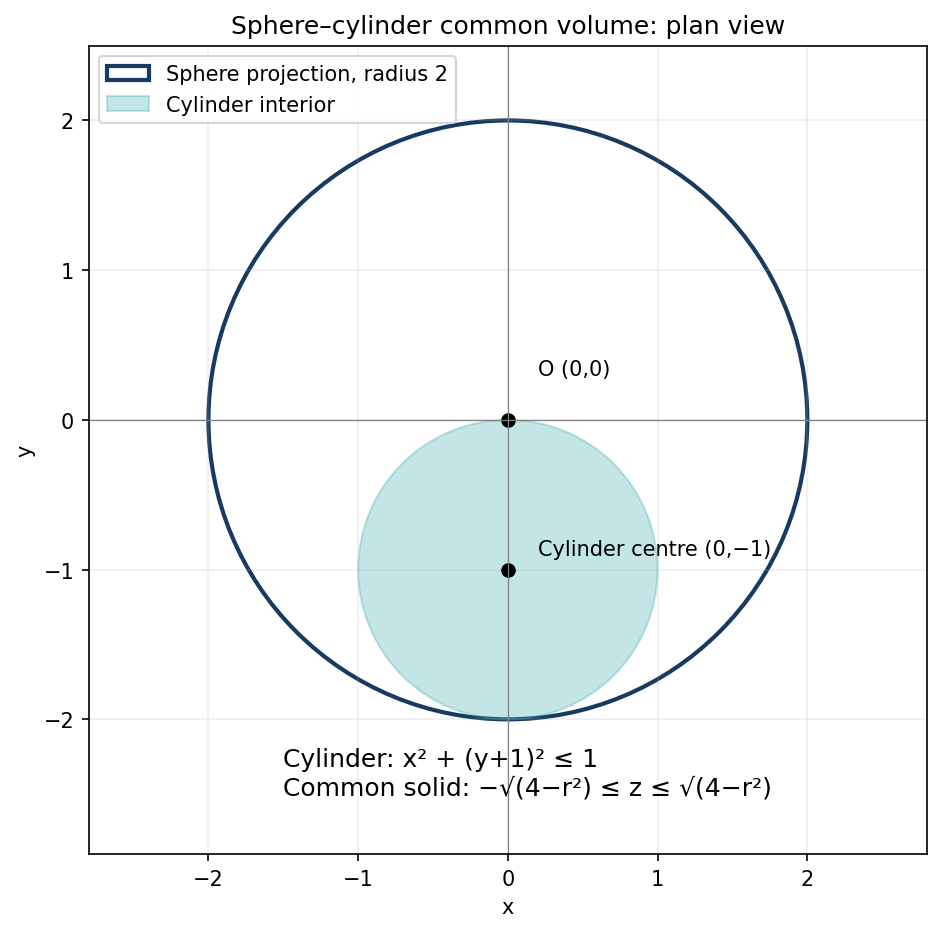
Determine the volume of the solid bounded by the spherical surface x² + y² + z² = 4 and the cylinder x² + y² + 2y = 0.
(12 marks)
Answer
Take the common solid inside both the sphere and cylinder, the usual interpretation. The cylinder is x²+(y+1)²=1. A different choice (inside the sphere but outside the cylinder) is stated separately.
| Step | Working |
|---|---|
| Cylindrical coordinates | x=r cosθ, y=r sinθ; sphere gives −√(4−r²)≤z≤√(4−r²). |
| Cylinder | r²+2r sinθ≤0 ⇒ 0≤r≤−2sinθ for π≤θ≤2π. |
| Volume integral | V=∫π²π ∫₀^(−2sinθ) 2√(4−r²) r dr dθ. |
| Radial antiderivative | ∫2r√(4−r²)dr=−(2/3)(4−r²)^(3/2). |
| Apply limits | V=(2/3)∫π²π[8−(4−4sin²θ)^(3/2)]dθ. |
| Absolute value | (4cos²θ)^(3/2)=8|cosθ|³, so V=16π/3−(16/3)∫π²π|cosθ|³dθ. |
| Angular integral | ∫π²π|cosθ|³dθ=2∫₀^(π/2)cos³θdθ=2(2/3)=4/3. |
| Answer | V=16π/3−64/9 ≈ 9.64405 cubic units. |
| Alternative region | Inside sphere but outside cylinder: 32π/3−V=16π/3+64/9 ≈ 23.86627 cubic units. |
Question 8(a)
Solve the differential equation (y² + 2xy + 1)dx + (2xy + x²)dy = 0 given that when x = 1, y = 1.
(11 marks)
Answer
| Step | Working |
|---|---|
| Identify | M=y²+2xy+1, N=2xy+x². |
| Exactness | ∂M/∂y=2y+2x=∂N/∂x. |
| Potential | Φ=∫M dx=xy²+x²y+x+g(y). |
| Differentiate in y | ∂Φ/∂y=2xy+x²+g′(y)=N ⇒ g′(y)=0. |
| Implicit solution | xy²+x²y+x=C. |
| Initial condition | C=1+1+1=3. |
| Answer | xy²+x²y+x=3, the solution curve through (1,1). |
Question 8(b)
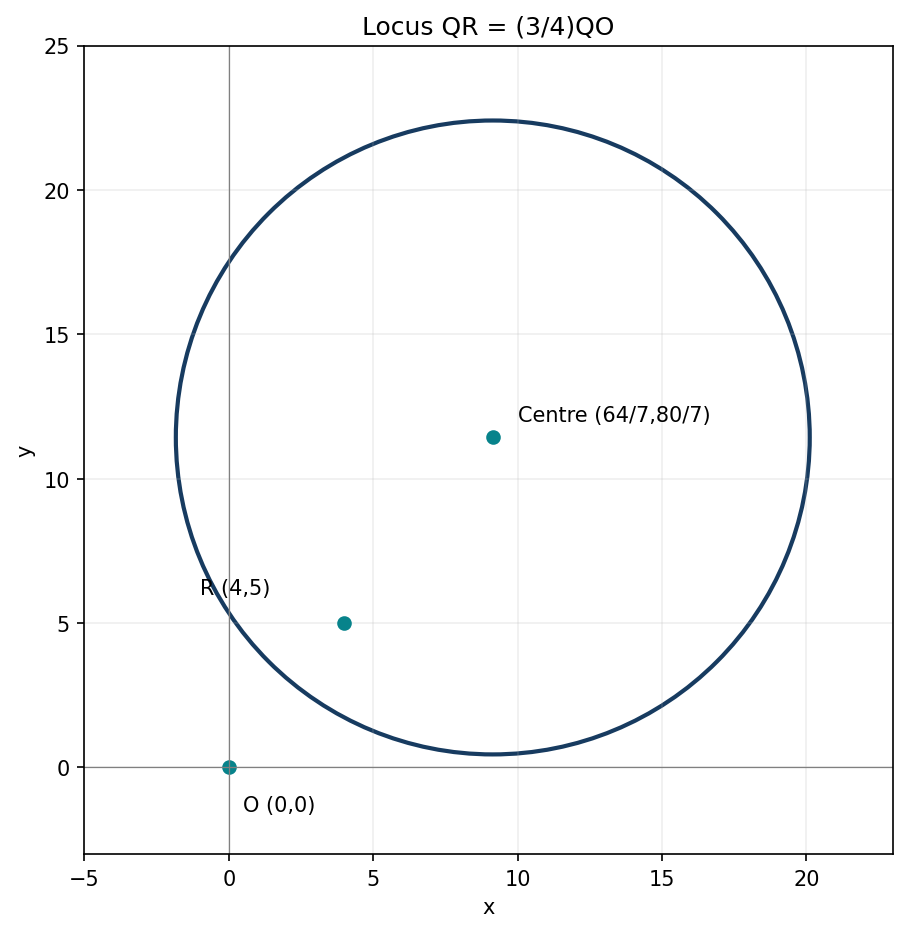
A point Q moves in a way that its distance from point R(4,5) is 3/4 times its distance from the origin. Determine the locus of Q.
(9 marks)
Answer
| Step | Working |
|---|---|
| Let Q=(x,y) | √[(x−4)²+(y−5)²]=(3/4)√(x²+y²). |
| Square | 16[(x−4)²+(y−5)²]=9(x²+y²). |
| Expand | 7x²+7y²−128x−160y+656=0. |
| Complete squares | (x−64/7)²+(y−80/7)²=5904/49. |
| Answer | Circle with centre (64/7,80/7) and radius 12√41/7. |