Power Production Systems — October/November 2021
KNEC Diploma in Mechanical Engineering — Module III. Paper code: 2502/305. Independent revision answers, not official KNEC marking schemes.
The supplied scan comprises printed pages 2–3 and all seven main questions. Its cover/instructions page is absent. Printed wording, including “tabular”, “inter-tube”, “stockers” and “multi-report”, is retained; interpretations are explained beside the answers. Monthly/daily maintenance descriptions are revision outlines and remain subject to the plant’s approved procedures.
Question 1(a)
Outline four benefits of carrying out energy monitoring and targeting.
(4 marks)
Answer
- Establishes a baseline and reveals abnormal use, leaks and avoidable waste.
- Sets measurable consumption targets linked to useful output and operating conditions.
- Verifies savings after improvements rather than assuming they occurred.
- Improves energy budgeting, accountability and prioritisation of corrective work.
Question 1(b)
Explain three types of energy audits.
(6 marks)
Answer
| Type | Explanation |
|---|---|
| Preliminary / walk-through | Uses bills, basic operating information and a site survey to identify major users, obvious losses and priorities for further investigation. |
| Targeted / system-specific | Examines one significant system, such as steam, compressed air or motors, with focused measurements and technical savings estimates. |
| Detailed / comprehensive | Builds a fuller energy balance using measured operating data, assesses interacting measures, quantifies savings/costs and evaluates implementation economics. |
Terminology varies by audit framework; these are three commonly used audit scopes, not a claim that every standard uses these exact labels.
Question 1(c)
(i) Outline five factors considered in locating a steam power plant. (ii) With the aid of a diagram, explain the operation of a baffle type steam separator.
(10 marks)
Answer
- Adequate, reliable cooling/feedwater supply and acceptable discharge arrangements.
- Access to a reliable fuel supply and suitable transport links.
- Proximity and connection to the load/electricity grid, with space for infrastructure.
- Suitable land, ground conditions, drainage and room for expansion.
- Environmental and community constraints, including emissions, ash disposal, noise and permitting.
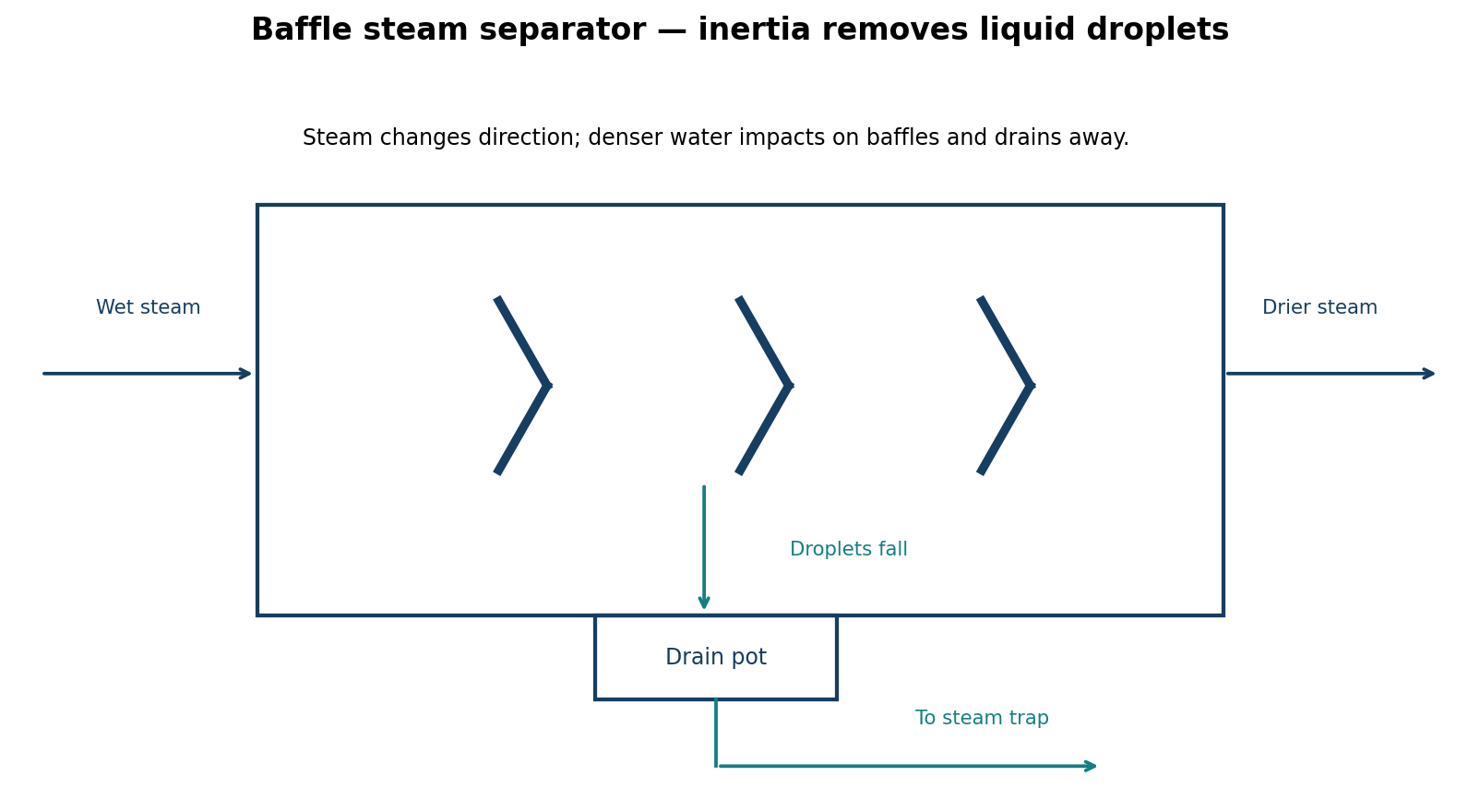
Wet steam changes direction around baffles. Droplets have greater inertia than the vapour and strike the surfaces, where they coalesce. The water drains into the bottom collection space and through a suitable steam trap; drier steam leaves through the outlet. The trap prevents the collection space flooding while limiting steam loss.
Question 2(a)
State six requirements of a steam boiler.
(3 marks)
Answer
- Deliver the required steam mass flow at the specified pressure and condition.
- Have adequate pressure-boundary strength and reliable safety/control devices.
- Convert fuel heat into steam efficiently with low avoidable losses.
- Provide adequate steam space/separation to limit water carryover.
- Allow water circulation, feedwater admission and controlled blowdown.
- Permit inspection, cleaning, maintenance and safe operation.
Question 2(b)
With the aid of a diagram, describe the principle of operation of the following boilers: (i) water-tube; (ii) fire-tube.
(8 marks)
Answer
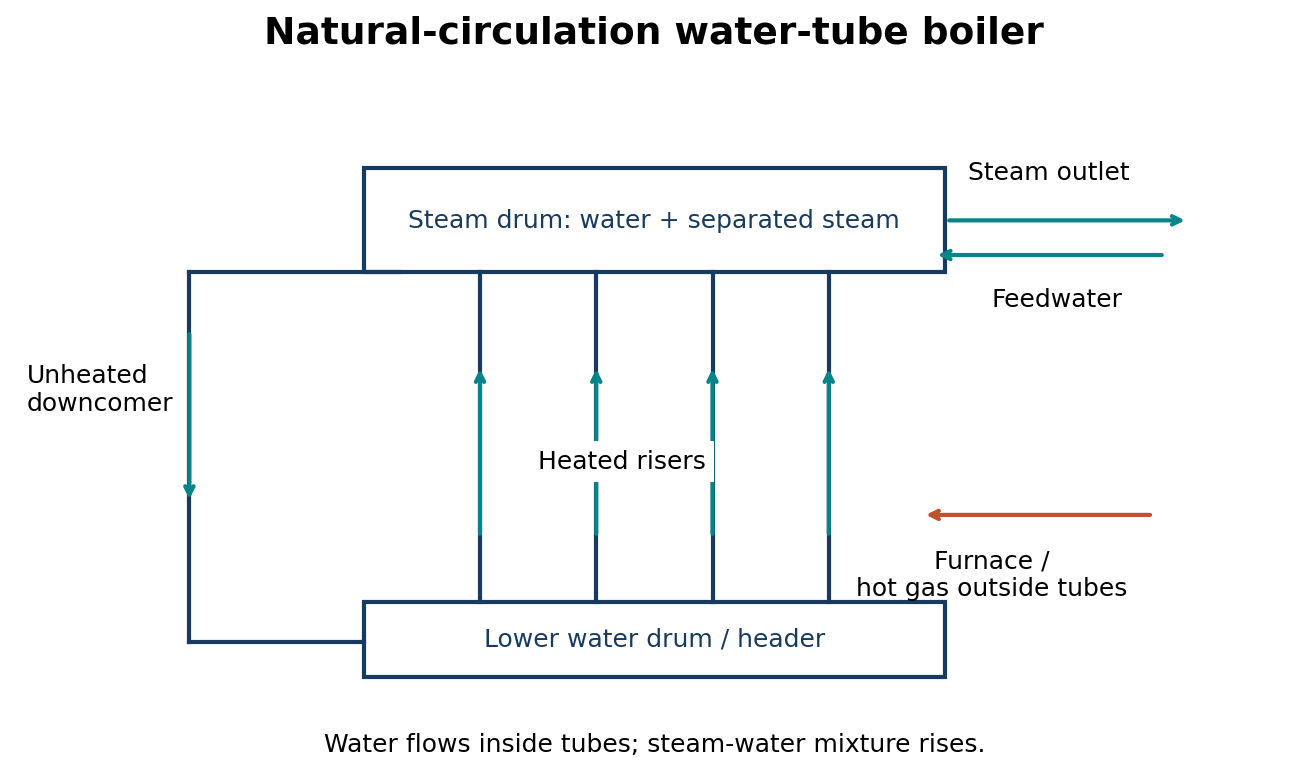
(i) Water-tube boiler: water circulates inside the tube bank. Furnace gases pass over the outside, generating a steam–water mixture. In a natural-circulation arrangement the mixture rises to a steam drum, steam separates, and denser water returns through downcomers. Feedwater replaces withdrawn steam.
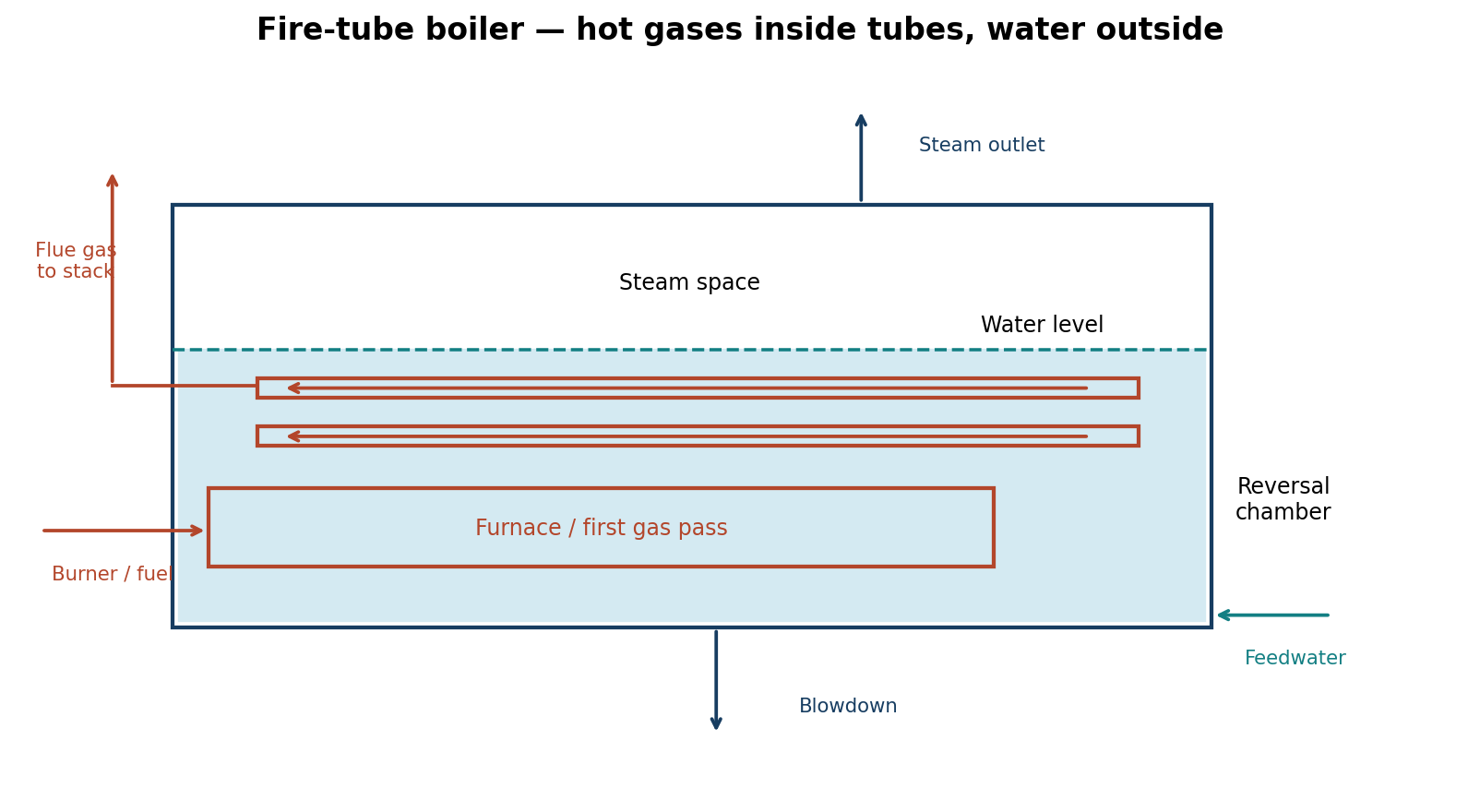
(ii) Fire-tube boiler: fuel burns in the furnace and hot gases pass through tubes contained in a water-filled shell. Heat crosses the tube walls into the surrounding water. Steam rises into the upper steam space for withdrawal; gases leave through the flue. Water level must keep the required heating surfaces covered.
Question 2(c)
Outline four monthly maintenance checks carried out on boilers.
(4 marks)
Answer
- Inspect accessible pressure parts, pipe joints, valves and mountings for leakage/corrosion.
- Inspect burner/fuel system, fan, air passages and combustion condition.
- Check water-level indications, low-water protection, pressure controls and alarms using authorised test procedures.
- Inspect refractory, insulation, doors and flue-gas passages for damage or fouling.
“Monthly” is the examination interval. Actual inspection/test intervals follow the manufacturer, competent inspector and site maintenance plan; do not defeat protection to perform a check.
Question 2(d)
With the aid of a diagram, describe the operation of a steam recovery system using a flash vessel.
(5 marks)
Answer
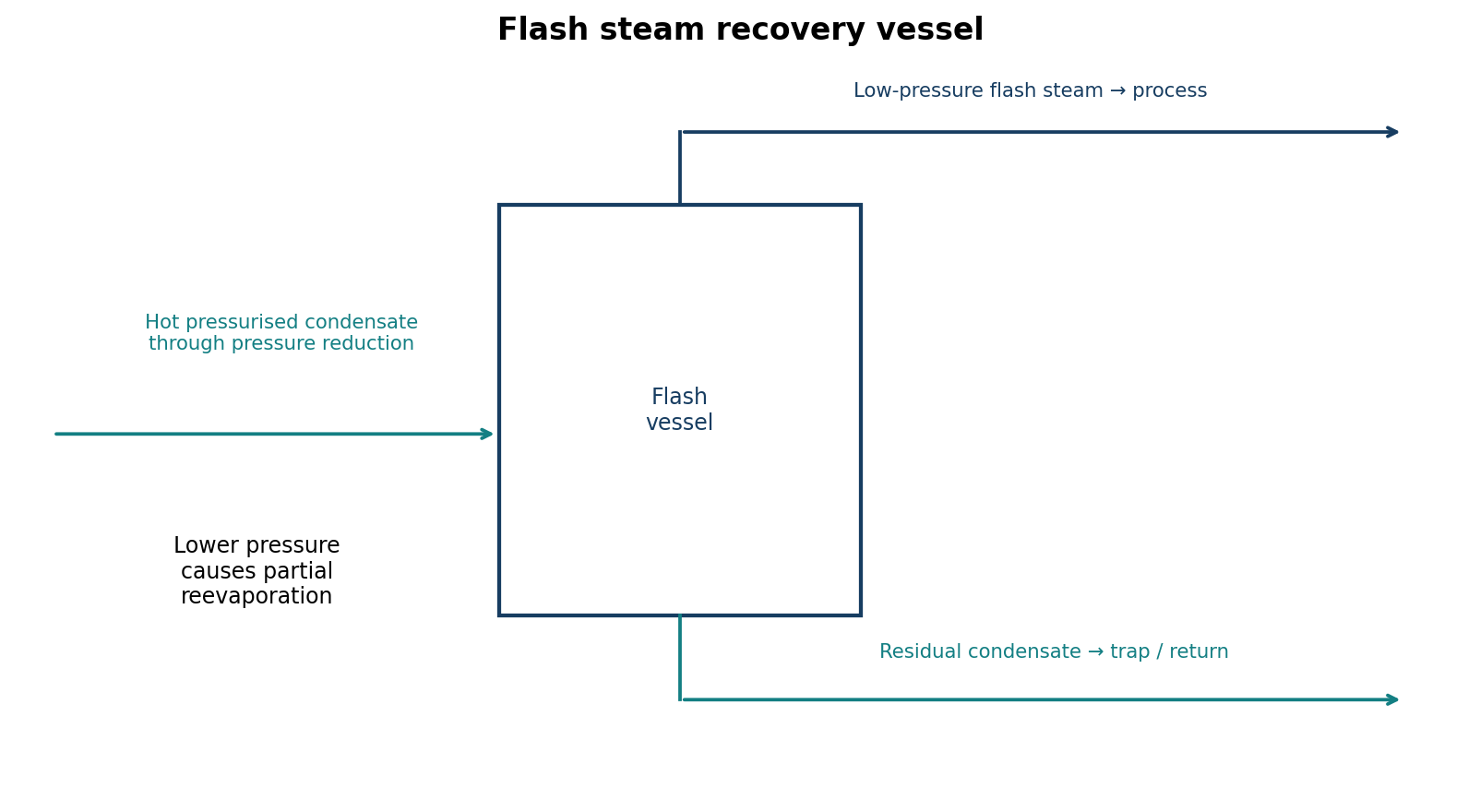
Hot condensate from higher-pressure equipment passes into a lower-pressure flash vessel. Some liquid evaporates because its inlet enthalpy exceeds that of saturated liquid at the lower pressure. The vessel slows the mixture and separates vapour from liquid. Flash steam leaves at the top for a suitable low-pressure heating user; residual condensate drains from the bottom to return/recovery equipment. Match demand and provide suitable pressure control, relief and drainage so upstream traps are not subjected to excessive back pressure.
Question 3(a)
List four impurities in raw boiler feed water.
(4 marks)
Answer
- Suspended solids such as silt and clay.
- Dissolved hardness salts of calcium and magnesium.
- Dissolved gases, particularly oxygen and carbon dioxide.
- Oil, organic matter and other dissolved contaminants.
Question 3(b)
With the aid of diagrams, describe the operation of the following units: (i) tabular air-preheaters; (ii) inter-tube superheaters.
(8 marks)
Answer
The printed “tabular” is interpreted as tubular. “Inter-tube superheater” is interpreted as superheater elements placed among/in the gas passages between boiler generating-tube banks.
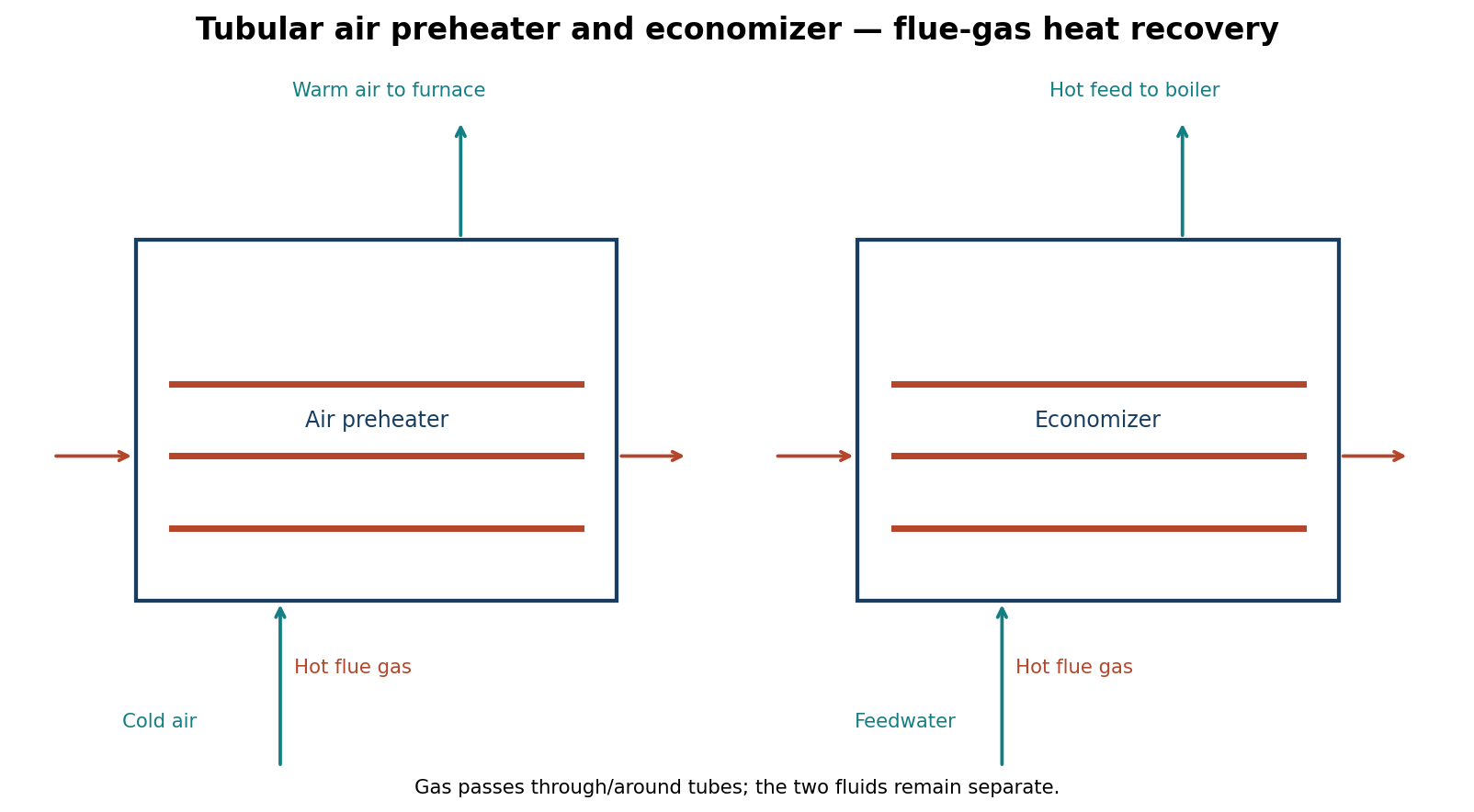
(i) Tubular air-preheater: hot flue gas passes through or around a bank of tubes while combustion air travels on the other side. Heat crosses tube walls without intended mixing. The warmed air is directed to the furnace and the cooled flue gas proceeds to the stack, recovering waste heat.

(ii) Saturated steam from the drum enters a superheater header and flows through tube elements exposed to hot combustion gases. The gases transfer heat through the walls, raising steam temperature above saturation at approximately constant pressure. Superheated steam collects at the outlet header. Appropriate steam flow and temperature control prevent tube overheating; it is steam, rather than feedwater, that is heated in these elements.
Question 3(c)
(i) Outline two requirements of a surface condenser. (ii) With the aid of a diagram, describe the operation of an ejector condenser.
(8 marks)
Answer
- Provide sufficient clean heat-transfer area and cooling-water flow to condense the exhaust at the required pressure, while keeping cooling water separate from condensate.
- Maintain tightness under vacuum and remove condensate and non-condensable gases reliably.
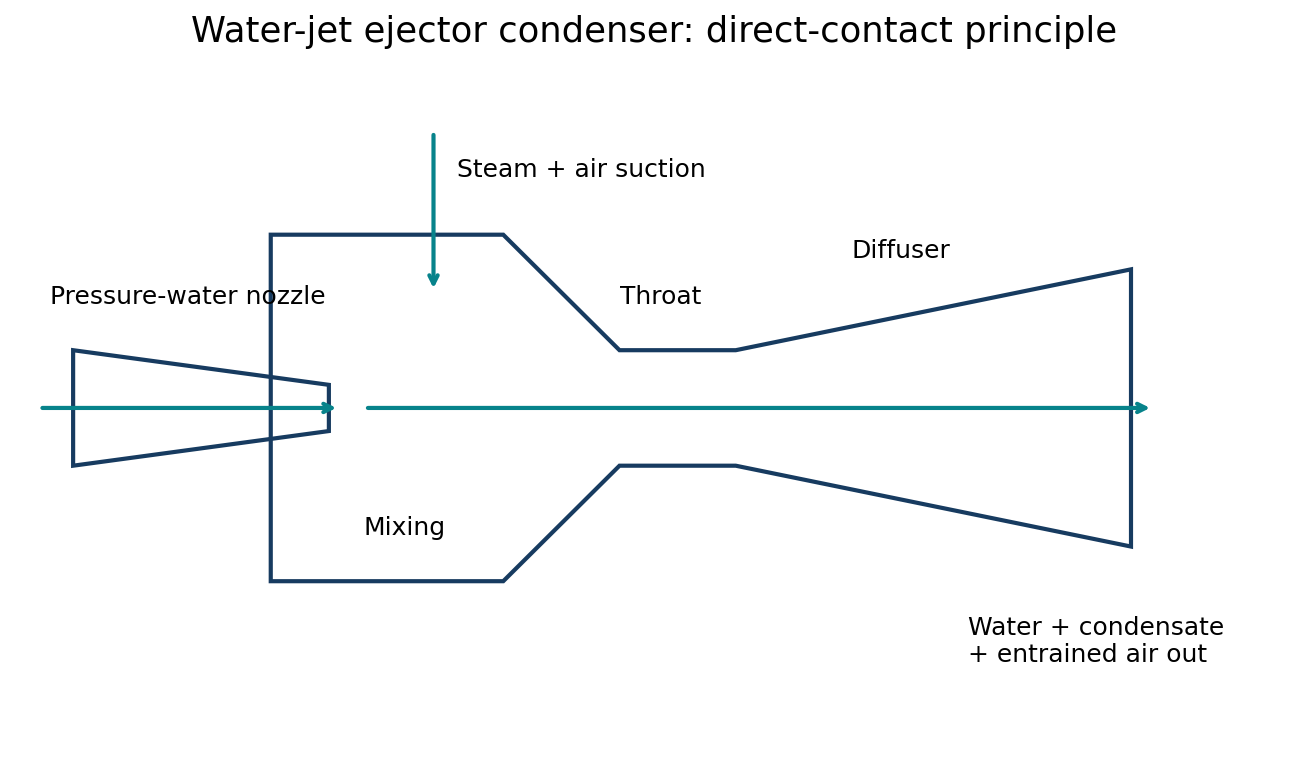
(ii) Pressurised cooling water accelerates through a nozzle, forming a high-speed jet. Low pressure in the suction/mixing chamber draws in exhaust steam and gases. Direct contact with the water condenses the steam; jet momentum entrains the remaining gas and carries the mixture through a throat. The diffuser reduces velocity and recovers sufficient pressure for discharge. Cooling water, condensate and entrained air leave together. This is a direct-contact ejector condenser, distinct from a steam-jet air ejector serving a separate surface condenser.
Question 4(a)
Explain the blow down method of feed water.
(3 marks)
Answer
The wording is imprecise: blowdown controls impurities in boiler water after feedwater has entered; it is not a method that removes dissolved salts from raw feedwater before the boiler.
A controlled quantity of concentrated boiler water is discharged and replaced by suitably treated feedwater. Surface/continuous blowdown controls dissolved-solids concentration; intermittent bottom blowdown removes settled sludge. Discharge passes to an appropriately rated vessel/recovery and cooling arrangement. The rate is set from water analysis and the approved procedure; excessive blowdown wastes water, chemicals and heat.
Question 4(b)
With the aid of a diagram, describe the demineralization process of feed water treatment.
(5 marks)
Answer
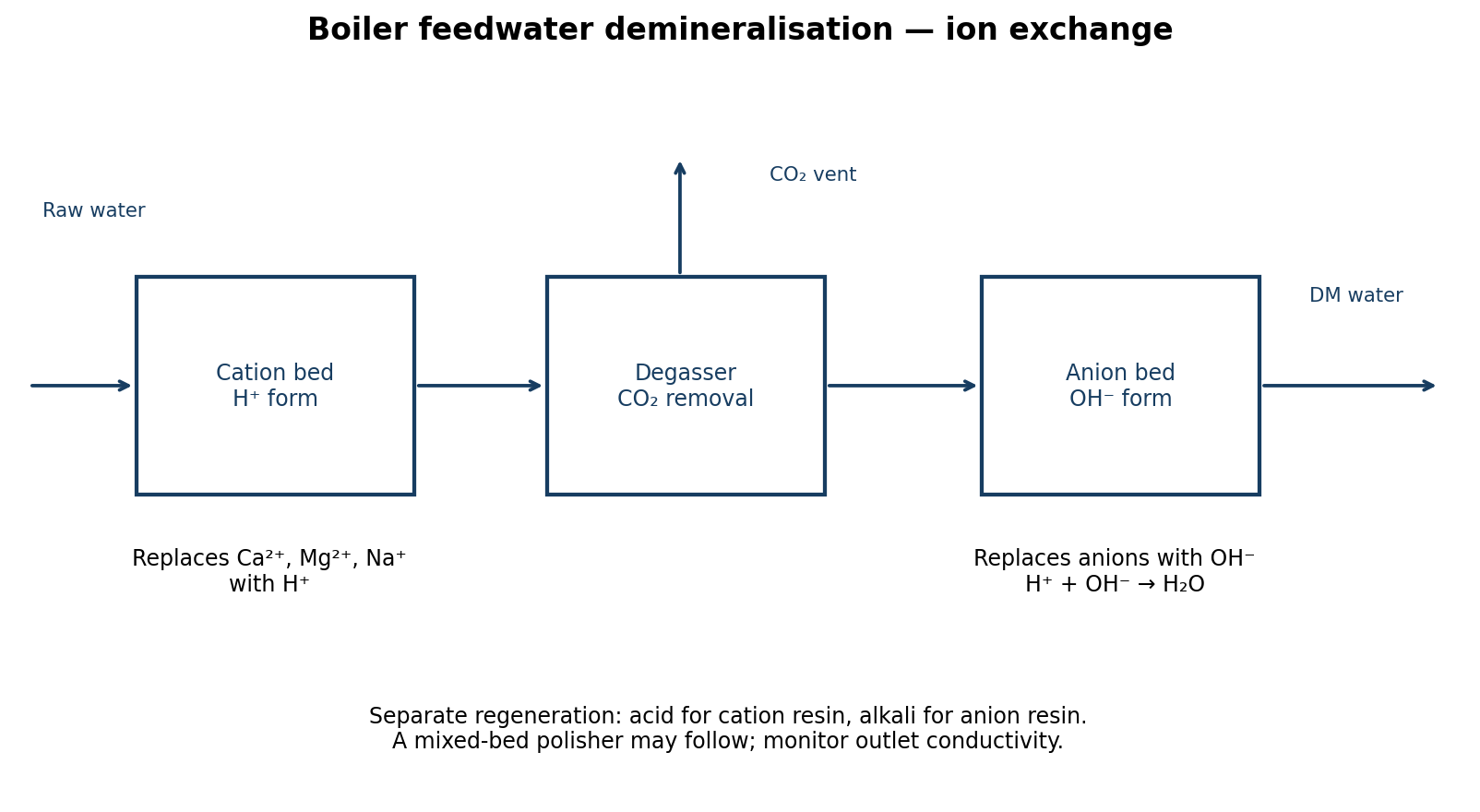
- Pre-filter water as required to protect the resin beds.
- Pass water through a hydrogen-form cation exchanger. Dissolved positive ions such as Ca²⁺, Mg²⁺ and Na⁺ are exchanged for H⁺.
- Pass the water through a hydroxide-form anion exchanger. Negative ions such as chloride and sulphate are exchanged for OH⁻.
- Released H⁺ and OH⁻ combine to form water, reducing dissolved ionic content. A degasser may remove CO₂ and a mixed bed may polish the product.
- Monitor product conductivity and other required chemistry. Exhausted resins are regenerated with the specified chemicals and thoroughly rinsed under a controlled specialist procedure.
Question 4(c)
With the aid of a diagram, explain the operation of a rotary cup oil burner.
(6 marks)
Answer
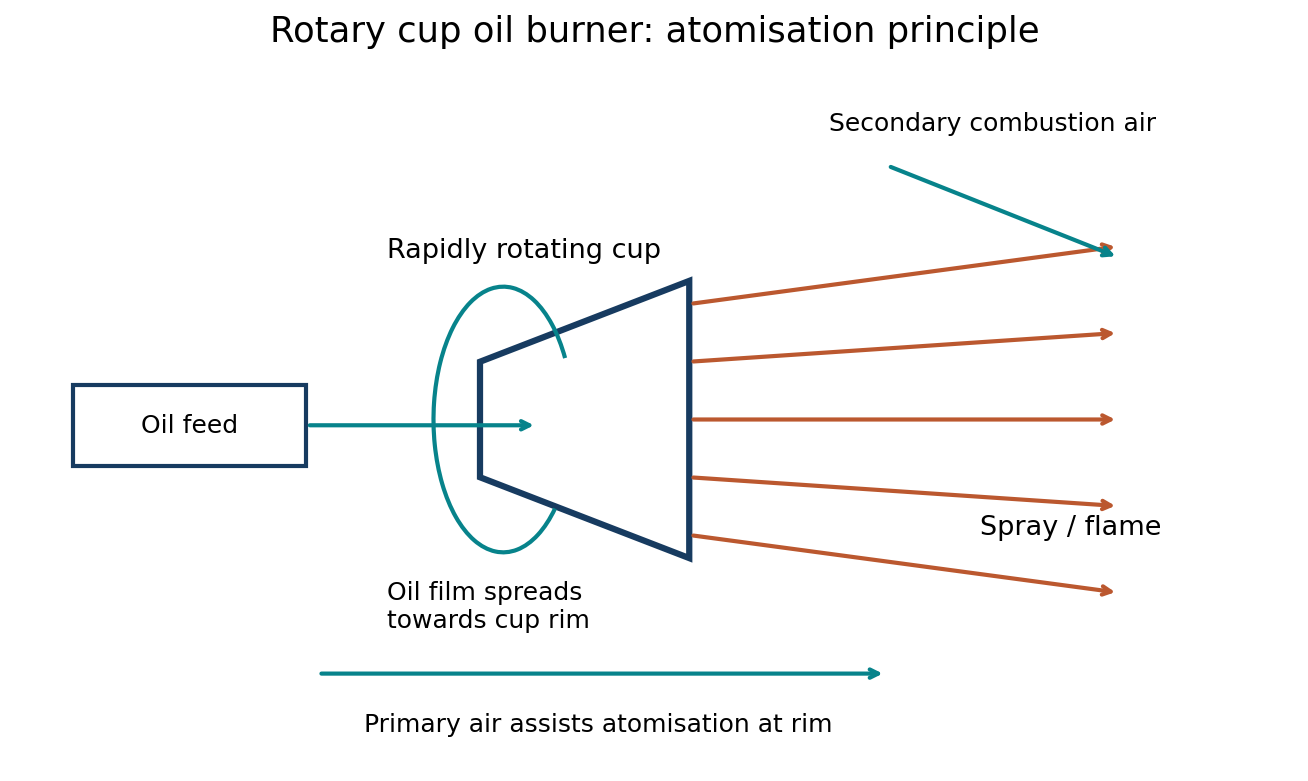
Fuel oil is fed onto the inner surface of a rapidly rotating cup. Centrifugal action spreads it into a thin film that moves towards the rim. At the rim the film breaks into a spray, aided by surrounding primary air. Secondary air mixes with the spray to provide oxygen and shape the flame. Ignition initiates burning; controlled fuel, air and cup speed maintain suitable atomisation and heat release. Oil may require temperature conditioning to achieve the specified viscosity. A flame-failure interlock shuts off fuel if combustion is lost.
Question 4(d)
With the aid of a diagram, describe the operation of an electrostatics filter used in industrial pollution control.
(6 marks)
Answer
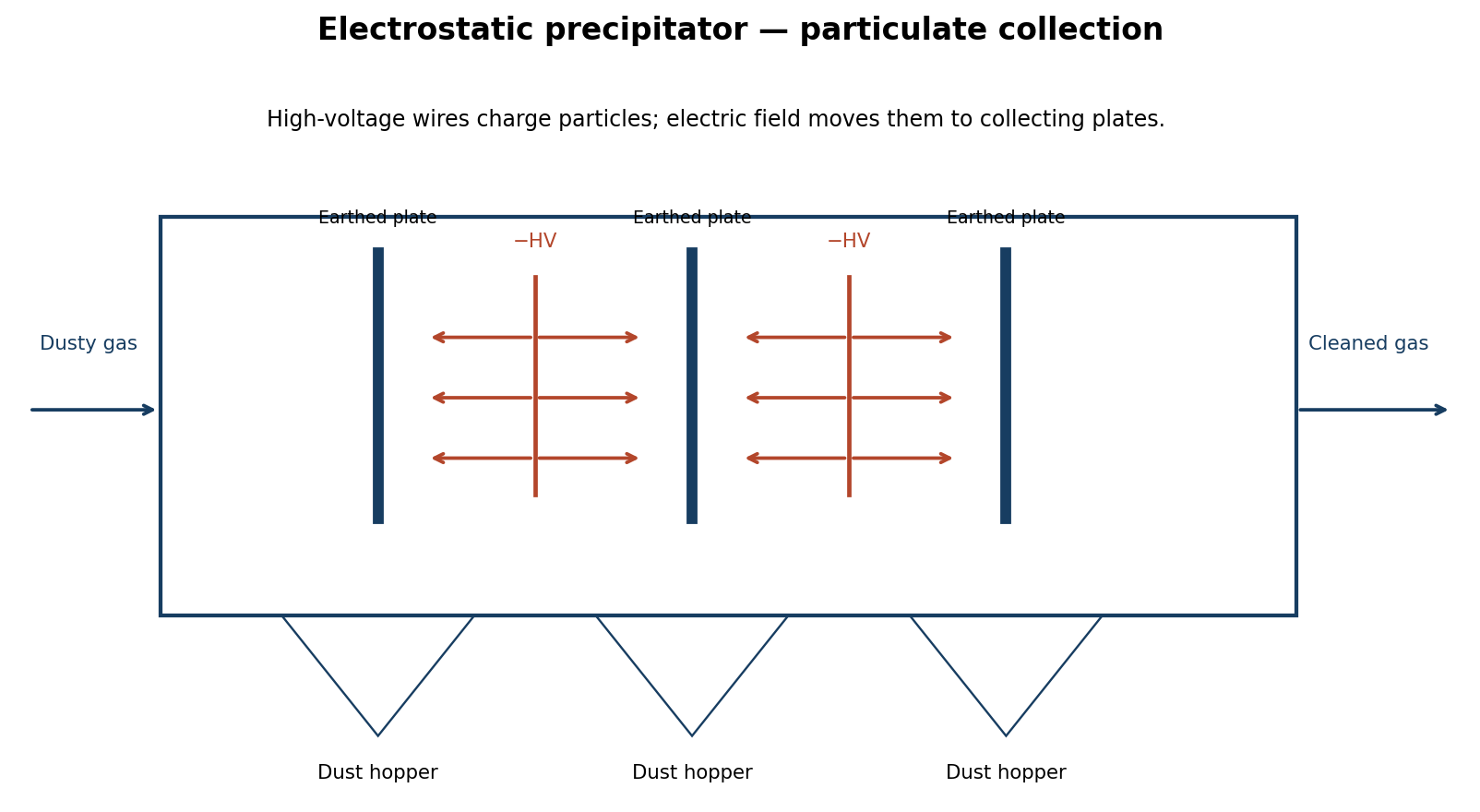
- Dust-laden gas passes between discharge electrodes and collecting plates.
- A high-voltage electric field produces a corona that gives particles an electrical charge.
- Charged particles migrate towards the collecting electrodes and deposit on them.
- Periodic rapping or another cleaning mechanism dislodges deposits into hoppers.
- Hopper discharge equipment removes the collected dust while cleaned gas leaves the unit.
- Gas distribution, electrical conditions, electrode alignment and dust properties affect collection efficiency. It removes particles rather than all gaseous pollutants.
Question 5(a)
Outline four factors to consider when selecting a water turbine.
(6 marks)
Answer
| Factor | Why it matters |
|---|---|
| Available net head | Determines the hydraulic energy available and suitable turbine family. |
| Discharge and its seasonal variation | Determines runner capacity and efficient operation over the flow range. |
| Required power, speed and load range | Must match generator/load requirements and acceptable part-load performance. |
| Site/water and lifecycle conditions | Sediment, cavitation risk, layout, access, installation and maintenance costs affect the practical choice. |
Question 5(b)
With the aid of a diagram, describe the operation of a Francis turbine.
(5 marks)
Answer
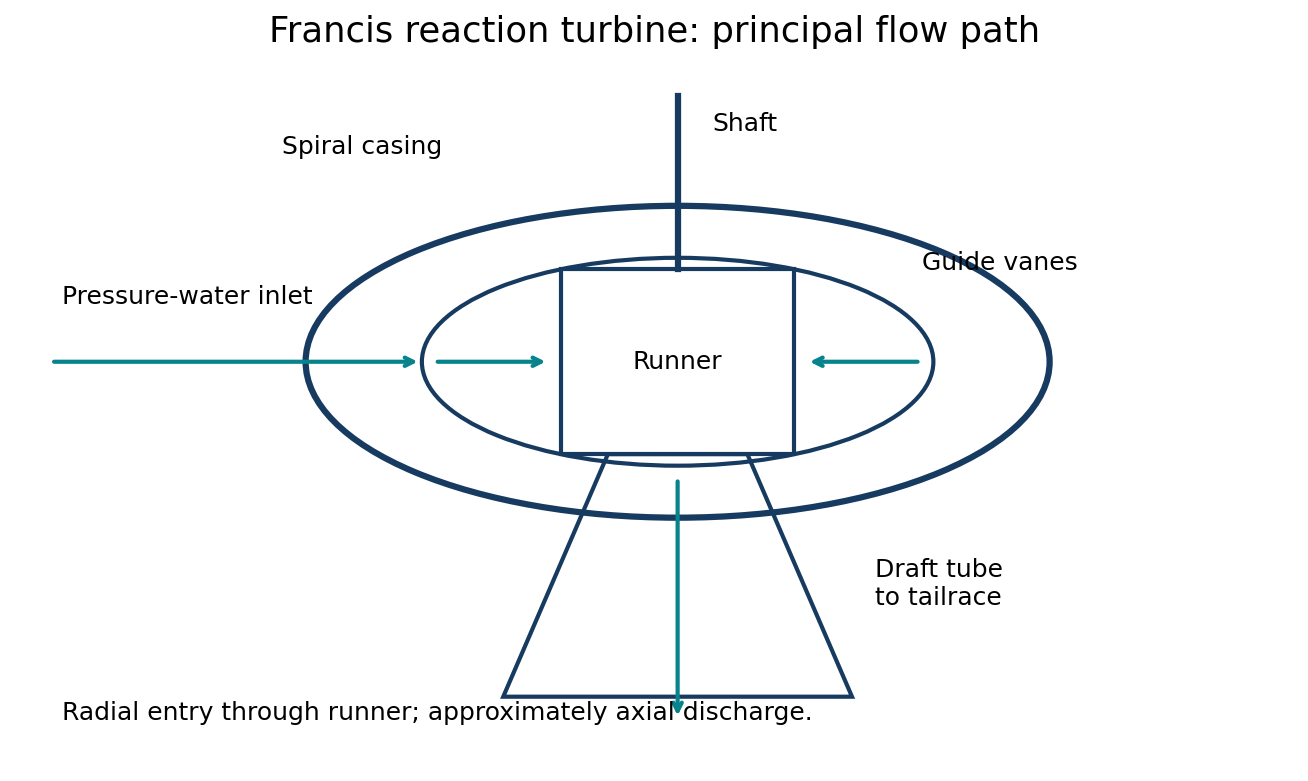
A Francis turbine is a reaction turbine commonly used for medium-head applications. Water enters a spiral casing that distributes it around the runner. Stay/guide vanes direct the flow and regulate admission. Water passes radially inwards through the runner, transferring energy through changes in pressure and momentum, then turns to leave approximately axially. The runner drives the shaft/generator. A draft tube carries discharge to the tailrace and recovers part of the exit kinetic energy; the runner passages remain filled with water.
Question 5(c)
Explain four advantages of nuclear energy over other forms of energy.
(4 marks)
Answer
- High fuel energy density: a comparatively small fuel mass can produce a large amount of heat/electricity.
- Low direct greenhouse-gas and air-pollutant emissions during power generation because fuel is not burned in air.
- Can provide sustained, dispatchable high-output generation with long operating runs between refuelling.
- Relatively small fuel-transport/storage requirements per unit of electricity, reducing dependence on continuous bulk fossil-fuel deliveries.
These advantages do not remove the needs for radiation protection, waste management, cooling, capital investment and eventual decommissioning.
Question 5(d)
With the aid of a layout diagram, describe the operation of a nuclear power plant.
(5 marks)
Answer
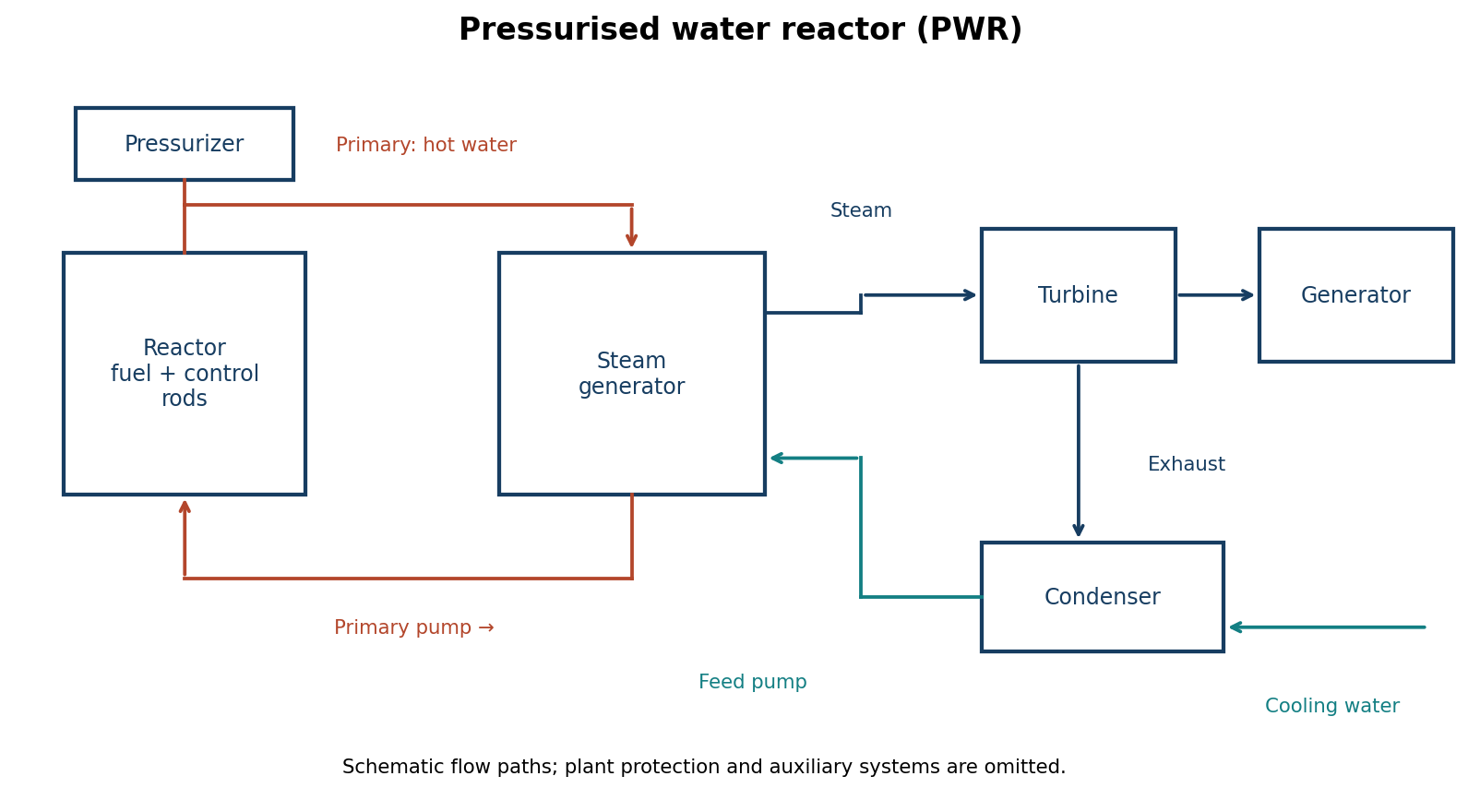
Controlled fission in the reactor heats pressurised primary coolant. The coolant circulates through a steam generator, transferring heat to separate secondary water. Secondary steam drives a turbine coupled to an electrical generator. Exhaust steam condenses by rejecting heat to a cooling-water system; condensate/feed pumps return it to the steam generator. The primary coolant returns to the reactor. Control rods, shielding, containment and protective cooling/control systems provide essential operating and protective functions.
Question 6(a)
List four factors which affect the rate of water cooling in a cooling tower.
(2 marks)
Answer
- Entering-air wet-bulb temperature and humidity.
- Airflow rate and its distribution through the tower.
- Water flow rate and entering hot-water temperature.
- Air–water contact area and contact time, influenced by fill and spray condition.
Question 6(b)
With the aid of a diagram, describe the operation of the following types of cooling towers: (i) atmospheric; (ii) forced draught.
(7 marks)
Answer
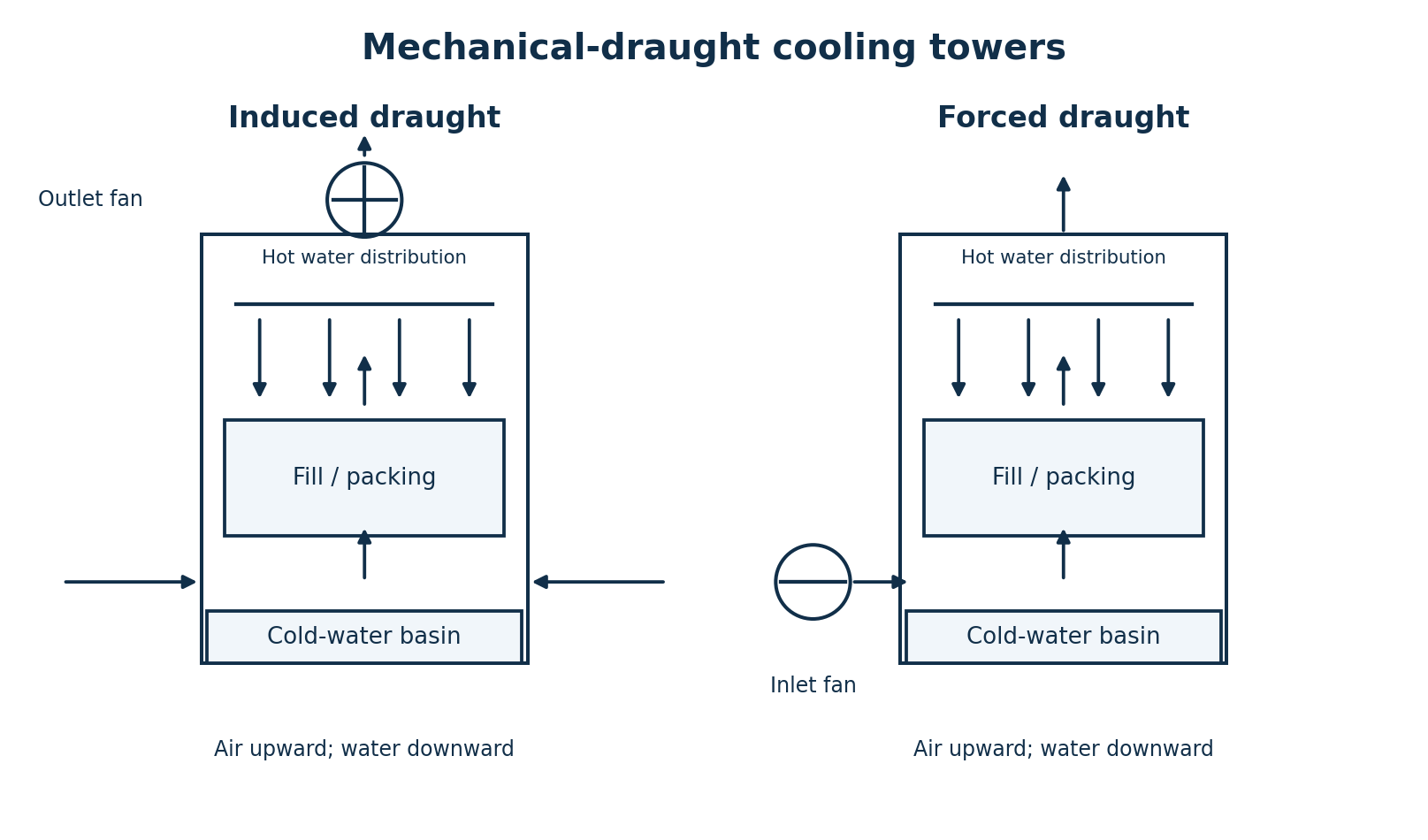
(i) Atmospheric tower: hot water is distributed over spray nozzles/fill. Ambient wind and natural air movement bring air into contact with the descending water without a mechanical fan. A small portion evaporates, removing heat from the remaining water, which collects in the basin. Performance depends strongly on ambient conditions.
(ii) Forced-draught tower: an inlet fan pushes air through the tower while hot water is distributed over the fill. Evaporation and sensible heat transfer cool the water. Warm moist air leaves the discharge and cooled water collects in the basin for recirculation. Drift eliminators reduce droplet carryover; make-up water replaces evaporation and other losses. The inlet fan distinguishes forced from induced draught.
Question 6(c)
Outline four maintenance practices carried out on a cooling tower.
(4 marks)
Answer
- Clean basin, strainers, nozzles and fill; remove scale, sludge and blockages.
- Inspect/service fans, motors, belts or gear drives, bearings and alignment.
- Maintain the prescribed water-treatment, cleaning and microbiological-control programme, with required monitoring.
- Inspect structure, corrosion protection, leaks, make-up/blowdown controls and drift eliminators; repair defects.
Question 6(d)
(i) State four heat losses experienced in a boiler plant. (ii) A boiler evaporates 3.6 kg of water per kg of coal into a dry saturated steam at 10 bar. If the temperature of feed water is 32 °C, determine: (i) equivalent evaporation from and at 100 °C; (ii) the factor of evaporation.
(7 marks)
Answer
- Sensible heat carried away in hot flue gases.
- Latent/sensible heat associated with water vapour in exhaust gases.
- Chemical/unburnt-fuel losses, including carbon in ash and incomplete combustion.
- Radiation and convection losses from external boiler surfaces.
Take 10 bar as absolute pressure, use dry-saturated-steam enthalpy from steam tables and approximate feedwater enthalpy by c_pT. Equivalent evaporation is per kilogram of coal, matching the supplied actual evaporation.
| Step | Working |
|---|---|
| Steam enthalpy | h_g(10 bar abs)=2777.1195 kJ/kg. |
| Feedwater enthalpy | h_fw=4.187×32=133.9840 kJ/kg. |
| Heat rise | Δh=h_g−h_fw=2643.1355 kJ/kg. |
| II. Evaporation factor | F=Δh/h_fg,100=2643.1355/2257=1.171084. |
| I. Equivalent evaporation | m_eq=3.6F=4.215901 kg water/kg coal, from and at 100 °C. |
If 10 bar is intended as gauge pressure, add atmospheric pressure before obtaining h_g; that produces a slightly different result.
Question 7(a)
Outline four safety precautions observed when operating a boiler.
(4 marks)
Answer
- Use trained, authorised operators and follow the approved operating and emergency procedures.
- Maintain correct water level, feedwater supply and water chemistry; investigate abnormal level indications promptly.
- Keep low-water trips, flame safeguards, alarms, pressure controls and safety valves serviceable; do not bypass them.
- Keep within approved operating limits and carry out controlled start-up/shutdown, leak/combustion checks and safe blowdown; isolate and depressurise before maintenance.
Question 7(b)
Explain the following types of boiler accidents: (i) dry fire; (ii) furnace explosion.
(4 marks)
Answer
| Accident | Explanation |
|---|---|
| Dry fire | Heating/firing continues with insufficient water covering the required heating surfaces. Metal can overheat, lose strength and fail. Stop firing through the approved protective/emergency procedure; do not suddenly feed water into an overheated dry boiler. |
| Furnace explosion | An accumulated flammable fuel–air mixture ignites rapidly in the furnace, producing a damaging pressure rise. It can follow failed ignition, flame loss with continuing fuel flow or inadequate purge. Correct interlocks, flame supervision and approved purge/ignition sequences are essential. |
Question 7(c)
Outline four daily maintenance tasks carried out on a boiler.
(4 marks)
Answer
- Inspect for steam/water/fuel leaks and abnormal sound, vibration, odour or combustion condition.
- Check water level/feedwater operation and perform prescribed functional checks of indications and protection.
- Record pressure, temperature, fuel/steam use and water-chemistry readings; carry out prescribed treatment/blowdown.
- Check burner/air supply, clear safe accessible obstructions and maintain housekeeping; report defects and arrange isolated repair.
Daily tasks depend on boiler design and the approved maintenance schedule. Pressure-boundary repairs and internal work are not performed on a live boiler.
Question 7(d)
With the aid of diagrams, describe the operation of the following types of stockers: (i) chain grate; (ii) multi-report.
(8 marks)
Answer
The scan prints “stockers” and “multi-report”. In this combustion context, interpret these as stokers and a multi-retort underfeed stoker; the interpretation is stated rather than silently changing the question.
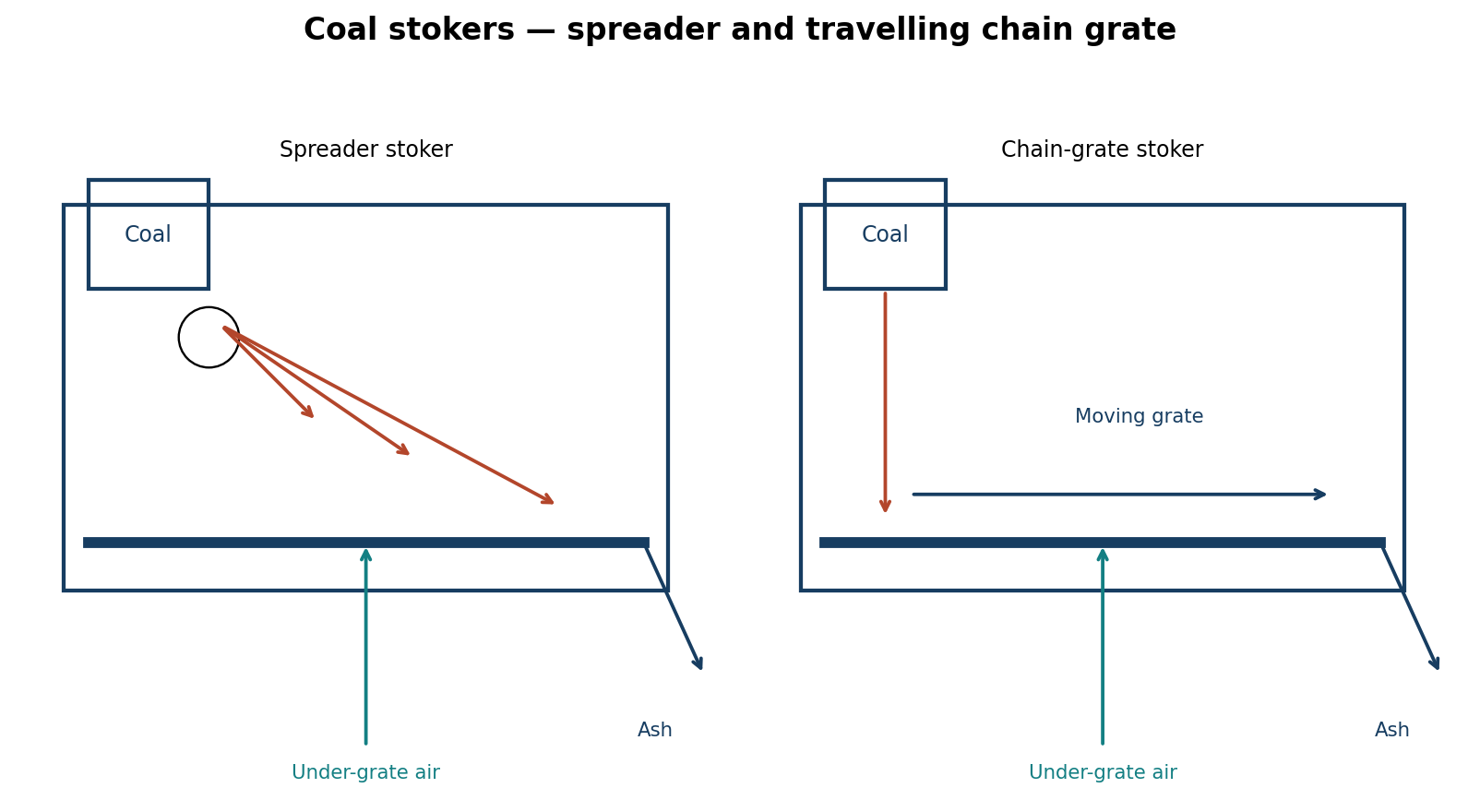
(i) A hopper feeds coal onto an endless travelling chain grate. The grate carries the fuel through ignition, main burning and burnout zones while air rises through grate openings. Grate speed and fuel-bed thickness regulate residence time and feed rate. Ash falls from the discharge end into the ash-handling system.
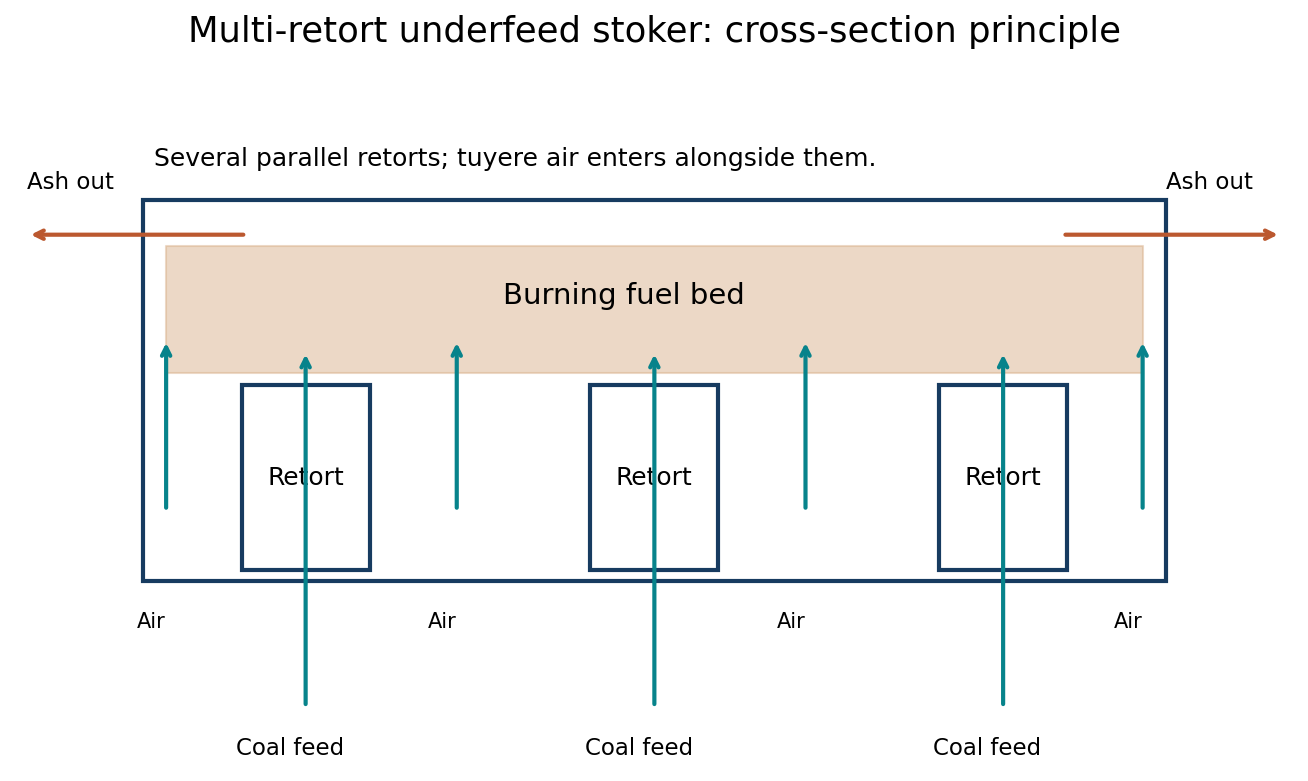
(ii) Mechanical feeders push fresh coal along several retorts beneath the fire bed. The coal is forced upwards towards the burning zone. Air enters through tuyeres between/alongside retorts, supporting combustion as volatile gases pass through the hot bed. Fuel progresses towards the sides/discharge, where burnt residue is removed. Multiple retorts spread fuel and air across a larger furnace area.