Engineering Mathematics III — October/November 2021
KNEC Diploma in Mechanical Engineering — Module III. Paper code: 2503/303, 2508/303, 2509/303; scan also prints 2501/203 and 2502/203. Independent revision answers, not official KNEC marking schemes.
The file is labelled Engineering Mathematics III. Its printed shared-paper codes include both /203 and /303; these are retained above. The scan begins at printed page 2 and contains all eight questions, followed by reference tables. The initial-point singularity, triple-integral region and Fourier jump values are explained explicitly. Handwritten workings are excluded.
Question 1(a)
Determine the particular solution of the differential equation: x sin y dx + (x² + 1) cos y dy = 0 given that when x = 1, y = π/2.
(5 marks)
Answer
| Step | Working |
|---|---|
| Separate | x/(x²+1) dx + cot y dy = 0, locally where sin y ≠ 0. |
| Integrate | (1/2)ln(x²+1)+ln|sin y|=C. |
| Invariant | √(x²+1) sin y=K, taking sin y positive near π/2. |
| Initial condition | √2×1=K ⇒ √(x²+1) sin y=√2. |
| Answer as an implicit curve | (x²+1)sin²y=2, with the branch through (1,π/2). |
| Initial-point qualification | At (1,π/2), the differential form reduces to dx=0. There is no differentiable finite-slope y(x) solution through that point: substituting finite y′ into x sin y+(x²+1)cos y y′=0 gives 1=0. |
| Local geometric interpretation | The solution curve has a vertical tangent. It can be written smoothly as x(y)=√(2csc²y−1) near π/2, or as two one-sided y(x) branches for x≥1. |
Question 1(b)
The motion of a damped system is described by the differential equation: d²y/dt² − dy/dt − 2y = e^(2t). Using the method of undetermined coefficients, solve the differential equation given that when t = 0, y = 1 and dy/dt = 2.
(15 marks)
Answer
Retain the printed minus signs. Although the question calls the system “damped”, the homogeneous equation contains an exponentially growing mode.
| Step | Working |
|---|---|
| Complementary function | m²−m−2=(m−2)(m+1)=0 ⇒ y_c=Ae²ᵗ+Be⁻ᵗ. |
| Resonant trial | e²ᵗ is already a homogeneous solution; take y_p=Cte²ᵗ. |
| Differentiate | y_p′=C(1+2t)e²ᵗ; y_p″=C(4+4t)e²ᵗ. |
| Substitute | y_p″−y_p′−2y_p=3Ce²ᵗ=e²ᵗ ⇒ C=1/3. |
| General solution | y=Ae²ᵗ+Be⁻ᵗ+(t/3)e²ᵗ. |
| Initial displacement | A+B=1. |
| Initial velocity | 2A−B+1/3=2 ⇒ 2A−B=5/3. |
| Constants | A=8/9; B=1/9. |
| Answer | y=(8/9)e²ᵗ+(1/9)e⁻ᵗ+(t/3)e²ᵗ. |
Question 2(a)
Derive from first principles, the Laplace transform of f(t) = t cos4t.
(9 marks)
Answer
| Step | Working |
|---|---|
| Definition | L{t cos4t}=∫₀∞t e⁻ˢᵗcos4t dt, Re(s)>0. |
| Integration aid | For real s>0, let α=s−4i. The desired integral is Re∫₀∞t e⁻ᵅᵗdt. |
| Integrate directly | ∫t e⁻ᵅᵗdt=−e⁻ᵅᵗ(t/α+1/α²). The upper-limit term vanishes. |
| Apply limits | ∫₀∞t e⁻ᵅᵗdt=1/α². |
| Real part | 1/(s−4i)²=(s+4i)²/(s²+16)²=(s²−16+8si)/(s²+16)². |
| Answer | L{t cos4t}=(s²−16)/(s²+16)², Re(s)>0. |
Question 2(b)
A mechanical system is described by the differential equation: d²x/dt² + 9x = sin2t. Use Laplace transforms to determine the function x(t) given that x(0) = 0 and x′(0) = 1.
(11 marks)
Answer
| Step | Working |
|---|---|
| Transform | s²X−sx(0)−x′(0)+9X=2/(s²+4). |
| Insert initial values | (s²+9)X−1=2/(s²+4). |
| Solve for X | X=1/(s²+9)+2/[(s²+4)(s²+9)]. |
| Partial fractions | 2/[(s²+4)(s²+9)]=(2/5)[1/(s²+4)−1/(s²+9)]. |
| Combine | X=(3/5)/(s²+9)+(2/5)/(s²+4). |
| Invert | x(t)=(1/5)sin3t+(1/5)sin2t. |
| Check | x(0)=0; x′(0)=3/5+2/5=1; x″+9x=sin2t. |
Question 3(a)
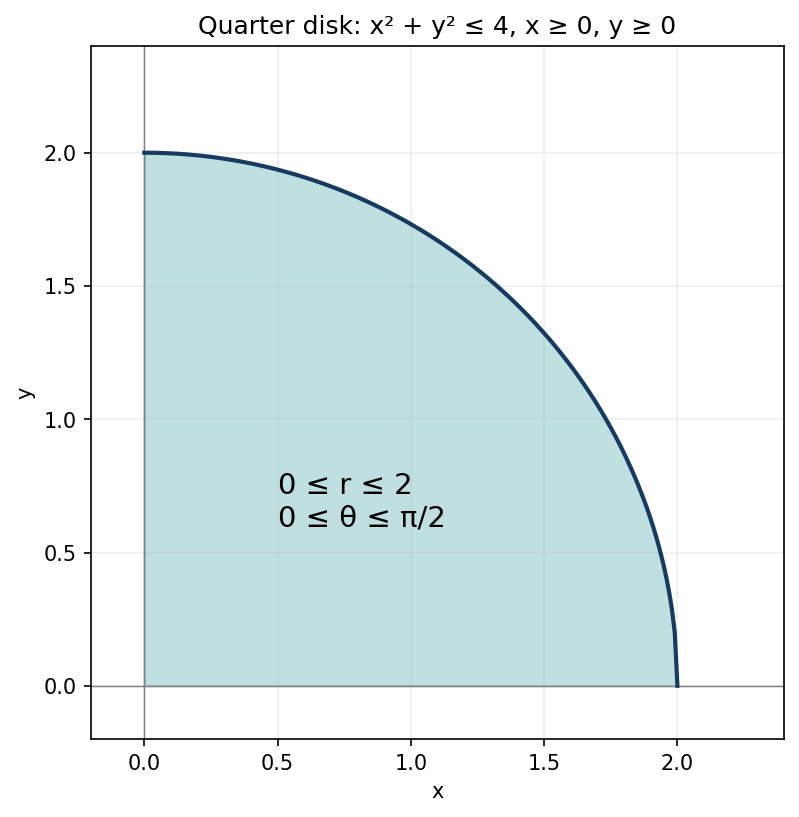
Sketch the region of the integration and evaluate the double integral: ∫₀² ∫₀^[√(4−x²)] x/√(x²+y²) dy dx.
(6 marks)
Answer
| Step | Working |
|---|---|
| Region | 0≤x≤2, 0≤y≤√(4−x²): quarter disk of radius 2 in the first quadrant. |
| Polar coordinates | x=r cosθ, y=r sinθ; dxdy=r drdθ. The integrand x/√(x²+y²)=cosθ for r>0. |
| Transform | I=∫₀^(π/2)∫₀² r cosθ dr dθ. |
| Integrate | I=[r²/2]₀²[sinθ]₀^(π/2)=2. |
| Answer | I=2. The point r=0 has no effect on the integral. |
Question 3(b)
Evaluate the triple integral ∭_S x²y²z dz dy dx, where S is defined by 0 ≤ z ≤ (x² − y²), 0 ≤ x ≤ 1, 0 ≤ y ≤ 1.
(7 marks)
Answer
For the stated solid S to exist at a point, x²−y²≥0. In the first quadrant this requires y≤x. Preserve that geometric restriction rather than integrating a negative-height solid.
| Step | Working |
|---|---|
| Actual solid | 0≤x≤1, 0≤y≤x, 0≤z≤x²−y². |
| Integrate z | ∫₀^(x²−y²)x²y²z dz=(1/2)x²y²(x²−y²)². |
| Expand and integrate y | (1/2)x²∫₀ˣ(x⁴y²−2x²y⁴+y⁶)dy=(1/2)x²[x⁷/3−2x⁷/5+x⁷/7]=(4/105)x⁹. |
| Integrate x | I=(4/105)∫₀¹x⁹dx=(4/105)(1/10)=2/525. |
| Answer for S | I=2/525≈0.00380952. |
| Literal oriented iterated alternative | If one instead mechanically uses y from 0 to 1 even when z’s upper bound is negative, the oriented iterated integral is (1/2)[1/21−2/25+1/21]=4/525. This is not the integral over the stated solid S. |
Question 3(c)
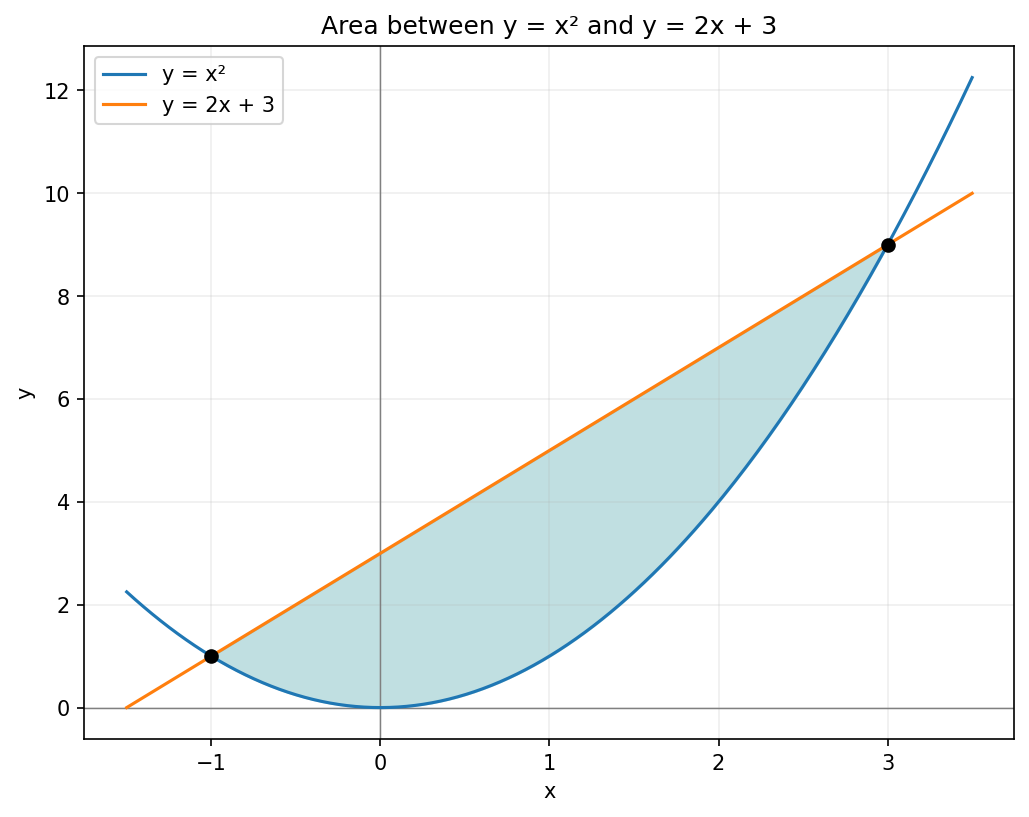
Use double integration to find the area bounded by the parabola y = x² and the line y = 2x + 3.
(7 marks)
Answer
| Step | Working |
|---|---|
| Intersections | x²=2x+3 ⇒ (x−3)(x+1)=0 ⇒ x=−1,3. |
| Upper and lower curves | On [−1,3], line y=2x+3 lies above parabola y=x². |
| Double integral | A=∫₋₁³∫_(x²)^(2x+3)1 dy dx=∫₋₁³(2x+3−x²)dx. |
| Antiderivative | x²+3x−x³/3. |
| Endpoints | At 3:9. At −1:−5/3. Hence A=9+5/3=32/3. |
| Answer | A=32/3 square units. |
Question 4(a)
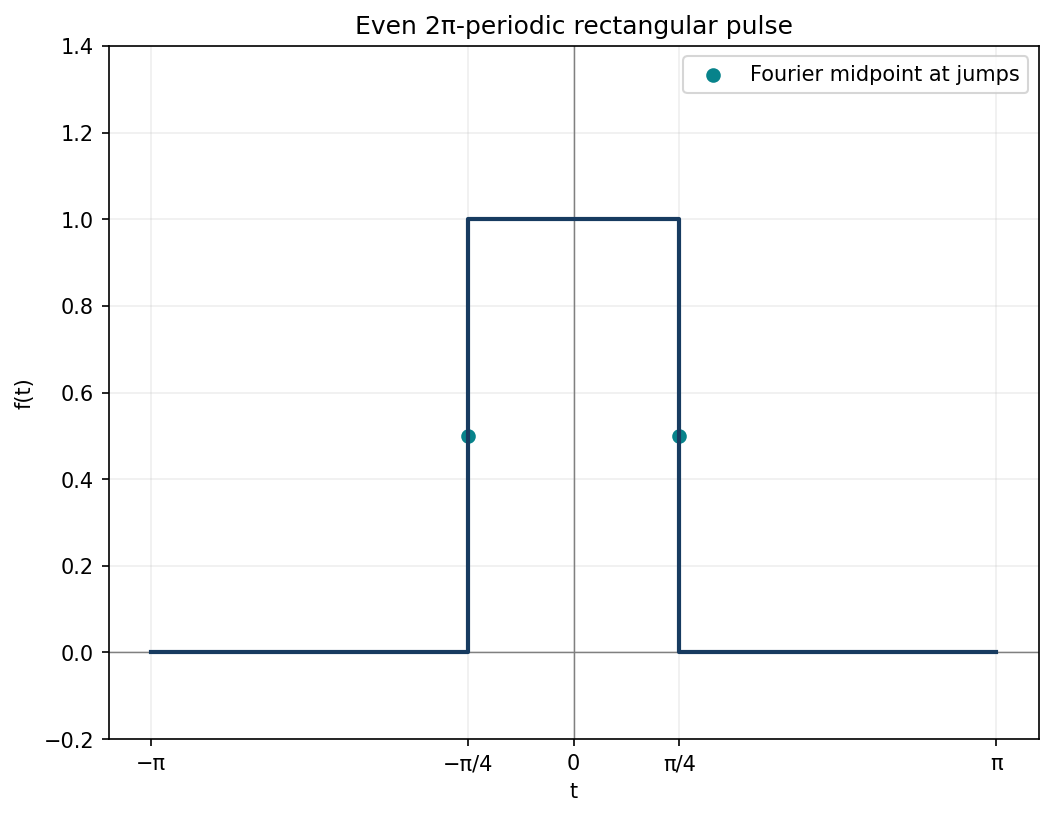
A periodic function f(t) is defined by: f(t)=0, −π≤t≤−π/4; f(t)=1, −π/4≤t≤π/4; f(t)=0, π/4≤t≤π; f(t+2π). (i) Sketch the function f(t) for −π≤t≤π. (ii) Determine the Fourier series of f(t). (iii) By setting t=π/4 in the series, show that Σₙ₌₁∞ (1/n)sin(nπ/2)=π/4.
(14 marks)
Answer
The final printed line indicates 2π-periodic continuation. The overlapping endpoint definitions at ±π/4 do not affect the coefficients; the Fourier series takes the jump midpoint 1/2 there.
| Step | Working |
|---|---|
| Symmetry | f is even ⇒ b_n=0. |
| Constant coefficient | a₀=(1/π)∫₋ππf(t)dt=(1/π)(π/2)=1/2. Thus a₀/2=1/4. |
| Cosine coefficients | a_n=(2/π)∫₀^(π/4)cos(nt)dt=2sin(nπ/4)/(nπ). |
| II. Fourier series | f(t)~1/4+(2/π)Σₙ₌₁∞[sin(nπ/4)/n]cos(nt). |
| III. At t=π/4 | f_series(π/4)=1/2, the midpoint of 1 and 0. |
| Substitute | 1/2=1/4+(2/π)Σ[sin(nπ/4)cos(nπ/4)/n]. |
| Double-angle identity | 2sin a cos a=sin2a ⇒ 1/2=1/4+(1/π)Σ sin(nπ/2)/n. |
| Result | Σₙ₌₁∞sin(nπ/2)/n=π/4. This is 1−1/3+1/5−1/7+…=π/4. |
Question 4(b)
Determine the Fourier sine series of g(t) = g(t+2) = t in the interval 0 < t < 1.
(6 marks)
Answer
| Step | Working |
|---|---|
| Half-range construction | Take the odd extension of g(t)=t on (0,1), then continue it with period 2. |
| Sine series | g(t)~Σₙ₌₁∞b_n sin(nπt), 0<t<1. |
| Coefficient | b_n=2∫₀¹t sin(nπt)dt. |
| Integration by parts | b_n=2[−t cos(nπt)/(nπ)+sin(nπt)/(nπ)²]₀¹=2(−1)ⁿ⁺¹/(nπ). |
| Answer | g(t)~(2/π)[sinπt−(sin2πt)/2+(sin3πt)/3−…]. |
Question 5(a)
Given that A=[0,1,3; 2,2,1; 0,1,2] and B=[2,2,1; 2,1,0; 1,1,2]. Determine: (i) D=AᵀB; (ii) C=A+B; (iii) C⁻¹.
(12 marks)
Answer
| Step | Working |
|---|---|
| Transpose | Aᵀ=[0,2,0; 1,2,1; 3,1,2]. |
| I. Matrix product | D=AᵀB=[4,2,0; 7,5,3; 10,9,7]. Each entry is a row of Aᵀ dotted with a column of B. |
| II. Sum | C=[2,3,4; 4,3,1; 1,2,4]. |
| Determinant | det C=2(12−2)−3(16−1)+4(8−3)=20−45+20=−5. |
| Cofactor matrix | K=[10,−15,5; −4,4,−1; −9,14,−6]. |
| Adjugate | adj C=Kᵀ=[10,−4,−9; −15,4,14; 5,−1,−6]. |
| III. Inverse | C⁻¹=(1/−5)adj C=[−2,4/5,9/5; 3,−4/5,−14/5; −1,1/5,6/5]. |
| Check | Multiplying C by the displayed inverse gives the 3×3 identity matrix. |
Question 5(b)
Three forces of a framework F₁, F₂ and F₃ are related by a system of linear equations: 2F₁+4F₂−6F₃=−4; F₁+5F₂+3F₃=10; F₁+3F₂+2F₃=5. Using Cramer’s rule, determine the forces.
(8 marks)
Answer
| Determinant | Rows | Value |
|---|---|---|
| D | [2,4,−6]; [1,5,3]; [1,3,2] | 18 |
| D₁ | [−4,4,−6]; [10,5,3]; [5,3,2] | −54 |
| D₂ | [2,−4,−6]; [1,10,3]; [1,5,2] | 36 |
| D₃ | [2,4,−4]; [1,5,10]; [1,3,5] | 18 |
| Step | Working |
|---|---|
| Cramer ratios | F₁=−54/18=−3; F₂=36/18=2; F₃=18/18=1. |
| Check | 2(−3)+4(2)−6(1)=−4; −3+5(2)+3(1)=10; −3+3(2)+2(1)=5. |
| Interpretation | F₁ acts opposite to its assumed positive direction. Force units are not stated in the printed question. |
Question 6(a)
A scalar function φ(x,y,z) is defined by φ(x,y,z)=ln(x²+y²+z²). Determine grad φ at (1,1,1).
(5 marks)
Answer
| Step | Working |
|---|---|
| Chain rule | ∇φ=[1/(x²+y²+z²)]∇(x²+y²+z²). |
| General gradient | ∇φ=(2xi+2yj+2zk)/(x²+y²+z²). |
| At the point | ∇φ(1,1,1)=(2/3)i+(2/3)j+(2/3)k. |
Question 6(b)
Determine: (i) Curl (Curl E) if E=x²y i+y³z j+z²y k at (2,1,1); (ii) div V if V=3xz³ i−2x²yz j+2yz⁴ k at (1,2,1).
(15 marks)
Answer
| Step | Working |
|---|---|
| I. First curl | ∇×E=(∂E_z/∂y−∂E_y/∂z)i+(∂E_x/∂z−∂E_z/∂x)j+(∂E_y/∂x−∂E_x/∂y)k. |
| Simplify first curl | ∇×E=(z²−y³)i+0j−x²k. |
| Curl again | ∇×(∇×E)=0i+[∂(z²−y³)/∂z−∂(−x²)/∂x]j+[0−∂(z²−y³)/∂y]k. |
| General double curl | ∇×(∇×E)=(2z+2x)j+3y²k. |
| I. At (2,1,1) | Curl(Curl E)=6j+3k. |
| II. Divergence | ∇·V=∂(3xz³)/∂x+∂(−2x²yz)/∂y+∂(2yz⁴)/∂z. |
| Simplify | ∇·V=3z³−2x²z+8yz³. |
| II. At (1,2,1) | 3−2+16=17. |
Question 7(a)
Given that xₙ is an approximation to the root of f(x)=x³−8x−5. (i) Using Newton-Raphson method, show that a better approximation to the root is given by: xₙ₊₁=(2xₙ³+5)/(3xₙ²−8) for n=0,1,2,… . (ii) Given that x₀=3, determine the value of x correct to three decimal places.
(8 marks)
Answer
| Step | Working |
|---|---|
| Derivative | f′(x)=3x²−8. |
| Newton step | xₙ₊₁=xₙ−(xₙ³−8xₙ−5)/(3xₙ²−8). |
| Simplify numerator | xₙ(3xₙ²−8)−xₙ³+8xₙ+5=2xₙ³+5. |
| I. Recurrence | xₙ₊₁=(2xₙ³+5)/(3xₙ²−8), when the denominator is nonzero. |
| n | xₙ | xₙ₊₁ |
|---|---|---|
| 0 | 3.000000000000 | 3.105263157895 |
| 1 | 3.105263157895 | 3.100442369989 |
| 2 | 3.100442369989 | 3.100431985859 |
| 3 | 3.100431985859 | 3.100431985810 |
| 4 | 3.100431985810 | 3.100431985810 |
II. The converged root is 3.1004319858…, giving x=3.100 to three decimal places.
Question 7(b)
The data in Table I shows values obtained from an experiment. Using Newton-Gregory interpolation formula, determine: (i) f(1.5); (ii) f(4.5).
(12 marks)
Answer
| x | 1 | 2 | 3 | 4 | 5 |
|---|---|---|---|---|---|
| y=f(x) | 2 | 5 | 10 | 17 | 26 |
| x | f | Δf | Δ²f |
|---|---|---|---|
| 1 | 2 | 3 | 2 |
| 2 | 5 | 5 | 2 |
| 3 | 10 | 7 | 2 |
| 4 | 17 | 9 | |
| 5 | 26 |
| Step | Working |
|---|---|
| Spacing | h=1; second differences are 2 and higher differences vanish. |
| I. Forward form at x₀=1 | u=(1.5−1)/1=0.5; f=f₀+uΔf₀+u(u−1)Δ²f₀/2. |
| Calculate f(1.5) | 2+0.5(3)+[0.5(−0.5)/2](2)=3.25. |
| II. Backward form at xₙ=5 | v=(4.5−5)/1=−0.5; f=fₙ+v∇fₙ+v(v+1)∇²fₙ/2. |
| Calculate f(4.5) | 26+(−0.5)(9)+[(−0.5)(0.5)/2](2)=21.25. |
| Check | All entries follow f(x)=x²+1, which gives the same two answers. |
Question 8(a)
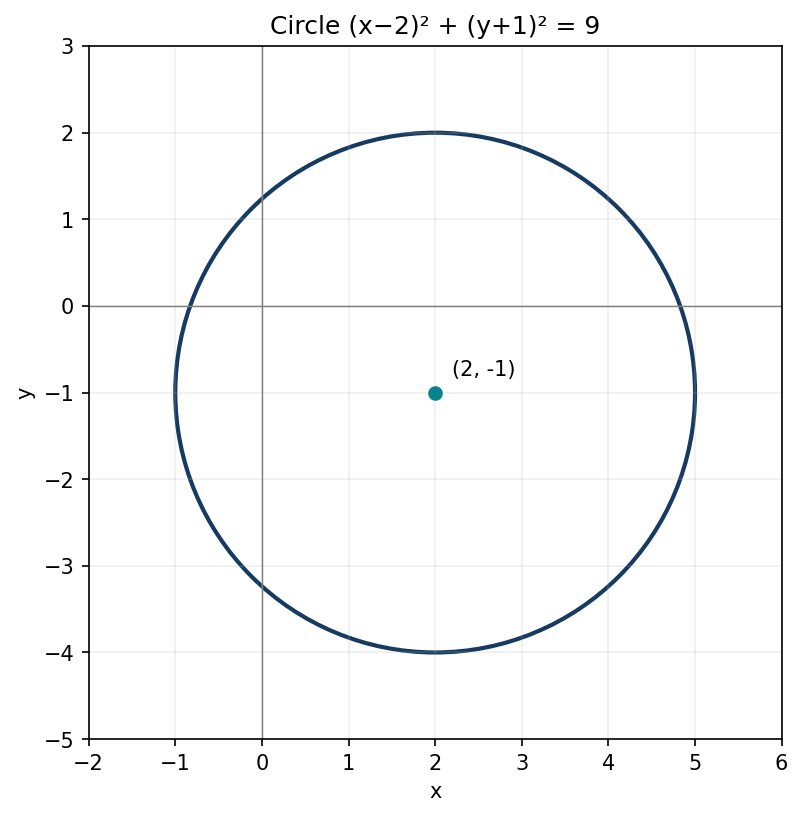
The equation of a circle is given by x²+y²−4x+2y−4=0. Determine its centre and radius, then sketch the circle.
(4 marks)
Answer
| Step | Working |
|---|---|
| Complete squares | (x−2)²−4+(y+1)²−1−4=0. |
| Standard form | (x−2)²+(y+1)²=9. |
| Answer | Centre (2,−1); radius 3. |
Question 8(b)
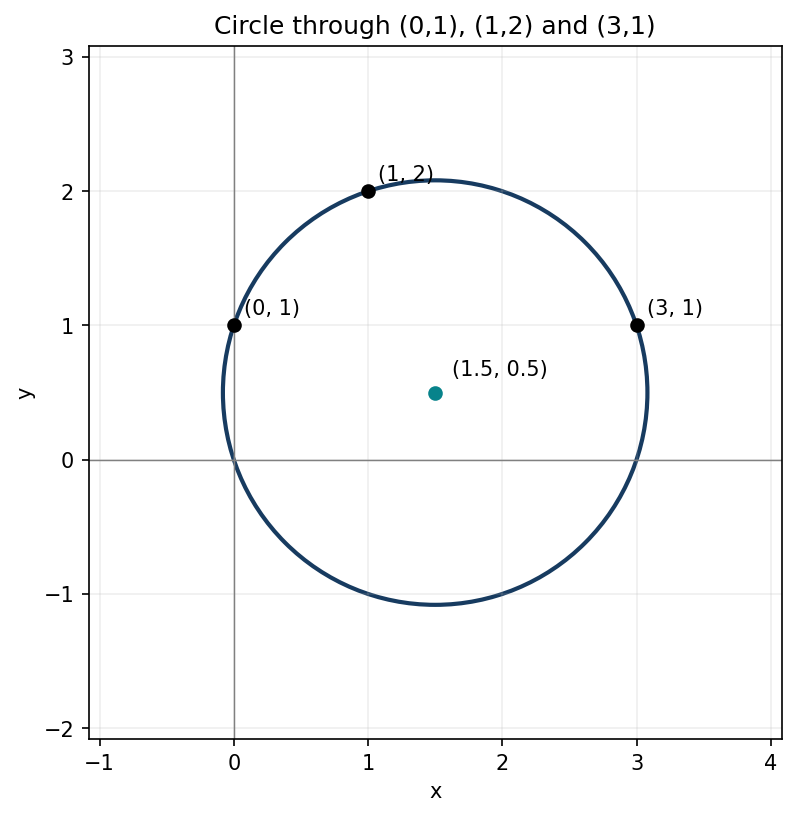
The equation of a circle passes through the points (0,1), (1,2) and (3,1). Determine the locus of these points, then sketch the locus.
(8 marks)
Answer
| Step | Working |
|---|---|
| General circle | x²+y²+Dx+Ey+F=0. |
| Point (0,1) | 1+E+F=0. |
| Point (1,2) | 5+D+2E+F=0. |
| Point (3,1) | 10+3D+E+F=0. |
| Solve | Subtract first from third: 9+3D=0 ⇒ D=−3. First from second: 4+D+E=0 ⇒ E=−1. Then F=0. |
| Locus | x²+y²−3x−y=0. |
| Standard form | (x−3/2)²+(y−1/2)²=5/2. Centre (3/2,1/2), radius √10/2. |
Question 8(c)
Determine the angle between A=2i+2j−k and B=6i−3j+2k.
(8 marks)
Answer
| Step | Working |
|---|---|
| Dot product | A·B=2(6)+2(−3)+(−1)(2)=4. |
| Magnitudes | |A|=√(4+4+1)=3; |B|=√(36+9+4)=7. |
| Angle relation | cosθ=(A·B)/(|A||B|)=4/21. |
| Answer | θ=cos⁻¹(4/21)=79.0194°≈79.02°. |