Level 6 — Electronic Skills — Mar/Apr 2026
Level 6 • March/April 2026 • Written assessment
Work through each question before checking the answer. These revision answers are prepared for learners; they are not an official marking scheme.
Question 1
Answer
- Temperature.
- Impurity/dopant concentration.
Question 2
Answer
- NPN.
- PNP.
Question 3
Answer
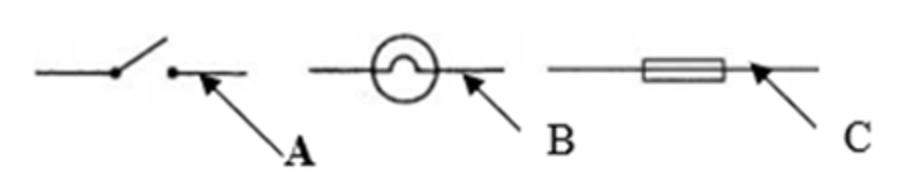
| Label | Component |
|---|---|
| A | Open switch |
| B | AC voltage source (circle with sine-wave mark) |
| C | Fuse (small rectangle containing a continuous line) |
Question 4
Answer
- Phosphorus.
- Arsenic.
Question 5
Answer

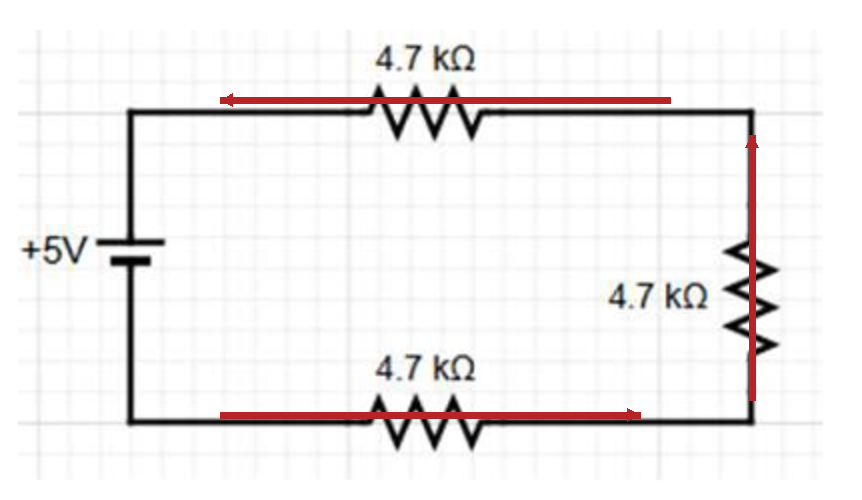
Electrons leave the negative terminal and move through the lower resistor, up the right-hand resistor and back through the upper resistor to the positive terminal. This is opposite to conventional current.
Question 6
Answer
- Convert time: 15 ms = 0.015 s.
- I = Q/t = 0.24/0.015 = 16 A.
Question 7
Answer
- Pixels = 3840×2160 = 8,294,400.
- Bits = 8,294,400×32 = 265,420,800.
- Bytes = 265,420,800/8 = 33,177,600.
- Decimal size = 33.1776 MB. Binary size = 33,177,600/1,048,576 = 31.640625 MiB, excluding file overhead.
Question 8
Answer
Silicon atoms share four valence electrons in covalent bonds. In a large crystal, interacting atomic energy levels split into closely spaced allowed levels, forming bands. The valence band contains bonding-electron states; the conduction band contains higher-energy states in which electrons can move through the crystal. A forbidden energy gap separates the bands.
Question 9
Answer
At 0 K, ideal intrinsic silicon has a full valence band and an empty conduction band, so there are no thermally generated mobile carriers. At room temperature, some electrons gain sufficient thermal energy to cross the band gap. Each promoted electron leaves a hole in the valence band; both the electrons and holes contribute to conduction. The relatively small semiconductor band gap permits this limited carrier generation.
Question 10
Answer
The question calls the device both a fan and a heater; the energy/time calculation is unchanged.
- Energy = 1.8 MJ = 1,800,000 J.
- Time = 30×60 = 1800 s.
- P = E/t = 1,800,000/1800 = 1000 W = 1 kW.
Question 11
Answer
R acts as the decimal point for resistance in ohms: 4.7 Ω. K is the tolerance letter: ±10%. This tolerance K should not be mistaken for the kilo-ohm prefix.
Question 12
Answer
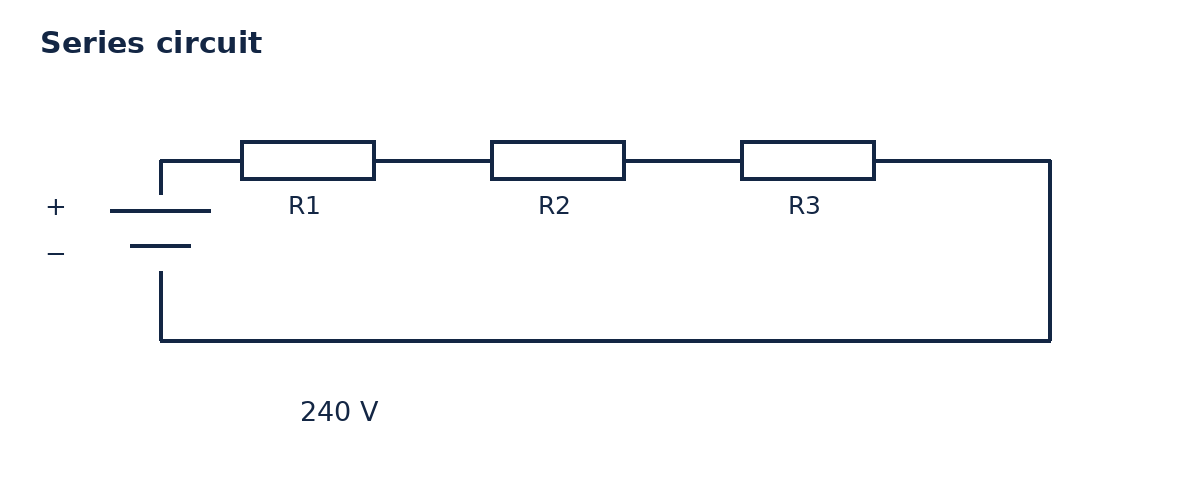
The same current flows through all three resistors. The voltage drops sum to 240 V; Rtotal = R1 + R2 + R3. This is a circuit-theory drawing, not a practical mains-wiring instruction.
Question 13
Answer
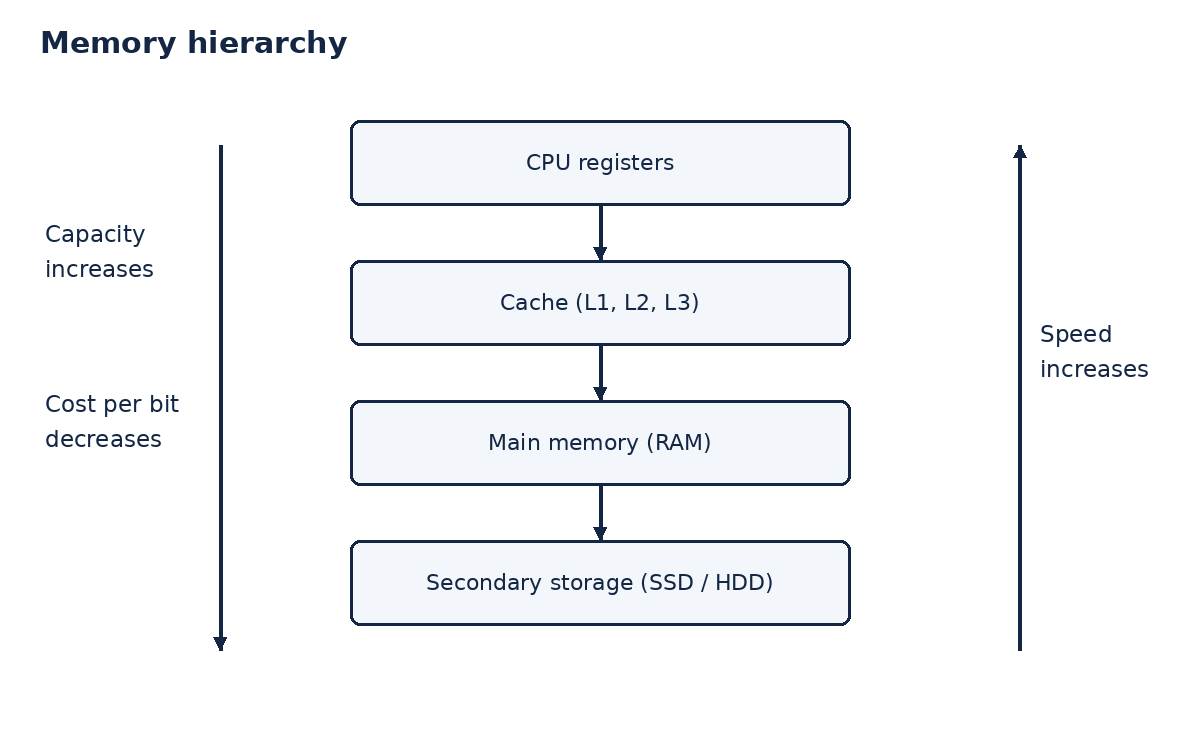
- Speed: cache has lower latency and is closer to the CPU.
- Cost: it is more expensive per byte, typically using SRAM.
- Capacity: only a relatively small cache is economical, while main RAM supplies a larger working-memory capacity.
Question 14
Answer
RAM holds the active files/data while the application works because it supports fast random access and adequate working capacity. SSD storage is useful for persistent files and scratch storage but does not replace RAM.
Question 15
Answer

Neutral germanium has 32 protons and 32 electrons, with four valence electrons. Neutron count depends on the isotope.

| Forward bias | Reverse bias |
|---|---|
| Reduces the junction barrier/depletion width | Increases the barrier/depletion width |
| Permits substantial current once appropriate operating conditions are reached | Only small leakage flows until breakdown; current limiting remains necessary |

Gallium has atomic number 31 and three valence electrons (shell distribution 2,8,18,3). Replacing a tetravalent Ge atom with Ga provides only three bonding electrons, leaving an electron vacancy. The acceptor can take an electron from a neighbouring bond, leaving a mobile hole. Holes are the majority carriers and electrons the minority carriers. The bulk material remains electrically neutral; p-type does not mean the whole crystal has a net positive charge.
Question 16
Answer
- R = R₀[1+α₀(T−0)] = 100[1+0.0043×80].
- 0.0043×80 = 0.344; R = 100×1.344 = 134.4 Ω.
- Small size and low weight.
- Low mass-production cost.
- High reliability from fewer interconnections.
- Lower power requirements for many equivalent functions, depending on the design.
![33 Ω in series with [15 Ω parallel 27 Ω] and 47 Ω across 240 V.](https://jemshah.com/wp-content/uploads/2026/10/cs058-q16-circuit.png)
- Parallel resistance = 15×27/(15+27) = 405/42 = 9.642857 Ω.
- Total = 33+9.642857+47 = 89.642857 Ω.
- Supply current = 240/89.642857 = 2.6773 A.
- Parallel voltage = I×Rparallel = 2.6773×9.642857 = 25.8167 V. Both parallel resistors have this potential difference.
Question 17
Answer
- 10.110₂ = 1×2 + 0×1 + 1/2 + 1/4 + 0/8 = 2.75₁₀.
- 1A4₁₆ = 1×256 + 10×16 + 4 = 420₁₀.
- 125₈ = 1×64 + 2×8 + 5 = 85₁₀.
- Write each digit separately: 454 = 0100 0101 0100; 234 = 0010 0011 0100.
- Add units: 0100 + 0100 = 1000 (8), a valid BCD digit.
- Add tens: 0101 + 0011 = 1000 (8), a valid BCD digit.
- Add hundreds: 0100 + 0010 = 0110 (6), a valid BCD digit.
- Result = 0110 1000 1000 (BCD) = 688₁₀. No digit needs the +0110 BCD correction in this addition.
- X = 24₈ = 2×8+4 = 20₁₀.
- Sum = 20+88 = 108₁₀.
- Excess-3 is per digit: 1+3=4→0100; 0+3=3→0011; 8+3=11→1011.
- Result = 0100 0011 1011.
Question 18
Answer
- Faster random access than typical mechanical HDDs.
- No moving parts, improving shock resistance.
- Quiet operation and often lower power use.
- 1450 W = 1.45 kW; 45 minutes = 0.75 hour.
- Energy = 1.45×0.75 = 1.0875 kWh.
- Cost = 1.0875×30 = KSh 32.625 ≈ KSh 32.63.
- PROM: programmed once to hold permanent instructions/data.
- EPROM: can be erased with ultraviolet light and reprogrammed.
- EEPROM/flash: non-volatile memory that can be electrically erased and rewritten; flash normally erases blocks.
- Available RAM = 16−2 = 14 GB.
- Using the exam convention 1 GB = 1024 MB: 14×1024 = 14,336 MB.
- 14336/1200 = 11.9467; maximum = 11 whole instances. 12 need 14,400 MB.
- If decimal GB were intended instead, 14,000/1200 = 11.6667, which also allows 11 instances.