Demonstrate Basic Electronic Skills
Level 6 — Basic Electronic Skills — November/December 2024 — Written
Source-based revision questions and worked answers for Jemshah learners. These are study answers, not an official CDACC marking scheme. Printed errors and unreadable details are identified in the affected answers.
Part 2 of 2
Question 13
a) 128 × 8 RAM chips are required to design a 2k × 8 memory. Determine (i) number of chips, (ii) address lines for the 2k × 8 memory, (iii) address lines common to all chips, (iv) decoder size. (10 marks)
b) Describe synchronous and asynchronous bus data-transfer schemes. (4 marks)
c) State and explain two DMA transfer modes. (6 marks)
Answer
a. RAM organisation
Worked calculation
- i. Required chips = 2048/128 = 16 chips, each 8 bits wide.
- ii. Address lines for 2048 locations = log₂(2048) = 11.
- iii. Address lines common to each chip = log₂(128) = 7 (A0–A6).
- iv. The remaining four lines A7–A10 feed a 4-to-16 decoder to select one chip.
b. Bus schemes
A synchronous bus uses a shared clock to define transfer timing. An asynchronous bus uses request/acknowledge handshaking; completion depends on the devices’ responses rather than a common clock.
c. DMA modes
- Burst/block mode: the DMA controller takes the bus and transfers a block; the CPU may have to wait for the block to finish.
- Cycle stealing: DMA takes individual bus cycles and releases the bus between transfers, interleaving CPU and DMA access.
Question 14
a) State four properties of passive electronic components. (4 marks)
b) Convert (i) 11001₂ to decimal, (ii) 74.562₈ to binary, (iii) 1983₁₀ to hexadecimal. (9 marks)
c) Simplify (AB + C)(AB + D). (7 marks)
Answer
a. Passive properties
- They cannot provide net power gain; they do not amplify a signal using energy from a separate supply.
- They dissipate energy (resistors) or store and return it (capacitors and inductors).
- Their operation does not require a bias supply that enables gain, although current or voltage may be applied to them.
- Their behaviour is described by quantities such as resistance, capacitance or inductance, and is limited by voltage, current and power ratings.
b. Conversions
Worked calculation
- i. 11001₂ = 16 + 8 + 1 = 25₁₀.
- ii. 74.562₈ = 111 100.101 110 010₂ (three bits for each octal digit).
- iii. 1983 ÷ 16 = 123 r15; 123 ÷ 16 = 7 r11; 7 ÷ 16 = 0 r7. Thus 1983₁₀ = 7BF₁₆.
c. Boolean simplification
Worked calculation
- (AB + C)(AB + D) = AB·AB + ABD + ABC + CD.
- Idempotence gives AB·AB = AB.
- Absorption gives AB + ABD = AB and AB + ABC = AB.
- Therefore F = AB + CD.
Question 15
a) Digital electronics is the drive gear to the advancement technology design of display
systems. Explain the following digital displays. (8 marks)
i.
Light emitting diode displays (LEDs)
ii.
Liquid crystal displays (LCDs)
iii.
Organic Light-Emitting Diodes (OLEDs)
iv.
Seven Segment Display
b) Draw and explain the voltage-current (V-I) characteristics curves of a P-N junction diode.
(12 marks)
Answer
a. Displays
- LED display: forward-biased semiconductor emitters produce the displayed light.
- LCD: liquid-crystal cells modulate light from a backlight or reflected source rather than emitting it directly.
- OLED: organic light-emitting layers create light in individual pixels, allowing deep blacks and thin panels.
- Seven-segment display: seven individually controlled segments form decimal digits; the segments may use LED or LCD technology.
b. Diode V–I curve
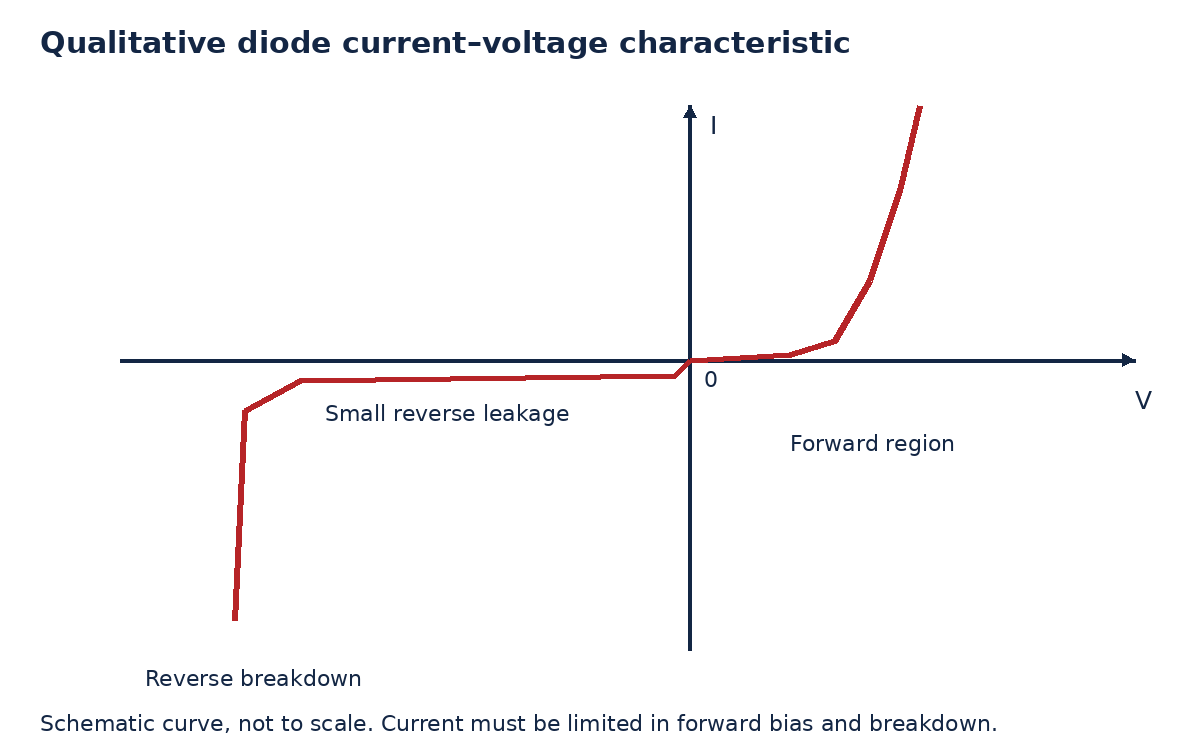
In forward bias, current is small at low voltage and then increases steeply. In reverse bias, only a small leakage current flows until the breakdown voltage is reached; beyond it reverse current rises sharply. The curve is nonlinear, depends on material and temperature, and reverse-breakdown current must be limited to avoid damage unless the diode is designed for that operation.