Level 6 — Electronic Skills — Nov/Dec 2025
Level 6 • November/December 2025 • Written assessment
Work through each question before checking the answer. These revision answers are prepared for learners; they are not an official marking scheme.
Question 1
Answer
- Material resistivity.
- Length.
- Cross-sectional area.
- Temperature.
Question 2
Answer

- Assume ideal uncoupled inductors (no mutual inductance).
- Lparallel = L2L3/(L2+L3) = 1×2/(1+2) = 2/3 H.
- Lequivalent = 0.5 + 2/3 = 7/6 H ≈ 1.167 H.
Question 3
Answer
- Rtotal = 27 + 3.3 = 30.3 Ω.
- I = V/R = 4.5/30.3 = 0.1485 A (148.5 mA).
Question 4
Answer
- Store energy in a magnetic field for switching-converter circuits.
- Oppose changing current, providing filtering/choke action that reduces ripple or noise.
Question 5
Answer
- 60 W = 0.060 kW.
- Energy = power × time = 0.060×5 = 0.30 kWh.
Question 6
Answer
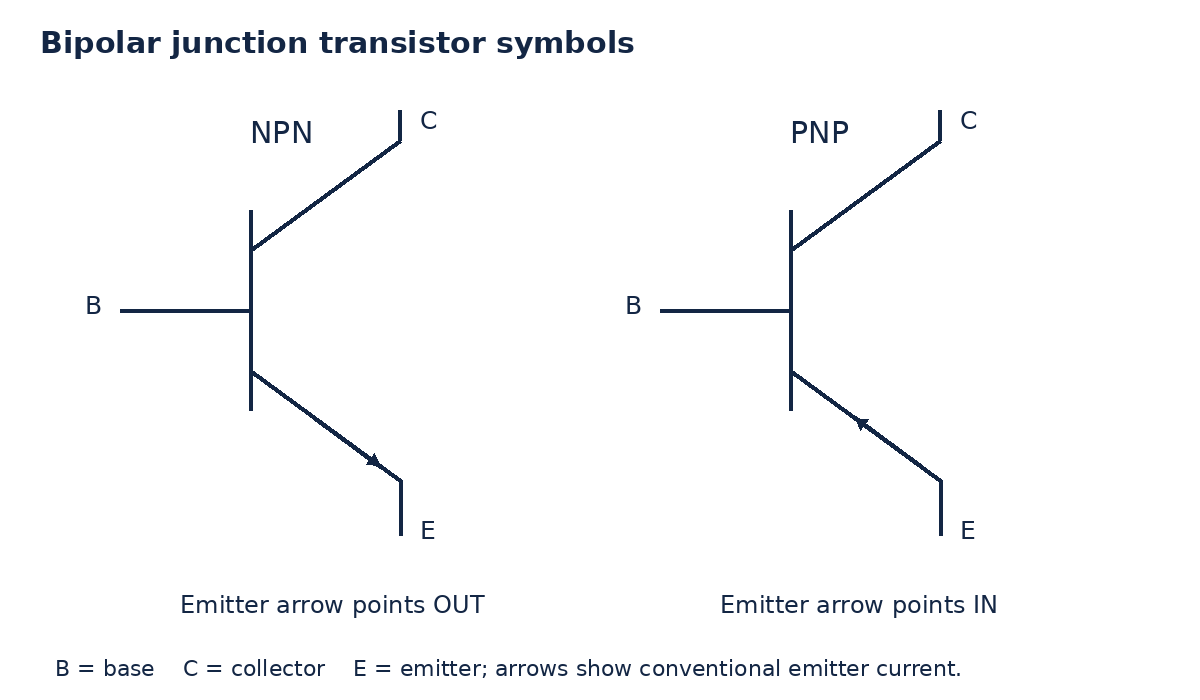
For a forward-active PNP, the emitter is at a higher potential than the base and the collector is below the base. Conventional current enters the emitter and divides into collector and base currents. Thus VEB is positive and IE = IC + IB; the corresponding signed VBE is negative.
Question 7
Answer
- Rotary/position encoders: adjacent positions differ by one bit, reducing ambiguous readings while crossing a boundary.
- Clock-domain-crossing pointers in asynchronous FIFOs: single-bit transitions reduce the chance of sampling an inconsistent multi-bit pointer.
Question 8
Answer
- Stores firmware/bootstrap instructions needed during startup.
- Stores stable lookup tables or embedded-device control code that must persist without power.
Question 9
Answer
- Ohm’s law: V = IR.
- V = 0.2×15 = 3 V.
Question 10
Answer
- Its larger band gap gives lower leakage and better operation at elevated temperatures.
- Silicon is abundant and forms a useful stable silicon-dioxide insulating layer for integrated-circuit manufacture.
Question 11
Answer
- Encode each decimal digit independently in four bits.
- 598 = 5|9|8 = 0101 1001 1000.
- 96.72 = 9|6 . 7|2 = 1001 0110 . 0111 0010. Preserve the decimal point; it is not an extra BCD digit.
Question 12
Answer

- Battery supplies the DC potential difference.
- Switch opens or closes the current path.
- Resistor limits LED current to the intended safe operating value.
- LED converts forward current into visible light; connect with correct polarity.
- Two voltage states can be represented and distinguished reliably.
- Logic gates provide simple implementation of control decisions.
- Binary storage and arithmetic are compatible with digital processors/memory.
- Defined high/low noise margins reduce susceptibility to small voltage disturbances; a medical device still requires appropriate safety engineering and validation.
Question 13
Answer
- Choose a suitable rated low-voltage DC supply, conductors and components.
- Disconnect power before assembly and check the circuit diagram/polarities.
- Connect components securely and include appropriate current limiting/protection.
- Inspect insulation, continuity and polarity, and check for a short circuit before energising.
- Apply power, measure the current/voltage and verify expected operation without overheating.
- Original current I = V/R. With resistance 2R, Inew = V/(2R) = I/2.
- At constant V, P = V²/R, so doubling R gives Pnew = P/2.
- Lighting and household-device control.
- Power conversion/charging systems.
- Sensors and industrial monitoring/control systems.
Question 14
Answer
- Small size and low weight from integrating many components.
- Low mass-production cost per function.
- High reliability due to fewer separate joints/interconnections.
- LED illumination when a current-limited LED is forward biased.
- Rectification: a diode conducts on the forward-biased part of an AC waveform.
- Bipolar-transistor amplification/switching uses an appropriately forward-biased base–emitter junction.
- Energy-efficient LED lighting.
- Low-power processors and automatic sleep/standby modes.
- Solar-powered electronic systems with efficient charging/conversion.
- Repairable designs, reduced hazardous materials and organised recycling of electronic waste.
Question 15
Answer
Atoms contain a nucleus and electrons in allowed energy states. Conductors have mobile electrons/partly filled energy bands. Semiconductor covalent bonding normally binds valence electrons, but thermal energy and doping create mobile electrons and holes that allow controlled conduction.
![[(2 Ω + 4 Ω) parallel 8 Ω] in series with 5 Ω and [3 Ω parallel 6 Ω], across 12 V.](https://jemshah.com/wp-content/uploads/2026/10/cs023-q15-circuit.png)
- Left top branch = 2+4 = 6 Ω. Left parallel equivalent = 6×8/(6+8) = 24/7 Ω.
- Right parallel equivalent = 3×6/(3+6) = 2 Ω.
- Total resistance = 24/7 + 5 + 2 = 73/7 Ω ≈ 10.4286 Ω.
- Total current = 12/(73/7) = 84/73 A ≈ 1.1507 A.
- Right parallel voltage = I×2 = 168/73 V ≈ 2.3014 V. Both right-hand resistors have this voltage.
- Current through 3 Ω = (168/73)/3 = 56/73 A ≈ 0.7671 A.
- Check: current through 6 Ω = 28/73 A; the branch currents sum to 84/73 A.